H is for Hellblade

 H


The aim of my Blogging From A to Z Challenge is to find the origins of online games, some relatively modern and some with ancient roots. Gaming might well be a modern take on an art that is almost timeless – storytelling. A perfect excuse for a writer to delve a little deeper. [Visit here for links to other A to Z participants.]

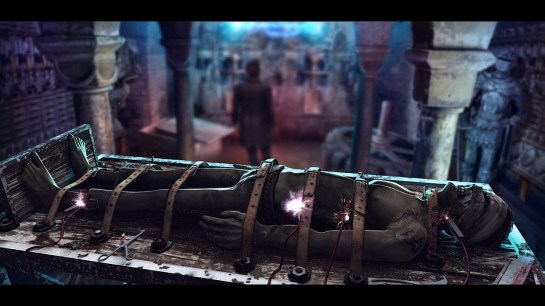
Game: Hellblade: Senua’s Sacrifice is an intense psychological action-adventure game which PCGamesN rated, “a miraculous technical feat made by a team just a fraction the size of the ones that typically dominate the triple-A space.”

Release Date: April 8, 2017

Developer/Publisher: Ninja Theory

Genre/gameplay mechanics: Award-winning game – dark fantasy action-adventure; hack and slash; puzzle-solving; psychological horror. Voice-acting integral to unique, 3D binaural audio design. Cutscenes combine motion/performance capture by video editor-turned-actress Melina Juergens and live-action performances by other actors.

Setting: A rendition of Helheim, the Norse underworld – effective use of audio and visual to submerge players in Senua’s nightmarish journey and her accurately-portrayed mental world. The world feels horrifyingly real as the sounds and graphics seem subtly distorted.

Storytelling: Hellblade follows Senua, a Pict warrior who journeys to Helheim to save the soul of her dead lover from the goddess Hela. Also, the character struggles with her mind, and the game revolves around her condition. Senua suffers from psychosis but believes it to be a curse. She is haunted by an entity known as the “Darkness”, voices in her head known as “Furies”, and memories from her past.

As Ninja Theory said in 2015, “Senua experiences psychosis, including hallucinations and delusions, as well as suffering from anxiety and depression. As a player, you will witness Senua’s living nightmare through her own eyes… Developing Hellblade independently gives us the freedom to tackle a subject as challenging as mental health. It is a subject that we are handling with all the respect it deserves, ensuring that our portrayal of Senua’s condition is both accurate and sensitive. To help us with this we are working closely with Professor Paul Fletcher, a professor of Health Neuroscience at the University of Cambridge, as well as arranging to consult directly with people who have experience of mental health difficulties. We are also very proud to say that Hellblade is being supported by Wellcome Trust, which is a global charitable foundation which aims to build a greater public understanding of science and in particular health.”

Releases:

  1. August 8, 2017 – Windows, PlayStation 4
  2. April 11, 2018 – Xbox One

Origins (Chronological):

  1. 2010 – Ninja Theory released Enslaved: Odyssey to the West, a video game that saw the Ninja team develop their motion capture with Andy Serkis.
  2. 8th century – The Roman Empire was unable to conquer a group of Celts in the northern reaches of Great Britain known as the Picts. Towards the end of the century, the first Vikings arrived in the islands of Orkney and replaced them as the main population of the land. Senua is portrayed as a Celtic warrior on Orkney.
  3. 793-1066 – Norse Mythology in the Viking Age: “Before the Norse (a.k.a. the Vikings) were converted to Christianity during the Middle Ages, they had their own vibrant native pagan religion that was as harshly beautiful as the Nordic landscape to which it was intimately connected.”
  4. The 1st century and earlier – The main inspiration of Senua’s character was the Iceni queen Boudica, while her name came from Senuna, a Celtic whose name was at first read incorrectly as Senua. The team researching Celtic culture and the Celts’ views on mental disorder, found out that they used the term ‘gelt’ for a man or woman who had been driven mad by a curse, grief, or the trauma of a battle. A gelt would take to a life in the woods in search of penance, punishment and purgatory. The team decided to make Senua a gelt, who had left her home in exile for those reasons.

Recommendation: Hellblade was a commercial success and was well received by critics, who praised it as a work of art and applauded its uncommon choice of revolving around psychosis, the quality and uniqueness of its approach of the condition, and its story and main character. Reviews included this  7 August 9 stars review from IGN: “An incredible atmospheric story reinforces Hellblade’s serious subject matter in this vivid tale of harrowing darkness.” 2017 Players were equally enthusiastic in their reactions.

Hellblade_02

4.55 Stars: Before I played the game, I watched numerous video reviews, diaries and walkthroughs, and I was excited. The game ticked so many boxes, and elements tied into my current WIP, whose second protagonist suffers from a form of psychosis. The actual experience was intense. As expected the voices-in-the head and confused images created a disturbing atmosphere, at times nightmarish. The combat should have been simple, but not for this nerve-jangled oldie who can’t hit the right keys fast enough – so died repeatedly…frustrating. I’ll keep trying though.

  1. Setting: 4.5*
  2. Storyline: 5*
  3. Gameplay: 3.75*
  4. Entertainment: 4.5*
  5. Genesis: 5*

Alternative ‘H’ thoughts:

H is also for Philip Pullman’s trilogy His Dark Materials, but I’ve yet to find a suitable game. Is there one?

+ ‘H’ Games played: Heroes of Might & Magic – but that comes under M.

Hela da

Who Cares?

1af16c3887c35d1c9c848826339b335d

Does anyone care if I get to Z? I’m burning myself out this April.

Does anyone care if I miss letters?  I’ve done 12 and have 14 more to do.

Who cares if the games are obscure? O is going to be tough, perhaps N even – and then there’s X and Y.

Does anyone care if I haven’t played all the games? I’ve never played on anything but a PC – Nintendo and PlayStation seem to have evaded me. Yet, many of the biggest franchises have been console games.

Do I care what happens? Well, I hate starting and leaving anything half-finished. I don’t like un-finished reads. But most of my draft novels are unfinished.

So why not my posts?

Maybe, I can just post the titles. Or be kind and give some clues – like in a puzzle game.

Except…I care and that hurts now – along with my fingers, head and more. I wish I could lie down.

G is for Guns or Butter

G

The aim of my Blogging From A to Z Challenge is to find the origins of online games, some relatively modern and some with ancient roots. Gaming might well be a modern take on an art that is almost timeless – storytelling. A perfect excuse for a writer to delve a little deeper. [Visit here for links to other A to Z participants.]

Game: The Global Dilemma: Guns or Butter  is a 1990 simulation game written by Chris Crawford. The game failed to achieve the play balance that Crawford desired, and he considered it among the worst games he released.

Release Date: 1990

Developer: Mindscape

Genre/gameplay mechanics: Single player DOS strategy simulation; wargame. Randomly generated B&W 2D-map of countries and provinces generated. Player uses the basic info to decide ‘military’ versus ‘food’ strategy to expand improving the economy of their country in an effort to outproduce the computer players.

Setting: Fictional computer-generated countries. Very basic structure and limited commodities to simulate macroeconomics.

Storytelling: simple plot of choosing best strategy to survive and beat computer AI.

Releases + Expansions:

Single release with no expansion as poor response.

Sequels: Balance of the Planet  is a 1990 environmental-based educational simulator developed by Chris Crawford and published on DOS, Macintosh, and PC-98 – arguably the first ‘eco-sim’.

Formats: Macintosh, IBM PC

Origins (Chronological):

  1. Mid 1980s – Crawford, Sid Meier and Dan Bunten all began work on new empire building games. They later met to discuss their designs. Meier stated his goal was to make the game fun and he was willing to abandon realism or depth to achieve that end. He went on to release Civilization in late 1991.
  2. 1985 – Crawford had an enormous hit with Balance of Power in 1985, selling hundreds of thousands of copies and making about $10 million for its publisher, Mindscape.
  3. 16th century – Macroeconomics descends from two areas of research: business cycle theory and monetary theory. Monetary theory dates back to the 16th century and the work of Martín de Azpilcueta, while business cycle analysis dates from the mid- 19th.

Recommendation: The game was a market flop, earning Crawford no royalties past the advance. Crawford was not alone in considering Dilemma to be among his poorest games, and the poor sales translated into almost no reviews. However, in 1991, PC Format named The Global Dilemma one of the 50 best computer games ever. The editors wrote, “If it’s global political simulations you’re after, nobody does it better than Chris Crawford. This and his earlier offering, Balance of Power, are unparalleled works of sheer genius.”

global-dilemma-guns-or-butter_4

2 Stars: Guns or Butter was the first computer game that I got addicted to – through strategy-devising and determination to beat the AI. I tried the ‘Butter’ route, using trade to prevail – but that was tough, so I often ended up facing the firing squad, which was the final graphic if the AI won. I was better at balancing my military and trade to beat the game. From there, I moved on to Sid Meier’s Civilization games and Age of Empires.

  1. Setting: 1*
  2. Storyline: 1*
  3. Gameplay: 2*
  4. Entertainment: 3*
  5. Genesis: 3*

Alternative ‘G’ thoughts:

G is also for Gladiator, Ridley Scott’s 2000 film with Russell Crowe – and a brilliant soundtrack for writing. Plus, a wealth of Roman links and the hack and slash video game, Gladiator: Sword of Vengeance. But I never played the game and it’s only related to the movie by profession.

Enter this portal to reach other Worlds in my A2ZMMORPG

Hela da


F is for Frankenstein

F

The aim of my Blogging From A to Z Challenge is to find the origins of online games, some relatively modern and some with ancient roots. Gaming might well be a modern take on an art that is almost timeless – storytelling. A perfect excuse for a writer to delve a little deeper. [Visit here for links to other A to Z participants.]

WARNING:

Devious experiments ahead.

Game: Mary Shelley’s 1818 novel Frankenstein; or, The Modern Prometheus has influenced popular culture for at least a century inspiring numerous films, television programs, video games and derivative works. Rather than focus on a single game, for now – there are at least six –  it’s time for a diversion. Let’s focus on the source material.

Release Date: January 1, 1818

Publisher: Lackington, Hughes, Harding, Mavor, & Jones

Genre/gameplay mechanics: a secret technique to impart life to non-living matter. [That is the core of the mechanic driving Frankenstein. Games vary and use different elements.]

Setting: North Pole, Italy, Germany, England, Ireland and Scotland in the 18th century. A sense of real places – as Mary Shelley did travel to some places – but with a gothic overtone.

Storytelling: “…Victor Frankenstein, a young scientist creates a grotesque but sapient creature in an unorthodox scientific experiment.” Cleverly structured to give both sides of the story, and more layered than many adaptations give credit for. The creation is called The Creature (but erroneously named Frankenstein in many adaptations). Various interpretations of the motivation behind Mary Shelley’s story and plot adds to the overall depth.

Releases + Expansions:

The novel has inspired countless adaptations over the years, including (according to Wikipedia):

  1. Films: The first film adaptation of the tale, Frankenstein, was made by Edison Studios in 1910, and the first sound adaptation of the story, Frankenstein (1931), was produced by Universal Pictures, directed by James Whale, and starred Boris Karloff as the monster. For many, this is the classic version, although there have been numerous others since, from the Hammer Films through 1994 and Mary Shelley’s Frankenstein directed by Kenneth Branagh to adaptations in the pipeline. Plus all the parodies, of course.
  2. Television: many adaptations again, and appearances in other shows. It’s two 1960s sitcoms that come to mind for me – The Munsters and The Addams Family.  However, on my Must Watch list is the 2014-2016 three-season Showtime series Penny Dreadful with its ‘Universal’ characters.
  3. Novels: The story has formed the basis of many original novels, some of which were considered sequels to Shelley’s original work, and some of which were based more upon the characters as portrayed in the Universal films. Yet others were completely new tales inspired by Frankenstein. The most recent direct sequel is William A Chanler’s 2017 Son of Terror: Frankenstein Continued.
  4. Games: Although there have been at least six games loosely linked to Frankenstein, none of those had more than mediocre reviews – a missed opportunity. Why isn’t there a great game? Will a reboot of the classic film yield one?

Origins (Chronological): Mary Shelley was born Mary Wollstonecraft Godwin in 1797. She was the second child of the feminist philosopher, educator, and writer Mary Wollstonecraft, who died less than a month after the birth, and the first child of the philosopher, novelist, and journalist William Godwin. She grew up among intellectuals and her father described her at age 15 as “singularly bold, somewhat imperious, and active of mind. Her desire for knowledge is great, and her perseverance in everything she undertakes almost invincible.”

Thus, her knowledge, research, reading and observation were excellent. Her sources would have been extensive – for instance:

  1. Two of the most notable natural philosophers among Shelley’s contemporaries were Giovanni Aldini, who made many public attempts at human reanimation through bio-electric Galvanism in London and Johann Konrad Dippel, who was supposed to have developed chemical means to extend the lifespan of humans.
  2. 1812 – Humphry Davy‘s book Elements of Chemical Philosophy, in which he had written that “science has … bestowed upon man powers which may be called creative; which have enabled him to change and modify the beings around him …”.
  3. 1667 –  John Milton‘s Paradise Lost, influenced Shelley as she included a quotation from book X on the title page, and it is one of three books Frankenstein’s monster finds which influences his psychological growth.
  4. 5th century BCE – Prometheus legend: The Modern Prometheus is the novel’s subtitle. Prometheus, in later versions of Greek mythology, was the Titan who created mankind at the behest of Zeus.

Frankenstein_ss_885c1dbb216c8c06abd49bde18090303aff67fbe

2.7 Stars: The only valid assessment possible is of the 2015 hidden-object puzzle game, Frankenstein: Master of Death on Steam. For the genre, it is a good game and received very positive reviews on Steam. The storyline was basic but there were loose elements of the original novel. However, the setting felt wrong.

  1. Setting:1*
  2. Storyline: 2*
  3. Gameplay: 2.5*
  4. Entertainment: 3*
  5. Genesis: 5*

Alternative ‘F’ thoughts:

I wanted to write about the Welsh detective Fiona Griffiths, having read the first three in the series – and knowing there was a TV series – but there’s no game.

+ ‘F’ Games played: Forsaken World.

What’s your favourite Frankenstein adaptation? Is there a game I missed?

Enter this portal to reach other Worlds in my A2ZMMORPG

Hela da

E is for Elder Scrolls

E

The aim of my Blogging From A to Z Challenge is to find the origins of online games, some relatively modern and some with ancient roots. Gaming might well be a modern take on an art that is almost timeless – storytelling. A perfect excuse for a writer to delve a little deeper. [Visit here for links to other A to Z participants.]

Game: The Elder Scrolls is a series of action fantasy RPGs known for its elaborate and richly detailed open worlds and its focus on free-form gameplay.

Release Date: March 25, 1994

Developer/Publisher: Bethesda

Genre/gameplay mechanics: RPG; open world; fantasy; action-adventure; 3rd person; multi-player; “a game designed to encourage exploration and reward curiosity”; choices are crucial.

Setting: The Elder Scrolls games primarily take place on the fictional continent of Tamriel, located on the world of Nirn, but there are a few exceptions, although these exist in the same fictional universe. The high-fantasy setting is realistic with detailed, immersive graphics as series evolved.

Storytelling: Rich and extensive with a developed history, or as Wikipedia says, “In accordance with many literary high fantasy works, the world of The Elder Scrolls is known for its attention to detail, including well-developed lore and backstory. This includes a vast amount of information such as names, dates, and places that constitute its history and the interconnected structure of its various societies, cultures, and religions.”

Releases + Expansions: The Elder Scrolls has evolved through seven releases and ten expansions.

Current release: The Elder Scrolls Online, an MMORPG set in Tamriel, released in April 2014 to mixed reviews. The response improved significantly with the re-release in January 2015. It was renamed as The Elder Scrolls Online: Tamriel Unlimited, with critics praising the changes.

Formats: MS-DOS, Microsoft Windows, Xbox, Xbox 360, PlayStation 3, N-Gage, J2ME, Xbox One, PlayStation 4, macOS, Nintendo Switch

Origins (Chronological):

  1. 1890s – This depends on whether The Elder Scrolls is ‘high fantasy. As Wikipedia says, “The term “high fantasy” was coined by Lloyd Alexanderin a 1971 essay, “High Fantasy and Heroic Romance” (originally given at the New England Round Table of Children’s Librarians in October 1969).” And from there, “The romances of William Morris, such as The Well at the World’s End, set in an imaginary medieval world, are sometimes regarded as the first examples of high fantasy. The works of  R. R. Tolkien—especially The Lord of the Rings—are regarded as archetypal works of high fantasy.” Therefore, the logical thought is that all games that follow in role-playing campaign settings have their origins much further back. What then? Do I look to those writers’ roots?

Adaptations set in the ‘Elder Scrolls’ universe:

  1. Novels: In 2009, science-fiction author Gregory Keyes released The Elder Scrolls: The Infernal City. In 2011, Lord of Souls was released as Keyes’ second novel in his The Elder Scrolls book series.

Recommendation: Highly successful, the series has sold more than 50 million copies worldwide and spawned a staunch community. The reviews have generally been very good. In 2012, Complex ranked The Elder Scrolls at number 20 on the list of the best video game franchises. In 2013, The Elder Scrolls was voted as the Greatest Game Series of the Decade on GameSpot, beating out 64 other competitors.

ElderScrolls01

4 Stars: Although aware of the series, I have only played The Elder Scrolls Online: Tamriel Unlimited, and only recently. However, this MMORPG compares well to similar games that I’ve played extensively. The setting was amazing and the game enthralling, even if I took some time to adapt to the mechanic and the divergent storylines. A game that a player must devote time to appreciate.

  1. Setting: 4.5*
  2. Storyline: 4*
  3. Gameplay: 4*
  4. Entertainment: 4*
  5. Genesis: 3.5*


Alternative ‘E’ thoughts:

E is also for Excalibur but that’s a sword that has yet to slide from a stone. And a 1981 epic fantasy movie that I enjoyed for its unusual re-telling of the Arthur legend. There was even a game that I never played – Excalibur: Morgana’s Revenge.

Enter this portal to reach other Worlds in my A2ZMMORPG

Hela da


#IWSG Rain Play

Insecure Writers Support Group Badge

Another month slips by and along comes another Insecure Writer’s Support Group monthly blog post. Behave brain and focus on the IWSG voluntary guidance question:

April 4 question – When your writing life is a bit cloudy or filled with rain, what do you do to dig down and keep on writing?

I’ll try and be brief.

If I’m desperate to get words out, then I switch into journo-mode and slog on to meet the deadline – and end up with a blah story, or a draft.

If I’ve got time to spare, and the weather is overcast or drizzling, then I go for the scribbles-surfing-research approach – or fall asleep with my dog on my lap.

If there’s thunder & lightning, and if the gods of frustration are weighing me down, then I escape into a gaming world.

And that’s why my 2018 Blogging from A to Z Challenge, aka A2ZMMORPG is on Gaming. As you will discover, H brings me back to my WIP and into the sunshine.

800px-Cloud_in_the_sunlight

Photo of a cloud illuminated by sunlight. ~ by Ibrahim Iujaz from Rep. Of Maldives

***

The awesome co-hosts for the April 4 posting of the IWSG are Olga Godim, Chemist Ken, Renee Scattergood, and Tamara Narayan!

Purpose of IWSG: To share and encourage. Writers can express doubts and concerns without fear of appearing foolish or weak. Those who have been through the fire can offer assistance and guidance. It’s a safe haven for insecure writers of all kinds!

Every month, we announce a question that members can answer in their IWSG post. These questions may prompt you to share advice, insight, a personal experience or story. Include your answer to the question in your IWSG post or let it inspire your post if you are struggling with something to say.

Posting: The first Wednesday of every month is officially Insecure Writer’s Support Group day. Post your thoughts on your own blog. Talk about your doubts and the fears you have conquered. Discuss your struggles and triumphs. Offer a word of encouragement for others who are struggling. Visit others in the group and connect with your fellow writer – aim for a dozen new people each time – and return comments. This group is all about connecting! 

Let’s rock the neurotic writing world!

Our Twitter handle is @TheIWSG and hashtag is #IWSG