The Liebster Award

liebster-award-main

I hinted yesterday that today’s post would be a response to some good news. Sarah Zama from The Old Shelter nominated me for the Liebster Award. Her A to Z blog on the Jazz Age Jazz was entertaining and informative. And her Reflections post is a must-read for the advice on preparing for A to Z – there’s a lot there that I’ll be attempting to take on-board

I always get both nervous and excited when I’m nominated for such an award, especially from a blogger that I respect. Excited about the recognition – nervous as I need to deal with some crucial questions.

This is actually the second time that I have been nominated for the Liebster – first was way back in October 23, 2013, so my answers may have changed since then.

Rules of the Liebster Award

If you have been nominated for The Liebster Award and you chose to accept it, write a blog post about the Liebster Award in which you:

  • Thank the person who nominated you, and post a link to their blog in your post.
  • Display the award on your blog — by including it in your post and/or displaying it using a “widget” or a “gadget”.
  • Answer 11 questions about yourself, which will be provided to you by the person who nominated you.
  • Provide 11 random facts about yourself.
  • Nominate 5 – 11 blogs that you feel deserve the award, who have a less than 1000 followers. [Some claim that this is a flexible rule, so I’m ignoring it. In fact, I don’t qualify. 😉 ]
  • Create a new list of questions for the nominees to answer
  • List these rules in your post (copy and paste from here). Once you have written and published it, you then have to:
  • Inform the people/blogs that you nominated that they have been nominated for the Liebster Award and provide a link for them to your post so that they can learn about it (they might not have ever heard of it!)

bakingbabybrownliebster

11 questions Sarah asked me

  1. When your started your blog, did you know what you were doing?

It was trial and error, but it always will be as the learning process never stops – no exceptions. I started when I began following blog-maestro Robert Lee Brewer  and his introduction to creating a Writer’s Platform. His ‘challenge’ took me through the early stages of blogging and social media.

  1. Many writers I know tell me they don’t blog because they prefer to write their own stories. Why do you?

Blogging for me is not the same as creating my fictional stories. The posts are a chance to address other issues from writing quandaries to health issues. However, a few posts do stray into fictional areas, such as my interviews with characters in my novels, and this year’s A to Z mystery.

  1. Do you plan your posts?

I start scribbling ideas for posts days ahead of when I want to schedule them. I have a black notebook with sketched out ideas, some of which have yet to be developed – like “The First Terrorists”. As the scheduled day approaches, I select the most appropriate idea. Right now I have a review of “The Road” imminent.

  1. Do you stick to a posting schedule?

I have a flexible posting schedule of a weekly post on Tuesday or Wednesday. There’s no particular theme as my readers went for Pick N’Mix. At the moment, that’s enough of a commitment. Looking way ahead, I might have to schedule “The First Terrorists” for October 10th (Columbus Day), especially as this desktop will be in transit to the USA. That will mean some clever scheduling for almost two months.

honoring-terrorists


  1. When you signed up for the A to Z Challenge the first time, did you know what you were doing?

I’d seen a few posts in 2013 so had a rough idea what I was getting into when I did the Challenge in 2014. I chose posts themed around what I was researching for a WIP, but admit that it was a learning process. However, I wrote some posts in advance so wasn’t a complete wreck by the end of April 2014.

  1. What were you thinking when you signed up the second time?

That I needed to write more posts in advance to give myself time to visit others. However, I stuck to a theme related to research for a WIP, although that book is now on a back-burner. This year I resisted the temptation to go with a research theme, as I said in my Reflection above. On further reflection, my research approach might be okay for 2017. Counterfactual history or maybe Snowdon Snippets.

  1. I can hardly resist a blogging challenge. Do you participate in many?

I resist the temptation to do more than A to Z, especially if they are over many days. I have done a few one-off challenges, like posting specific sentences from a manuscript, or details on my current main character.

  1. What is the blogging challenge which was the most fun for you?

In general, trying to select a weekly post that will be of interest to my readers and followers is a challenge. I’m still working on that one, hoping that I will suss what sparks their attention. And what dictates that? The number of comments? Likes? Visits? Probably, the overall reaction. Being ignored is the pits though. In terms of particular posts and fun, I would say that writing the mystery part of “A Brilliant Conspiracy” my A to Z Challenge this year. Challenging because of my rules, but fun as those same rules played a part in the plot and the climax. But I keep worrying that it was too obscure. Was it?

  1. Did you ever produce a vlog? If not, would you consider doing it?

Never have, and won’t consider doing it as I stammer and swallow words because of my disability. That’s also the reason why my days of public speaking ended last century and I won’t do any readings.

  1. Have you ever read articles about marketing to learn promoting your blog?

Read a few but tend to feel that most suggest things that I’m unlikely to do. Perhaps tweaks. Most of the great strides were in the early years. Is that where my blog fails?

  1. Do you think writing a blog is the same as writing a book?

Very different from writing fiction, as different products. However, not in terms of commitment. Both require persistence and perseverance. I find them complimentary – like wine and cheese.


11 random things about myself

  1. Although I’m British, in terms of my maroon passport, I’m actually part Chilean. My maternal grandmother was from Chile and met my grandfather when he was working for a nitrate mining company out there. My mother was born in Santiago.
  2. My office has a view towards Snowdon, which I will miss when we move to the US. However, Idaho has plenty of spectacular mountains and wild scenery.
  3. I went to school in Canada, for a few terms, so got a taste for the outdoor lifestyle over there – especially the skiing. I even went white-water rafting.
  4. My first time on a ski slope I was ready to chuck it all in. I was scared of the nursery slopes. My instructor sent me up the next level run, telling me to try that one. I struggled down, but never looked back. Taking slopes head-on became a regular thrill. I even raced a bit…but not down the nursery slope.
  5. My first success in writing was winning three days with the Royal Navy, when aged about ten I wrote an essay on A Day In The Life of a Helicopter Pilot.
  6. That RN adventure was the last time that I sailed around the Isle of Wight in a large ship – the guided missile destroyer HMS Devonshire – Displacement 5,440 tonnes (6,850 tonnes full load). On September 20th I will sail around the Isle of Wight again but on RMS Queen Mary 2, bound for New York – Displacement 75,000 tonnes.

    862aa8c7d3a3a172a1b352d9bc0d0e1c

    Queen Mary 2 in New York Harbor

  7. I still have one of the books that I read and adored as a child, George Brooksbank’s “Old Mr Fox”. With a cover by celebrated artist Archibald Thorburn, this was my father’s copy, which he was given in 1932 for Christmas, the same year the book was published.
  8. My favourite author is J.R.R Tolkien, but I first discovered him when I read the essay based on his lecture “Beowulf: The Monsters and the Critics“. Reading “The Hobbit” and “Lord of the Rings” came a few months later.
  9. I read the whole of “Lord of the Rings” over one very long weekend when I was at Eton College in 1969. I still have the three hardback copies with their wonderful fold-out maps.
  10. History has always fascinated me, so it was one of my specialist subjects at school and at college. I even enjoy Virtual or Alternative Histories, so one day I might work out how the Vikings colonised Kanata.
  11. I’ve had Multiple Sclerosis since 2000 but writing keeps my brain on track, although it can be exhausting. And I now call it the MaelStrom MonSter.


With the A to Z Challenge in mind, I’d first like to nominate a few fellow A to Z-ers for this award.

Tasha @ Tasha’s Thinkings Wrote 2.5 blogs during A to Z, including her entertaining spooky one on Fictional Phantoms.

Miriam @ An’ de walls came tumblin’ down  Her A to Z was clever stories in which each sentence began with the chosen letter of the day.

Jen @ Lexical Creations This children’s writer tackled a double theme for A to Z. Each post featured an Alphabet book and an instalment of her own fun alphabetical story with letters as characters.

Cheryl @ Plucking Of My Heartstrings Her 2016 theme was non-profit organizations that deserve support, so please visit as many as you can.

Maryann @ if i only had a time machine Her informative and detailed A to Z posts were A 1970s Time Capsule from A to Z. Facts and video clips galore.

Archie @ Travel With Archie – and finally a great travelogue with A to Z posts on US cities. Wonderfully informative and great photos.

Finally, I’m choosing two other bloggers that are deserving of the Liebster Award.

Chrys @ Write with Fey Catching sparks for stories and passing on torches of inspiration.

Mark @ Time Present and Time Past        Author/Lecturer who knows how to tell his facts in an informative and engrossing way.
quill

And these are the questions for them, and of course most are about blogging:

  • Do you have goals for your blog? What are they?
  • Do you have a blogging schedule?
  • I can hardly resist a blogging challenge. Do you participate in many?
  • What is your favourite way to interact with other bloggers?
  • What is your own personal favourite of your own blog posts, and why?
  • What kind of blogs do you like to read the most?
  • Where would you most like to visit?
  • If you could have any kind of pet, what would it be?
  • If you could choose to live in another time, when would you choose?
  • Would you change your chosen career path?
  • Do you have a favourite book that you re-read?


Again, thanks so much to Sarah for giving me the possibility to share the love. And thanks to all those that have inspired me to nominate them.
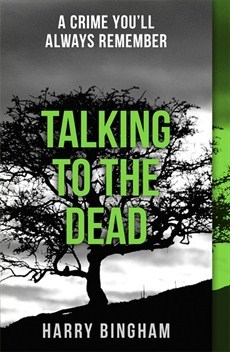
Talking to the Dead – a review

Time for another review of a novel linked to my own writing.

Some months ago, my character of D.S. Sparkle Anwyl began to emerge, becoming the detective embroiled in “Seeking A Knife”. However, I had some problems making her believably Welsh. It was no good just living in Snowdonia, I needed more to work with.  So I embarked on extensive research. There was fiction reading as well, since I wanted to avoid plagiarising Welsh detectives, like Constable Evan Evans.

Then I discovered DC Fiona Griffiths and the bar was raised.

 TalkingToTheDead17552649

Talking to the Dead (Fiona Griffiths #1)

by Harry Bingham

The first novel in a powerfully original new crime series featuring a young policewoman haunted by her own dark past.

It’s DC Fiona Griffiths’ first murder case – and she’s in at the deep end. A woman and her six-year-old daughter killed with chilling brutality in a dingy flat. The only clue: the platinum bank card of a long-dead tycoon, found amidst the squalor.

DC Griffiths has already proved herself dedicated to the job, but there’s another side to her she is less keen to reveal. Something to do with a mysterious two-year gap in her CV, her strange inability to cry – and a disconcerting familiarity with corpses.

Fiona is desperate to put the past behind her but as more gruesome killings follow, the case leads her inexorably back into those dark places in her own mind where another dead girl is waiting to be found…

My review:

Fiona ‘Fi’ Griffiths might be a junior officer assigned to a fraud investigation, but she’s willing to manoeuvre herself onto the team investigating the murders in a dingy flat. Her intelligence, among other clever moves and clandestine activities, is a key factor in her unravelling the links between the two cases. I knew that she would struggle until the justice that she demanded was implemented; but I was never quite sure whether she would prevail.

Those brains have earned her a degree, and set her apart from many colleagues. [Note: The College of Policing has proposed that, “Every new constable from 2019 could be required to have a degree – or agree to work towards an equivalent qualification.]

This active mind is a facet of a complex character that is well described through her POV. That voice is distinctive, revealing and never feels like the author. The voice of Fi kept me reading, wanting her to battle through everything thrown at her, some from outside and some from in herself, or in her past.

But it becomes clear from Fi’s words that she struggles to be part of ‘Planet Normal’ and the author makes that part of her engrossing personality. Her weirdness worked for me, leading the reader down murky paths on Cardiff’s darker side, and in her mind.

Fi is not your conventional detective, nor are her methods. She is a complex character and she shoves the investigation in unexpected directions. The author weaves words and phrases with style, bringing this world of Cardiff alive, for me at least. This was a different Wales from the area I know – Snowdonia – and yet there were glimpses of the rural roots at the country’s heart, and those roots are an intrinsic part of Fi.

Some readers have criticised the writer for creating a policewoman that would fail her first psych test. But I’m with those that realise that her intelligence gives Fi the edge in working the system in her favour. There were moments when I felt she might be bending the rules precariously, but she has the ability – and luck – to evade crashing over the precipice, this time. And if she can confuse her colleagues, what chance have the criminals.

The novel is not just about an investigation – that would make this just another crime read. This is about Fi and her personal attitudes, demons, and questions, so I’m full of praise for the way that Harry Bingham pulls this off, especially in the final chapter. A superb read that compels me to read the rest of the series.

*

As for my own detective and similarities, Fi and Sparkle are… a whole country apart, and more. Fi is from South Wales, Sparkle from the North and Snowdonia. Both quirky yes but not in the same way. No University education for Sparkle, she’s got her experience on the beat…and with the bullies at school. Sparkle’s deductive techniques are not Fi’s, although they might work together. And their means of dealing with criminals is very different.

No real comparison, but a definite benchmark.


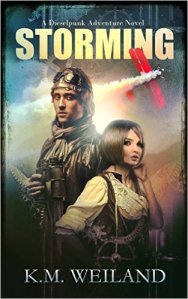
Storming – a review

519rEmGPimL._SX311_BO1,204,203,200_

Time for another review – Storming by K.M. Weiland – the third novel from a writer whose website is a mine of writing gems. Her fiction writing certainly demonstrates all the craft that she mentors on her website. So on to the review:

Storming lives up to the blurb that inspired me, “Cocky, funny, and full of heart, Storming is a jaunty historical/dieselpunk mash-up that combines rip-roaring adventure and small-town charm with the thrill of futuristic possibilities.”

I was hooked from the opening, when a young woman falls from the clouds in front of Hitch Hitchcock’s biplane. Hitch is a pilot protagonist who has run away from his past, but now has to face it head-on as he tries to “save his Nebraska hometown from storm-wielding sky pirates.”

The young woman, Jael is mysterious and spunky, and tied to the pirates, which is craftily revealed. I wanted Hitch and Jael to fall for each other, but nothing is ever so easy, especially in one of K.M Weiland’s novels. I gave up trying to suss out what was going to happen next – after getting caught out in her first novel, “Behold the Dawn” [another recommended read]. She knows exactly how to make the twists pay off.

All the characters are memorable, including the supporting cast – I could really visualise the Berringer brothers. The young boy Walter adds a strong thread that kept me on the edge of my Kindle as his story weaves throughout, and he adds to the exhilarating climax.

Having read a few ‘steampunk’ novels, I relished the sky pirates and their strange weather-controlling airship, and their unusual language. At first, Jael speaks only this language and a smattering of English words, adding to the mystery of her and her people. I sensed a Slavic origin, and have my own theories, but read the novel and form your own.

K.M Weiland has written yet another novel that demonstrates that she ‘practises what she preaches’.


The Road Ahead

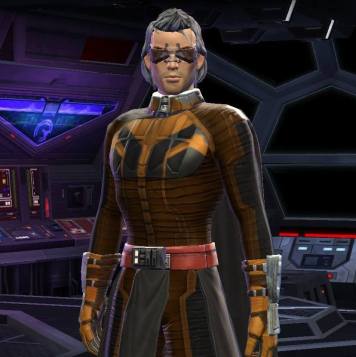
Llywdro_SWTOR

Apologies for the silence. I had hoped to blog about our moving plans, as we thought we were finally in a position to advance. But again we have to wait. Maybe next week.

For now, here is a link to an interview with me, just published on Tasha’s Thinkings. It was a great chance to talk about myself, my writing, and most crucially… about Star Wars.

Read on and enjoy.

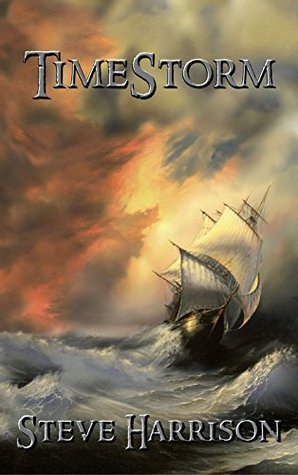
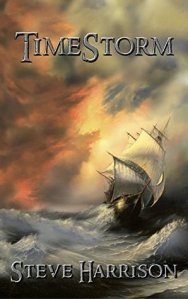
TimeStorm – a review

23489695

Time for another review – TimeStorm by Steve Harrison, which my critique partner suggested that I read to see the way that the author handles multiple viewpoints.

From a writing perspective, the technique worked well. Each chapter has the POV character’s name as the title, and sometimes this is a one-off, other times it is a recurring character. I will return to those POVs as part of the ‘review proper’.

As I read this enjoyable novel by Steve Harrison, I could feel that he is – as the blurb says – “A great fan of the grand seafaring adventure fiction of CS Forester, Patrick O’Brien and Alexander Kent.” That atmosphere is captured in the telling, without feeling over-researched.

The book was inspired by a replica 18th century sailing ship on Sydney Harbour and a question from Steve’s brother, Tony: “What if that was a real convict ship?”

From that premise came this clever tale of the crew and ‘passengers’ from a convict ship swept by a storm from 1795 to 21st century Sydney. The ‘stranger in a strange land’ scenario is carefully played out, with all the characters reacting convincingly to their dangerous situation, whether ship’s officer, convict leader, or the ‘present day’ characters confronted with something more than unexpected.

The central character of Lieutenant Christopher ‘Kit’ Blaney, is – as the blurb says – “an old-fashioned hero, a man of honour, duty and principle”, but he has human failings that make him believable. For some of the chapters, he is the POV, with chapters carrying his name.

But there are other points of view (POV), with their own chapters, and this multi-POV approach keeps the story flowing, showing different facets – some of which would normally be missed out.

Each POV feeds into the evolving plot, which had me gripped. There are two main characters – Blaney, from the 18th century, and a 21st century journalist. But the other POVs with their stories and subplots, are integral to the unfolding plot.

From the first chapter, I was intrigued by one other character, wondering how he would fit in, but sensing he might return. Read TimeStorm to discover how, but I won’t spoil the crafty twist in the tail.

For those that logged on for my post last week – Why read? – there was a second lesson in this novel: How to bookend your novel, by linking the opening and ending. But explaining more would be a spoiler.


Why read?

InsecureWritersSupportGroup2

It’s February 3rd and time for another Insecure Writer’s Support Group monthly post. I may be Insecure but I’m putting aside the whining and complaining – for a few days at least.

Today I want to be positive and talk about the benefits of reading from a writer’s point of view. And by that I don’t mean just reading what you write, although as writers we should to do that a few times from a reader’s perspective.

For now, I’m talking about other books, not just for the sheer pleasure but for the lessons that we can learn. We can learn what works and what doesn’t from both great reads that keep us hooked from the first sentence, and from those shockers that are an endless struggle. In each novel there should be at least one lesson – even if it’s ‘make sure you use an editor’ or ‘flowing words are like magic’.

So what have I learned over the decades?

roger-woddis

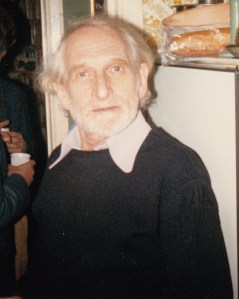
Roger Woddis in 1986 – photo by BG

When I started out on my writer’s journey, my writing tutor, the late great Roger Woddis said that my writing suffered from too much ‘purple prose’. The problem stemmed from my passion for “Lord of the Rings” and the style of J.R.R. Tolkien. I was trying to emulate him without understanding the way that he used language. However, over the decades and with many re-reads, I am learning to see the master at work. And as I read other writers, I see that a writer can effectively use beautiful language without obscuring the meaning.

23489695

The current lesson is about ‘Multiple POVs’, which is relevant since my current WIP, “Storms Compass”, tells the stories of various characters struggling to survive after a mega solar storm devastates the Earth. My critique partner suggested that I look at how Steve Harrison handles multiple viewpoints in TimeStorm”. The POVs each have their own chapter with the character’s name as the title. Each one feeds into the evolving plot, which has me gripped – so a review will follow very soon.  There is a main POV character and the other POVs add to his story.

I could go on, giving examples from books that I have read, but I want to end by directing you to K.M. Weiland, a writer whose website is an invaluable resource, and includes many articles that refer to novels and movies as examples. For instance, I am working through my character’s arcs at present, and she gives some great examples – see: http://www.helpingwritersbecomeauthors.com/character-arcs-3/. This and other articles show the importance of reading other novels. The added bonus is that K.M Weiland writes novels in which she practices what she preaches, from her early novels Behold the Dawn and Dreamlander – both of which I enjoyed – to Storming, which is next on my To Read list.

519rEmGPimL._SX311_BO1,204,203,200_

And beyond that I may be delving into the real classics like Machiavelli ‘s “The Prince” and the stories in “The Mabinogion“. We can all learn from the master storytellers of the past.

So read on dudes!

*

The first Wednesday of every month is officially Insecure Writer’s Support Group day. We post our thoughts on our own blogs. We talk about our doubts and the fears we have conquered. We discuss our struggles and triumphs. We offer a word of encouragement for others who are struggling.

Please visit others in the group and connect with my fellow writers.

Let’s rock the neurotic writing world!

Our Twitter hashtag is #IWSG

And be sure to check out our Facebook group –https://www.facebook.com/groups/IWSG13/

The awesome co-hosts for the February 3 posting of the IWSG are Allison Gammons,Tamara Narayan, Eva E. Solar, Rachel Pattison, and Ann V. Friend!