D is for Detroit

D

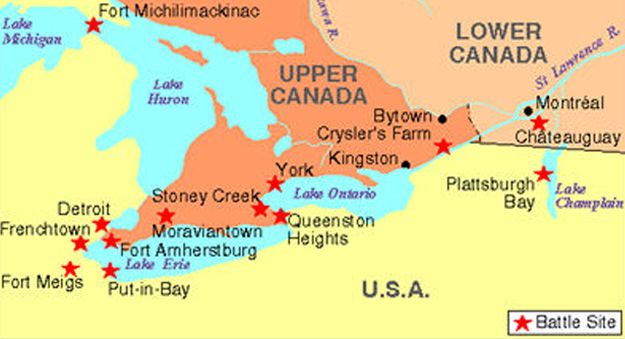
On July 12, 1812, General William Hull led an invading American force of about 1,000 untrained, poorly equipped militia across the Detroit River and occupied the Canadian town of Sandwich (now a neighbourhood of Windsor, Ontario).

During the War of 1812, the Detroit River served as a major barrier between the American Michigan Territory and British Upper Canada, especially during the Battle of Fort Detroit in August 1812, when Detroit briefly fell to the British.

The Siege of Detroit, also known as the Surrender of Detroit, or the Battle of Fort Detroit, was an early engagement in the War of 1812. A British force under Major General Isaac Brock with Native American allies under the Shawnee leader, Tecumseh, used bluff and deception to intimidate the American Brigadier General William Hull into surrendering the fort and town of Detroit, Michigan, and a dispirited army (numbering 2,500 with the addition of 500 Canadians), although they outnumbered the victorious British and Native Americans (330 regulars, 400 militia, and 600 First Nations).
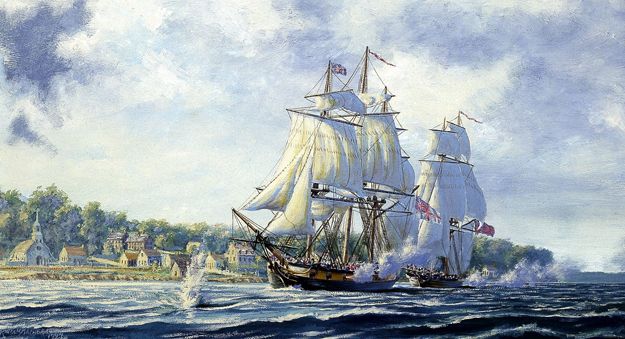
'Bombardment Of Fort Detroit, 1812 by Peter Rindlisbacher.'

‘Bombardment Of Fort Detroit, 1812 by Peter Rindlisbacher.’

The American loss was considerable: some 2188 men, 39 guns, and a large store of shot, flint, and powder.  The surrender not only cost the United States the village of Detroit, but control over most of the Michigan Territory.

The British victory reinvigorated the militia and civil authorities of Upper Canada, who had previously been pessimistic and affected by pro-American agitators. Many Native American people in the Northwest Territory were inspired to take arms against American outposts and settlers.

The British held Detroit for more than a year before their small fleet on Lake Erie was defeated, which forced them to abandon the western frontier of Upper Canada,

But that will be my Monday post, as E is for Erie.

http://www.eighteentwelve.ca/?q=eng/Topic/14

http://en.wikipedia.org/wiki/Siege_of_Detroit

http://www.historyofwar.org/articles/battles_detroit.html

http://www.warof1812.ca/batdetroit.html

PREVIOUS A TO Z POSTS:

A is for Anishinaabe ~ B is for Brock ~ C is for Coloured Corps

A2Z-BADGE-000 [2015] - Life is Good

The brainchild of Arlee Bird, at Tossing it Out, the A to Z Challenge is posting every day in April except Sundays (we get those off for good behaviour.) And since there are 26 days, that matches the 26 letters of the alphabet. On April 1, we blog about something that begins with the letter “A.” April 2 is “B,” April 3 is “C,” and so on. Please visit other challenge writers.

My theme is ‘The War of 1812’, a military conflict, lasting for two-and-a-half years, fought by the United States of America against the United Kingdom of Great Britain and Ireland, its North American colonies, and its American Indian allies. The Memoirs of a British naval officer from the war is central to my novel “Seeking A Knife” – part of the Snowdon Shadows series.

Further reading on The War of 1812:

http://www.eighteentwelve.ca/?q=eng

http://www.theglobeandmail.com/globe-debate/the-war-of-1812-stupid-but-important/article547554/
816b270f3de9e39b80fbee847ad01e9a

C is for Coloured Corps

C

Shortly after the Americans declared war on the British in June 1812, a 68 year old West African named Richard Pierpoint proposed the formation of a Black fighting unit, a “Corps of men of Colour.” A small militia unit was formed and became known as the Coloured Corps. Pierpoint, who had fought for the British in the American Revolutionary War, was one of over 50 who served in that unit throughout the war. While the commanding officers were white, six of the enlisted Black men served as sergeants or corporals and the rest served as privates. The number strength of the unit varied throughout the war due to fatalities, illness, desertions and the occasional addition of Black soldiers from other militias. There were usually between 25-30 men. The Coloured Corps saw action in some of best-known battles of the War of 1812. At the Battle of Queenston Heights, they participated in the recapture of the Redan Battery after the death of Major General Brock.

Coloured Corps Painting “Runchey’s Coloured Corps” by Cameron Porteous. Image courtesy of canadianartcards.com. 1812 1 20N.

Coloured Corps Painting
“Runchey’s Coloured Corps” by Cameron Porteous.
Image courtesy of canadianartcards.com. 1812 1 20N.

The Black population throughout British North America had much to fear, should the Americans win the war: those who were free men might find themselves sold into slavery. Those who were enslaved might have hoped that their service to the King as soldiers would win them their freedom.

There were both free and enslaved men in the Coloured Corps’ ranks. While Pierpoint gained his freedom for his service in a British provincial regiment, Butler’s Rangers, he was one of many who were free men when the Corps was founded. Robert Scott, a free man and farmer living in the town of York, joined up. George Martin, another Coloured Corps enlistee, had been a slave as a child, until his freedom was purchased by his own father who, like Pierpoint, had served in Butler’s Rangers.

However, others were not so lucky. “Jack” was a slave who had enlisted in the Coloured Corps, perhaps believing that by doing so he might gain his freedom. He was owned by a white slaveholder, W. A. Nelles, who requested that the military return “Jack” to him in March 1814. Prince Henry was the legal property of William Jarvis, the Provincial Secretary of Upper Canada. He appears on the muster roll in 1813. Was he signed up by Jarvis, or was he a ‘run-away,’ hoping his military service would gain him his freedom?

The Coloured Corps was a unique fighting unit within the British military, consisting of men who valued freedom and who were willing to fight to ensure freedom for themselves, their families and their country.

In 1813, the company was transformed into a unit of the Provincial Corps of Artificers and attached to the Royal Sappers and Miners. It served on the Niagara front during the war, and was disbanded a few months after the war ended.

5b2fc081af57b463cfdb9eb29cd481b6

1814 Corps of Artificiers. Image courtesy of Parks Canada.

The Coloured Corps was dismissed in March of 1815, a few months after the signing of the Treaty of Ghent. In the years following the war, Coloured Corps veterans worked hard at getting back pay and their pensions. The records indicate that these claims were still being settled well into the 1820s and early 1830s. In fact, getting what was owed was often left to their widows and children, as many Coloured Corps veterans died before receiving what was due to them.

The unit’s history and heritage is perpetuated in the modern Canadian Army by the Lincoln and Welland Regiment.

Further Information:

http://tubman.info.yorku.ca/educational-resources/war-of-1812/richard-pierpoint/coloured-corps/

http://www.thecanadianencyclopedia.ca/en/article/the-coloured-corps-african-canadians-and-the-war-of-1812/

http://en.wikipedia.org/wiki/Captain_Runchey%27s_Company_of_Coloured_Men

http://www.eighteentwelve.ca/?q=eng/Topic/25

http://www.pbs.org/wned/war-of-1812/essays/black-soldier-and-sailors-war/

A2Z-BADGE-000 [2015] - Life is Good

The brainchild of Arlee Bird, at Tossing it Out, the A to Z Challenge is posting every day in April except Sundays (we get those off for good behaviour.) And since there are 26 days, that matches the 26 letters of the alphabet. On April 1, we blog about something that begins with the letter “A.” April 2 is “B,” April 3 is “C,” and so on. Please visit other challenge writers.

My theme is ‘The War of 1812’, a military conflict, lasting for two-and-a-half years, fought by the United States of America against the United Kingdom of Great Britain and Ireland, its North American colonies, and its American Indian allies. The Memoirs of a British naval officer from the war is central to my novel “Seeking A Knife” – part of the Snowdon Shadows series.

Further reading on The War of 1812:

http://www.eighteentwelve.ca/?q=eng

http://www.theglobeandmail.com/globe-debate/the-war-of-1812-stupid-but-important/article547554/

B is for Brock

B

Major-General Sir Isaac Brock KB (6 October 1769 – 13 October 1812) was a British Army officer and administrator, who was assigned to Lower Canada in 1802. Despite facing desertions and near-mutinies, he commanded his regiment in Upper Canada (present-day Ontario) successfully for many years. He was promoted to major general, and became responsible for defending Upper Canada against the United States. While many in Canada and Britain believed war could be averted, Brock began to ready the army and militia for what was to come. To this end he oversaw improvements to the fortifications at Quebec and improved the Provincial Marine which was responsible for transporting troops and supplies on the Great Lakes. Though appointed brigadier general in 1807 by Governor General Sir James Henry Craig, Brock was frustrated by a lack of supplies and support.

However, he worked to alter the militia act to expand his forces and began building relationships with Native American leaders such as the Shawnee chief Tecumseh, and nations such as the Anishinaabe. Brock felt that British military fortunes were bleak. In Upper Canada, he possessed only 1,200 regulars which were supported by around 11,000 militia. As he doubted the loyalty of many Canadians, he believed only around 4,000 of the latter group would be willing to fight. Despite this outlook, when the War broke out, the populace was prepared, and quick victories at Fort Michilimackinac and Detroit defeated American invasion efforts.

Brock’s actions, particularly his success at Detroit, earned him a knighthood, membership in the Order of the Bath, accolades and the sobriquet “The Hero of Upper Canada”.

Brock died at the Battle of Queenston Heights. Leading two companies of the 49th Regiment and two companies of York militia, he charged up the heights assisted by aide-de-camp Lieutenant Colonel John Macdonell. In the attack, Brock was struck in the chest and killed, as was his aide who died in a second charge. However the battle was eventually a British victory. [Q will be for Queenston]

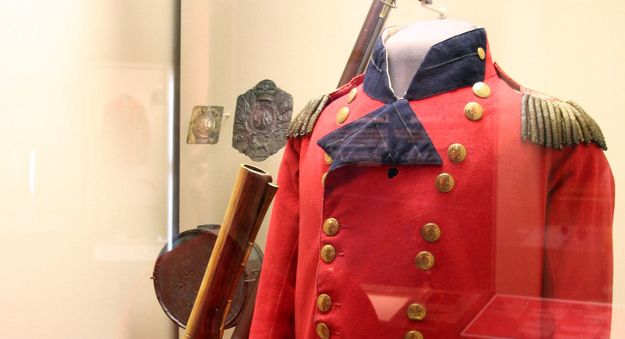
Twelve years after Brock’s death, a 130 foot stone monument was erected in his honour on the heights near the spot where he was killed. His remains, as well as those of Macdonell, were reburied beneath the monument in an elaborate ceremony attended by many of his contemporaries. In 1840, the monument was destroyed by a massive blast of gunpowder, ignited by an American sympathizer. The monument was subsequently rebuilt in 1856, 52 feet taller than before. Today, the monument, which now straddles the longest undefended border in the world, remains one of the most imposing historical landmarks in Canada. Relics of Brock’s career can be seen at the Canadian War Museum in Ottawa, where his bullet-pierced tunic is prominently on display.

ff494dbde08a47201535fa8f3fca5945

The coat worn by Major General Sir Isaac Brock at the time of his death at Queenston Heights on 13 October 1812. On display at the Canadian War Museum, the bullet hole is evident under the lapel (courtesy Archives of Ontario/S1427)

http://www.eighteentwelve.ca/?q=eng/Topic/16

http://en.wikipedia.org/wiki/Isaac_Brock

http://militaryhistory.about.com/od/1800sarmybiographies/p/War-Of-1812-Major-General-Sir-Isaac-Brock.htm

http://www.warof1812.ca/brock.htm

A2Z-BADGE-000 [2015] - Life is Good

The brainchild of Arlee Bird, at Tossing it Out, the A to Z Challenge is posting every day in April except Sundays (we get those off for good behaviour.) And since there are 26 days, that matches the 26 letters of the alphabet. On April 1, we blog about something that begins with the letter “A.” April 2 is “B,” April 3 is “C,” and so on. Please visit other challenge writers.

My theme is ‘The War of 1812’, a military conflict, lasting for two-and-a-half years, fought by the United States of America against the United Kingdom of Great Britain and Ireland, its North American colonies, and its American Indian allies. The Memoirs of a British naval officer from the war is central to my novel “Seeking A Knife” – part of the Snowdon Shadows series.

Further reading on The War of 1812:

http://www.eighteentwelve.ca/?q=eng

http://www.theglobeandmail.com/globe-debate/the-war-of-1812-stupid-but-important/article547554/

A is for Anishinaabe


For the first day of my A to Z Challenge, I resisted choosing the arena for the War of 1812 – America. But first what caused the conflict? Unsettled issues between the British and the United States after the War of Independence were a factor, as was the Royal Navy attempting to press gang American sailors. However, the US also thought that American settlers in the territory that would become Canada would support their invasion across the border. Canada then consisted of the maritime colonies and parts of southern Quebec and Ontario.  But let’s start with the First Nations, who were the other major players on both sides.

A

A is for the Anishinaabe (Ojibwe, Odawa, Potowatomi), who were among two dozen tribal nations that were involved in the conflict.

When war was declared, there were 8,410 warriors of the Western Confederacy, who included Ojibwe, Odawa, Potowatomi, Huron, Shawnee, Mississaugas, Nipissings and Algonkians. The Anishinaabe made up 7,410 of this number, an overwhelming majority. Although the Shawnee war chief Tecumseh is most associated with the war, it was the Anishinaabe that formed the majority.

The tribes met for military and political purposes and maintained relations with fellow Anishinaabeg nations (Mississauga, Algonquin, and Nipissing) from Michilimackinac, an island between Lake Huron and Lake Michigan, It’s always been revered, although opinion is divided whether it is because the island is the turtle of creation or the place of origin of the spirits now called Bgoji-anishnaabensag.

Mackinac Island, William Dashwood – A Painting Commissioned by Robert McDouall

Mackinac Island, William Dashwood – A Painting Commissioned by Robert McDouall

Major General Brock, aware that there were not enough regular forces available to defend Upper Canada, suggested that capturing Michilimackinac and Detroit, from the US, would allay the suspicions of the natives who no longer trusted the British after the Battle of Fallen Timbers in 1796. The chiefs constantly recalled when the Americans overpowered the Western Confederacy and the British abandoned the retreating Anishinaabeg to massacre, by locking the gates to Fort Miami.

When Brock’s forces fought alongside the Anishinaabe to secure Fort Michilimackinac, many more of the western nations joined the British.

Throughout the war, the Anishinaabe were repeatedly told that their interests would not be forgotten when peace was made. So much so that at the conclusion of the War of 1812, the Odawa suggested that the British negotiators offer the Americans a greater quantity of Anishinaabe land on the mainland in order to keep Michilimackinac in their possession.

The possibility was there, but in the end the British meekly vacated Michilimackinac to the United States. It is totally conceivable that at least a portion of upper Michigan or Wisconsin could have been set aside as an “Indian country” as the British had promised. The mechanisms were in place but not the honour. This is why the Anishinaabeg say that “we did not lose the war but we lost the peace”.

Further reading on the Anishinaabe and the War of 1812:

http://activehistory.ca/tag/anishinaabeg/

http://activehistory.ca/2014/09/anishnaabeg-in-the-war-of-1812-more-than-tecumseh-and-his-indians/

http://en.wikipedia.org/wiki/Anishinaabe

http://www.theworldofgord.com/2012/11/heritage-toronto-talk-anishinaabe-first.html


A2Z-BADGE-000 [2015] - Life is Good

The brainchild of Arlee Bird, at Tossing it Out, the A to Z Challenge is posting every day in April except Sundays (we get those off for good behaviour.) And since there are 26 days, that matches the 26 letters of the alphabet. On April 1, we blog about something that begins with the letter “A.” April 2 is “B,” April 3 is “C,” and so on. Please visit other challenge writers.


My theme is ‘The War of 1812’, a military conflict, lasting for two-and-a-half years, fought by the United States of America against the United Kingdom of Great Britain and Ireland, its North American colonies, and its American Indian allies. The Memoirs of a British naval officer from the war is central to my novel “Seeking A Knife” – part of the Snowdon Shadows series.


Further reading on The War of 1812:

http://www.eighteentwelve.ca/?q=eng

http://www.theglobeandmail.com/globe-debate/the-war-of-1812-stupid-but-important/article547554/

Myth Creation

InsecureWritersSupportGroup2

Today, Wednesday 1st April is the moment that sees great events collide – and for some that means never believe anything – there could be a prank lurking.

For me this is the first day of the Blogging from A to Z (April 2015) Challenge, the monthly Insecure Writers Support Group post, and the day when submissions open at Crooked Cat – very relevant as I am an avid Cat reader with dozens of their books on my Kindle.

After all the valuable comments from my beta readers, and the involvement of my excellent editor, Sue Barnard, I intend to be submitting “Storms Compass”, the first part of my “Gossamer Flames” saga. Whether it is suitable remains to be seen.

LATEST NEWS ON APRIL  3rd: I have decided that I will not be submitting “Storms Compass” to Crooked Cat, as (a) it is not suitable due to the overt fantasy/shamanic aspect; (b) it still needs a stronger overarching plot-line with the distinct protagonist and antagonist appearing more; (c) it’s too short still at 45,600 words..

On to IWSG and today’s insecurity – or rather an insecurity that’s been told to wait in the garden. Many experts talk about the right arcs/stages to make a novel work – and the wrong ones. Which method do you use?

I’ve been looking at my WIPs to see if the stages are in the right place. I admit that I am a plotter, but I structure as the story unfolds in my head, then scrawl notes, and then make an outline/guideline. But I don’t use arcs or stages to work anything out – when the story reaches 25% it moves on of its own accord. No forceful persuasion.

And my first drafts, especially the most recent? They are, without consciously plotting them that way, following those prescribed arcs. Why?

6837eccf9d84f42792d7367187de5150

I recollect that Joseph Campbell, in Hero with a Thousand Faces, mentioned the ancient story tellers and how their plots were structured. He termed it the monomyth and found it in most world mythology.

Is there something in a storyteller’s makeup that allows us to instinctively weave a plot that works? Perhaps the process matures over time, the more tales we read, watch or write. How did the writers of the classics achieve this without the guidance that we have in the 21st century? Or is that where the Muses come in?

All Nine often used to come to me, I mean the Muses:
But I ignored them: my girl was in my arms.
Now I’ve left my sweetheart: and they’ve left me,
And I roll my eyes, seeking a knife or rope.
But Heaven is full of gods: You came to aid me:
Greetings, Boredom, mother of the Muse.

Epigram 27 * Venetian Epigrams (1790)

Johann Wolfgang von Goethe (28 August 1749 – 22 March 1832)

 That epigram or poetic observation had a significance for Goethe that is shared by one of my characters in “Seeking A Knife”, the second novel in the Snowdon Shadows series, and at present it is positioned before the tale begins. It could even be significant that the Venetian Epigrams were published in 1790, so available to any well-bred gentleman that fought in the War of 1812, like the naval officer whose Memoirs play such a key role in “Seeking A Knife”.

As for my A to Z Challenge post, that follows once you have recovered.

 ***

Purpose of the IWSG day: To share and encourage. Writers can express doubts and concerns without fear of appearing foolish or weak. Those who have been through the fire can offer assistance and guidance. It’s a safe haven for insecure writers of all kinds!

Posting: The first Wednesday of every month is officially Insecure Writer’s Support Group day. Post our thoughts on our own blog. Talk about our doubts and the fears we have conquered. Discuss our struggles and triumphs. Offer a word of encouragement for others who are struggling. Visit others in the group and connect with our fellow writers – aiming for a dozen new people each time.  Let’s rock the neurotic writing world!

Our Twitter hashtag is #IWSG
Alex Cavanaugh’s awesome co-hosts for the April 1 posting of the IWSG are Suzanne Furness,Tonja Drecker, Toi Thomas, Rachna Chhabria, Fundy Blue, and Donna Hole!