Rewriting a new Kanata timeline threw up this turning point, which was a chance to solidify the dynastic ties around Northern Europe. Before the ‘our timeline’ revelation, will you recognise the real historical event or which crucial event in British history may never happen?
And all because I couldn’t stop constructing my Kanata alternative history. The initial trigger, Leif Eriksson’s permanent colonisation of Vinland, inspired me to rewrite other key episodes in history. I wanted the legacy forged from Vikings merging with the indigenous people to ripple down time. Kanata evolved into my vision of a 21st Century Viking Age.
My Kanata alternative history triggered by Leif Eriksson colonising Vinland, inspired me to rewrite some key episodes in history. I wanted the legacy forged by a Viking alliance with the indigenous people rippled down time. A 21st Century Viking Age.
This episode is a crucial stage in the development of the airships at the heart of modern Kanata. Before the ‘our timeline’ revelation, will you recognise the real historical event? Expect more alternative history ahead.
I’ve been doing the A to Z Challenge since 2014 and began pondering my 2020 theme sometime last year. But in the last few months, everything has overwhelmed me – emails, regular posts like IWSG and WEP, replying to comments, and my own writing. Plus, my health issues.
So, I’m taking the simpler way out – reposting my best posts from 2014 to 2019 Challenges.
Thanks to Jacqui Murray for triggering that approach with her 2019 solution: ..a genre for every letter of the alphabet, but with one or two posts every month. Her reasoning chimed with my own thoughts about too many posts to write/read/comment on etcetera in April.
She wasn’t alone as others found other solutions to negotiating the A to Z Challenge.
However, I’m still going to post on the official A to Z days, starting with A for Assault on Wednesday April 1st, 2020. If you’re tempted and follow that link, you will discover Part One of Azure Spark, which evolved into a novella featuring my Welsh detective Sparkle Anwyl. I edited the posts into three acts, and all three will be posted during April: on the 1st, 11th, and 23rd.
I suspect not everyone got to read ‘Azure Spark’ so this will be another chance. A chance to to revisit older posts on other themes; like my 2017 History of Kanata or my 2015 The War of 1812. But I’ve yet to decide what posts to choose.
Watch this space.
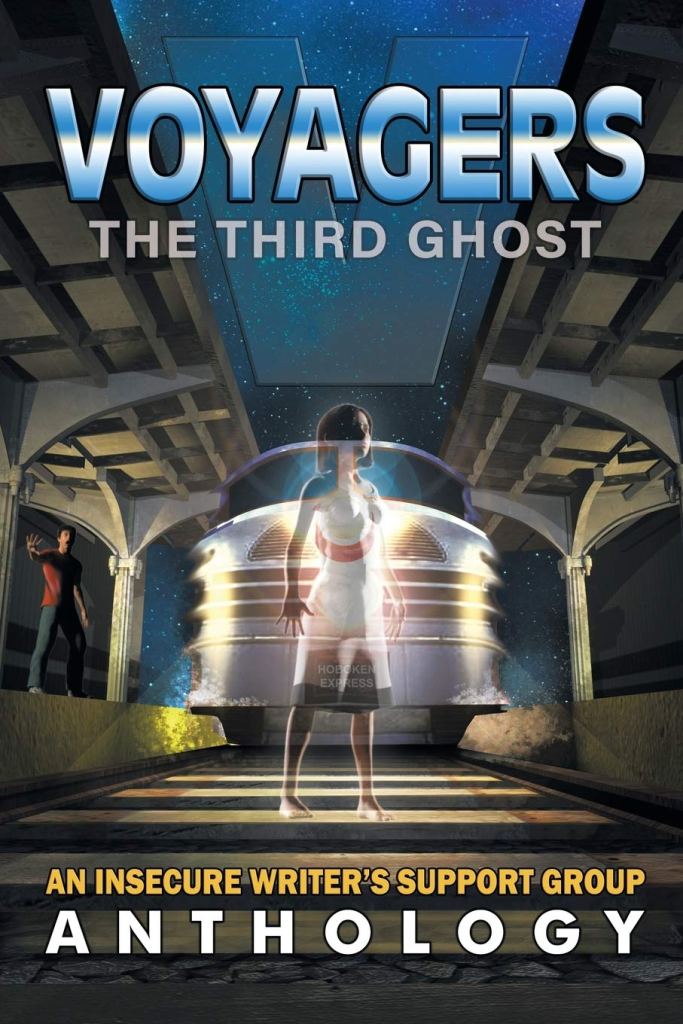
All I can say is Sparkle Anwyl’s case will be complete, and Azure Spark is referenced in my WIP ‘Fevered Fuse’ – my current priority along with the more imminent and crucial release of the IWSG Anthology, Voyagers: The Third Ghost on May 5th.
Originally, I had planned to write a Sparkle Anwyl case for the 2019 WEP + IWSG Challenge starting in April and ending in December. I wrote the first episode in April, but then posted the next episode of Kindled Casket, last month. There is a ‘caged bird’ in the episode but not as planned – that follows in the next episode. That case will unfold over the next few months.
Hence, the attached standalone short – Fettered Air. A departure from my Welsh police procedural, so your responses will interest me.
Fettered Air
I slide ski-swift across the winter’s blanket under the Blood Wolf’s Moon. Beside me the chicken-legged hut creak-crashes through the forest.
We’re alone in the taiga.
No sign of Baba Yaga. She’s vanished as have the denizens.
No howling wolves. Nor snow leopard scents. No eagle-owl hoots. Nor honking
swans. No ice-crawlers corpse feeding.
For nothing breathes in the wailing wind.
Yet, Nature writhes in pain, dragon’s bile dripping on her from
mortal fangs.
I am Skaði. Goddess, giantess, huntress and snow-stealth
specialist. Size is not the issue. Speed is.
The house is noisier, but we make a team. This hut can track her mistress better than even I, its feet scratching up clues, windows watching for signs.
Our mission came from Svetovid, seer and guardian god – and
we had no choice.
“Find Baba Yaga before this world rebels.”
Why me, a giantess from Jötunheimr? Because neither Odin nor
Thor will ask me ever since the marital strife with my spouse, Njörðr.
“Nobody else volunteered,” added Svetovid. “Besides those
deities I posted on separate operations.”
He’s as secretive as my Vanir and Aesir brethren. Not just
Loki plays with intelligence. Our trickster-thief and clown has too many
imitators.
“Others are missing?” I asked, expecting evasion.
“Find Baba Yaga. That’s all.”
So, a need-to-know answer means Skaði is disposable. Nothing
has changed.
Am I that terrible?
I had my reasons for smashing my husband’s sand sculptures. The whale-way was a prison with seabirds flaunting freedom.
But he called my majestic mountain retreat a dreary cell. “I’m
trapped here. I can’t ski or snowboard like you.” He ranted and ripped down my hunting
trophies.
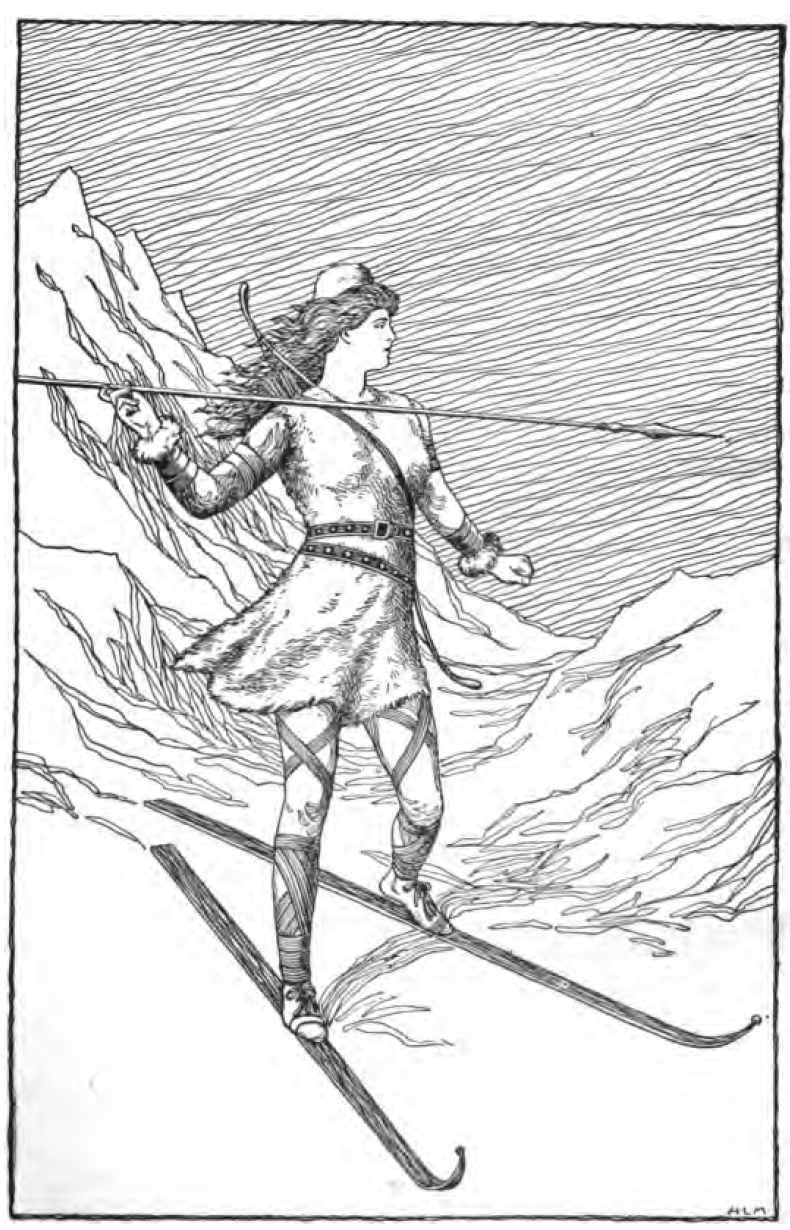
“Skadi Hunting in the Mountains” (1901) by H. L. M – Foster, Mary H. 1901. Asgard Stories: Tales from Norse Mythology. Silver, Burdett and Company
Marriage dissolved.
Thus, I get the menial tasks. Unless Odin sends his ravens or
wolves with heart-baits.
Not this occasion. A telepathic eagle with four heads.
“Find Baba Yaga.” Svetovid’s orders resound in my brain.
The wilderness wrestles promethium chains. That is enough reason to pursue the quarry.
So we scour Siberia.
The creak-crashing hut spins above the earth-coat. We have
the crone’s spoor.
Calls and cries clamour on the snow-breath.
Ahead a green clearing by a lake glows bright. Invisible to vicious
human eyes, but I see the torches, tents and throng bridging the veils.
Baba has parked her mortar by a host of other vehicles, one
that is familiar – my stepdaughter’s pantherine-drawn chariot.
With groans and creaks, the chicken-legs spin the hut to a
halt by the pestle-guarded mortar. Shutters slam shut. A fence of human bones
topped with skulls encircles them.
My gaze shoots arrows at the polytheistic conclave nobody
invited me to.
Goddesses gathered from the Nine Realms. They have abandoned
their posts to feast. Brews flow, dice roll and deities chatter. Everyone
distracted as Midgard clamours for release.
Baba knocks back vodka, cackling to another crone – Hecate,
clutching a goatskin of wine. Their dice are corpse-stones, and Hel’s are
soul-vessels.
Are they oblivious to the desolation? Among the feasting, denizen envoys are airing their anxiety.
My pounding heart settles. Mind muses past irritable white-out.
Not all the deities are wizen and wild in their attire and behaviour. Some goddesses appear serious.
Freyja, stepdaughter and party animal rises – statuesque and sober, despite her goblet of mead.
Her eyes seize mine as she silences the symposium.
“Sisters, the snow-dancer is here. The world cries, and we have
battle-sweat to spill. But when shall we three score meet again?”
“When the chaos is banished, when the spear-din is won,” Hel
replies.
I add my voice, realising their design. “Ere midnight. After
the sleep of the blade claims those flouting our laws.” Faces flash in my head.
I smile. “Nature’s justice must wield the icicle of blood against false leaders
poisoning life.”
My sisters nod. Creatures yowl.
Freyja smiles and summons her champions. “I come, Durga and Adrastea.
We have fangs to extract.”
Her pantherines roar in response.
We will shatter the fetters on Nature. No more will humans build cages entrapping our laughter and song.
Yes, this is my #WEP/IWSG post for June so part of the 2019 WEP/IWSG Challenge. This a standalone short, although Skaði appears in my novel Eagle Passage, which I wrote the first draft of for NaNoWriMo 2016.
Word Count 660: FCA
Comments are welcome as usual and the following applies:
This is the first
post written with my new ‘one-handed’ keyboard – well, smaller than my
UK-bought one so easier to use when my left-hand cramps and claws. Just need to
adapt to its idiosyncrasies.
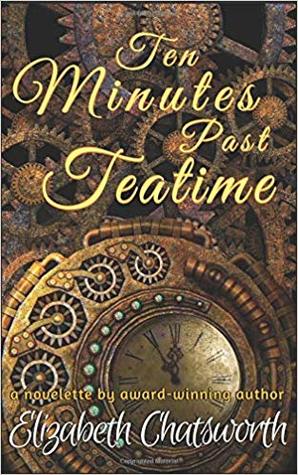
On to my review of a
short story that a writer I follow sent her subscribers.
A Victorian spinster-scientist and a Viking shield-maiden find passion and
danger in dark-age Ireland.
1896: Forty-three-year-old scientist Miss Minerva Minett is determined to
become the first female member of an exclusive inventor’s club. To win their
annual membership competition, she invents a time-traveling submersible, and
launches her vessel into the Irish sea for a quick trip to the dark ages. But
when she sinks a Viking longship, accidentally joins a monastery raid, and
falls into the arms of a grizzled shield-maiden, she discovers that time may
not be on her side.
Review 4.3 stars
This entertaining steampunk short story had me amused and entertained
as forty-three-year-old Victorian scientist Miss Minerva Minett attempted to
become the first female member of an exclusive inventor’s club, by launching
her time-traveling submersible into the Irish sea for a quick trip to the dark
ages.
From the amusing opening through her encounter with the
grizzled shield-maiden, Alfhild to the twist at the end, I chuckled at the
inventive mind of Minerva and her creator.
The experiments and inventions were as memorable as the
characters, including the one that delivered the twist at the end. Being
steampunk, I expected alternative history, so I won’t over-judge the
authenticity beyond wondering about some oddities such as a misplaced dragon-head.
The romance between Alfhild and Minerva is a bonus with neat
contrasts across cultures and time. And with a name like Minerva, there had to
be goddess references.
Alfhild was the true goddess, not she. Or maybe they both were?
It was a thesis she would have to explore in more detail. For the sake of science.
But the humour is always there.
Minerva cocked her head. Surely, she didn’t hear the word goldfish in the chorus? “ . . . Minerva’s Magic Goldfish. Answers every sailor’s wish . . .” Oh, dear.
As a reader and a gamer, this was inevitable – a second game related book. Although the first was a book that led to a game – Witcher – while this arose from a game. But both related to games that absorb/distract me.
THE OFFICIAL NOVELIZATION BASED ON THE POPULAR VIDEO GAME FRANCHISE.THE OFFICIAL NOVELIZATION BASED ON THE POPULAR VIDEO GAME FRANCHISE.
They call her misthios–mercenary–and she will take what she is owed.
Kassandra was raised by her parents to be fierce and uncaring, the ideal Spartan child, destined for greatness. But when a terrible tragedy leaves her stranded on the isle of Kephallonia, near Greece, she decides to find work as a mercenary, away from the constraints of Sparta.
Many years later, Kassandra is plagued by debt and living under the shadow of a tyrant when a mysterious stranger offers her a deal: assassinate the Wolf, a renowned Spartan general, and he will wipe her debt clean. The offer is simple, but the task is not, as she will need to infiltrate the war between Athens and Sparta to succeed.
Kassandra’s odyssey takes her behind enemy lines and among uncertain allies. A web of conspiracy threatens her life, and she must cut down the enemies that surround her to get to the truth. Luckily, a Spartan’s blade is always sharp.
Review 4.4 stars
As a fan of historical fiction and a gamer, this was an enjoyable
book throughout. I admit that I finished the main questline of the game, Assassin’s Creed: Odyssey before reading
this novelisation. And I played Kassandra
preferring the performance of the voice actress, Melissanthi Mahut.
Kassandra is a mercenary who is caught up in a conspiracy that threatens her life – and the future of Greece. Here past is entwined with Sparta’s past and one she can’t avoid.
This novel was as immersive as the game but building on what
I already knew of the ancient Greek world and from the game world. Not
surprising from Gordon Doherty, a writer of ancient historical fiction who
clearly knows how to make a historical period come alive – in this case, the
Second Peloponnesian War between
Athens and Sparta at the head of their respective Leagues.
Once finished, I was interested to see how far the historical
detail departed from reality, knowing that some have called the Assassin’s
Creed universe ‘alternative history’. In this storyline, there are elements and
a few characters that are fictional and perhaps ‘alternative’. But the
background, the world and many of the principal players are historical – like my
favourite, Brasidas. The
characters come alive – helped I admit by meeting them in game – although they
may not have the complexities that some readers might expect.
The game is visually stunning – as Greece is – but this
novel adds the smells of the world from the flowers and sea breezes to the unwashed
bodies and corpses. There are moments that are darker, more visceral and
realistic. That’s the power of crafted words.
I’ve idolised Sparta – sometimes – but I’m convinced now
that Sparta is not the place for me. Athens is more suited to my artistic and
democratic temperament – but under Perikles.
This novelisation adds more to the plot – even alternative
motives and actions that embellish a storyline that must work in a game setting
where it’s hard to have multiple endings. For me, there were few surprises, but
I enjoyed the development of characters and situations that fleshed out events
and structure. Time was more akin to what one would expect – journeys take days
and weeks; scouting out a target can take weeks, if not months; events occur
over months, even years. We mustn’t forget that the Second Peloponnesian War lasted
almost thirty years, from 431 to 404 BCE.
This novelisation ended with a clever scene that worked for
the Assassin’s Creed universe and was perhaps better although different from my
ending. A fun and recommended read if you enjoy this genre of book.
Story – four stars
Setting/World-building
– five stars
Authenticity –
five stars
Characters – four
stars
Structure – five
stars
Readability – four
stars
Editing – four
stars
**
I’m still exploring the game of Assassin’s Creed: Odyssey, although I am now on side-quests and
exploring places unfound – and I have yet to slay the Minotaur. At some point
in the future, I will review the game – if there is the demand. For now, the
focus will be on books – albeit the current one is non-fiction.







 Writing Wings