Writers, Have You Rocked The Vault?

Yesterday, I posted a review of The Urban Setting Thesaurus: A Writer’s Guide to City Spaces, and today I’m celebrating its release date with authors Becca Puglisi and Angela Ackerman. Congratulations ladies. 🙂 

#myfavoritethesaurus

As this is there day, they have the comm, or the floor, here at Writing Wings.


It is a writer’s job to draw readers into the fictional story so completely that they forget the real world. Our goal is to render them powerless, so despite the late hour, mountain of laundry, or workday ahead, they cannot give up the journey unfolding within the paper-crisp pages before them.

Strong, compelling writing comes down to the right words, in the right order. Sounds easy, but as all writers know, it is anything BUT. So how do we create this storytelling magic? How can we weave description in such a way that the fictional landscape becomes authentic and real—a mirror of the reader’s world in all the ways that count most?

The Setting Thesaurus DuoWell, there’s some good news on that front. Two new books have released this week that may change the description game for writers. The Urban Setting Thesaurus: A Writer’s Guide to City Spaces and The Rural Setting Thesaurus: A Writer’s Guide to Personal and Natural Spaces look at the sights, smells, tastes, textures, and sounds a character might experience within 225 different contemporary settings. And this is only the start of what these books offer writers.

In fact, swing by and check out this hidden entry from the Urban Setting Thesaurus: Police Car.

And there’s one more thing you might want to know more about….

Rock_The_Vault_WHW1Becca and Angela, authors of The Emotion Thesaurus, are celebrating their double release with a fun event going on from June 13-20th called ROCK THE VAULT. At the heart of Writers Helping Writers is a tremendous vault, and these two ladies have been hoarding prizes of epic writerly proportions.

A safe full of prizes, ripe for the taking…if the writing community can work together to unlock it, of course.

Ready to do your part? Stop by Writers Helping Writers to find out more!


The Urban Setting Thesaurus: A Writer’s Guide to City Spaces

Tomorrow, June 13th, Becca Puglisi and Angela Ackerman are expanding their indispensable Thesaurus family by adding The Rural Setting Thesaurus: A Writer’s Guide to Natural and Personal Places and The Urban Setting Thesaurus: A Writer’s Guide to City Spaces.

“We are very excited about these books, and hope they’ll change how you think about setting and description. Sensory detail, a large part of each book, is an especially powerful way to draw readers into our story’s world, so we really need to get it right.”

For Angela’s taster visit: http://writershelpingwriters.net/2016/06/launch-mock-post/

However, here is my review of The Urban Setting Thesaurus: A Writer’s Guide to City Spaces.

Pageflex Persona [document: PRS0000046_00072]


As a writer, one of my most referred to books is The Emotion Thesaurus: A Writer’s Guide to Character Expression, so I was excited to find the Thesaurus family had new additions. I was not disappointed when I delved into The Urban Setting Thesaurus: A Writer’s Guide to City Spaces.

The Thesaurus is well laid out, with three parts, starting with some insightful and useful sections that explain why setting is so important, and how writers can enhance their creations by using it well. Setting is too often the poor relation of characterization and plot, but, as Ackerman and Puglisi demonstrate, it can lift your writing.

As they say, “We are very excited about these books, and hope they’ll change how you think about setting and description. Sensory detail, a large part of each book, is an especially powerful way to draw readers into our story’s world, so we really need to get it right.”

These eight sections include: The Setting as a Vehicle for Characterization; The Setting as a Vehicle for Delivering Backstory; The Crown Jewel of Settings: Sensory Details; and Common Setting Snags. These were informative, and made me aware of all the opportunities that I was missing in my own writing.

The main body of the Thesaurus contains a collection of over 100 diverse settings arranged under helpful headings: IN THE CITY; RESTAURANTS; RETAIL STORES; SPORTS, ENTERTAINMENT AND ART VENUES; and TRANSPORTATION. There is plenty of options to choose from when finding the most suitable location – for instance I choice the settings ALLEY, BAR, RACETRACK, and POLICE CAR as the starting points for my exploration, and just these locations led down a multitude of avenues.

Each setting contains a wealth of suggestions on the SIGHTS, inside and outside, although you definitely don’t need every one. These are just great prompts and reminders. Then you get the same on SOUNDS, SMELLS, TASTES, TEXTURES AND SENSATIONS.  The suggestions don’t stop there. There are POSSIBLE SOURCES OF CONFLICT, PEOPLE COMMONLY FOUND HERE, SETTING NOTES AND TIPS, and another thought-provoking paragraph that demonstrates techniques – the SETTING DESCRIPTION EXAMPLE for each setting.

For me, these EXAMPLEs demonstrated what was possible and the techniques available to a writer. Full marks to the authors for their well-crafter slices of fiction, that demonstrate what is possible with Settings.

Perhaps the feature that got me dashing along other avenues most, was the RELATED SETTINGS THAT MAY TIE IN WITH THIS ONE. This lists those other settings, and in the eBook links to them. So POLICE CAR took me to the Police station. Prison, Courtroom etcetera. It was hard to stop exploring this Urban world. If that’s not enough, there are even related settings in The Rural Setting Thesaurus: A Writer’s Guide to Natural and Personal Places, so the two books work in tandem.

The final part of the book contains tools to aid you in applying all these gems, as well as a list of all the Rural Settings, Recommended Reading, and more information on the first class team behind the Thesaurus family.

After this wordy exploration of the invaluable Urban Setting Thesaurus, I’m off to buy The Rural Setting Thesaurus: A Writer’s Guide to Natural and Personal Places as its sister thesaurus is a tempting taster of what to expect. Both have to be an essential part of any fiction writer’s library. They will be part of mine.

Bad Moon Rising – a review

I’ve been sticking with the crime fiction for my reading, although my next review is of a darker offering. But I was engrossed once again, not least because the forensics in this was so well researched and described.

BadMoon21618187

Bad Moon Rising (D.I. Paolo Storey #1)

by Frances di Plino (Goodreads Author)

*** SEMI-FINALIST in the KINDLE BOOK REVIEW 2012 competition ***
*** FINALIST for THE PEOPLE’S BOOK PRIZE 2014***

One more soul is safe.

Brought up believing sex is the devil’s work, a killer only finds release once he has saved his victims’ souls. Abiding by his vision, he marks them as his. A gift to guide his chosen ones on the rightful path to redemption.

Detective Inspector Paolo Storey is out to stop him, but Paolo has problems of his own. Hunting down the killer as the death toll rises, the lines soon blur between Paolo’s personal and professional lives.

For anyone that likes their crime fiction dark and gritty, then I recommend “Bad Moon Rising” by Frances di Plino. The killer is believably twisted by his religious calling, and his identity is cunningly hidden from Detective Inspector Paolo Storey, his colleagues and the reader.

Frances di Plino has crafted a memorable detective, complex and tragic like some of the finest flawed characters. When I finished the novel, I wanted to know more about him and where his life was going. I must read the next book in the series.

The depth of characterisation doesn’t end with the protagonist and antagonist. Even the minor characters are well portrayed, and stand out in their own right. There is also a strong sense of the complex workings of all aspects of the police, including forensics, but told believably.

The personal interactions weave around the investigation, especially with Paolo Storey, whose own attitudes often drive the action. This takes the story to another level, where all the elements are working seamlessly to create a relentless story…a dark tale that seeps into unexpected crannies.

The twist was unusual, but that is the sign of a clever author. Find a new angle and make it work. I’m intrigued what Someday Never Comes (D.I. Paolo Storey, #2)  will add to this excellent series opener.

The Secret of Lakeham Abbey – a review

Yesterday, I posted “What earns Stars?” about my dilemma over review stars, and mentioned the book that rates more than five. Well this is the one that I had in mind, so read on.

30118466

The Secret of Lakeham Abbey

by Sally Quilford (Goodreads Author)

1948

When Percy Sullivan’s family take over Lakeham Abbey for the summer, it was a chance to get away from battered post-war London and be cossetted by the capable and pretty housekeeper, Anne Pargeter.

They soon learn that the Abbey conceals a dark secret; one that someone was willing to kill to hide. When Anne is convicted of murder and sentenced to execution, Percy is determined to do all he can to save his friend from the gallows.

He encourages everyone to tell their side of the story. This leads to some startling revelations, including a shocking secret that Percy’s mother tried to hide from him.


The blurb hooked me on the book’s launch day, and I immediately read the opening pages online. Then I had to read more. This was a beautifully crafted mystery in the tradition of the Golden Age of Detective Fiction, and I found it hard to put down. Despite life’s interruptions, I finished it in just over a day – close to my record.

From the first sentence, I loved the voices of the characters, especially Percy Sullivan’s. He’s a teenager driven by his desire to prove his friend Anne Pargeter, and his encouragement of everyone to tell their side of the story is genius. Genius on his part, and on the author’s.

All of them have great voices that reveal so much about them and their part in the clever plot. Everyone has something to hide, however insignificant – but then don’t we all. For the sleuths like Percy, the art is reading between the lies and half-truths to unravel the hidden truths. True to the Golden Age detectives, Percy and the police gather everyone for a neatly located revelation that surprises all.

Although secrets and murder are the driving force, and Percy’s focus in on solving the mystery, there is romance between various characters – but I won’t say whom. In fact, there is plenty of emotional interactions between characters, all well-painted.

This was not only an excellent read, and a ‘read-again’ book, but it also made me work back through the novel looking for the crafty techniques that Sally Quillford used. “The Secret of Lakeham Abbey” reminded me of a clever Agatha Christie mystery.


As a writer, this novel was a lesson in how to craft a mystery, which was why I studied all the scenes that gave clues to the murder. Learning how to use red herrings, deceit, and well-timed distractions, is something that I still have to take on board. Thanks Sally Quillford for helping show me some of the how. And that’s why I wish I could give “The Secret of Lakeham Abbey” six stars.


What earns Stars?

Insecure Writers Support Group Badge


Writing book reviews makes me insecure when it comes to awarding stars. Hence this post on the official Insecure Writer’s Support Group day.

At one point, in the dim past, it seemed simple: if it was a book that I would re-read, then it earned five stars, like J.R.R. Tolkien’s Lord of the Rings. If it was a disappointment, then it earned three (or less). Nothing earned less, as one and two star books didn’t get past the initial blurb-opening-cover test – although I admit to a few mistakes.

Anyway, here’s my latest guide to the Stars based on reviewing as a fellow writer and as a reader.

One Star: The author managed the awesome feat of publishing a book.

Two Stars: Published and with almost no formatting/proof-reading/typo/spelling errors etcetera.

Three Stars: Published, error-free-ish, and with a logical, understandable plotline. Okay read.

Four Stars: As three, plus engaging story, characters, setting, and well-crafted sub-plots. Recommended read.

Five Stars: Not just a recommended read, but a book that demonstrates the craft of writing. Enjoyable and inspirational.

Although this star system avoids judging books against each other, which I hate doing, there is one major problem with this rating method. My review tomorrow demonstrates that failing. What score should I give a book that deserves five stars, is a ‘read-again’ book, and demands that I work through it looking for the clever techniques that the writer used. Do I need to have a Six Star grade?

31c70d96800cdc7b9006c55d54c15c7b

I remember doing that when I got to the end of Agatha Christie’s The Murder of Roger Ackroyd. I needed to know how she had got away with Rule 1 of the 10 Rules of Golden Age Detective Fiction, producing a clever twist ending that worked. Of course, that rule is now broken in many instances, as are many others.

Anyway, I’m not sure how I will apply my Stars grading to non-fiction, but what are your measures of a fiction book’s qualities? Do you avoid giving five stars? Do you want to give five stars to most books that you choose to read? Have you ever given a book one star, even if it was mine?

*

The first Wednesday of every month is officially Insecure Writer’s Support Group day. We post our thoughts on our own blogs. We talk about our doubts and the fears we have conquered. We discuss our struggles and triumphs. We offer a word of encouragement for others who are struggling.

Please visit others in the group and connect with my fellow writers.

Let’s rock the neurotic writing world!

Our Twitter hashtag is #IWSG

And be sure to check out our Facebook group –https://www.facebook.com/groups/IWSG13/

The awesome co-hosts for the June 1st posting of the IWSG are  Murees Dupe, Alexia Chamberlynn, Chemist Ken, and Heather Gardner. 


Blaze – a review

Having finished two novels in quick succession last week, there will be two book reviews this week as well as my Insecure Writers Support Group monthly post tomorrow.

First though a review of another mystery novel that gave me some more insights into writing an engrossing and exciting read.

Blaze_27218007

Blaze (A Stone Mountain Mystery #2)

by Kristina Stanley 

Instead of exchanging vows, Kalin Thompson spends her wedding day running from a forest fire near Stone Mountain Resort, and the pregnant friend trapped with her has just gone into labor. Meanwhile, Kalin’s fiancé, Ben Timlin, hangs from the rafters of a burning building, fighting for his life. Can the situation get any hotter?

When the fire is declared as arson, finding the firebug responsible becomes Kalin’s personal mission. In the course of her investigation as Director of Security, she discovers that some people will go to extreme measures to keep her from exposing their secrets.

Having enjoyed Kristina Stanley’s winter mystery Descent, Book 1 of the Stone Mountain series, I was looking forward to No 2 Blaze, and I wasn’t disappointed.

From the moment the forest fire ruins Kalin and Ben’s wedding plans, I was swept up in the crises and life-threatening situations. There are moments of calm, time for reflection, but there are always questions driving the reader along. So I didn’t tarry too long.. We know that nothing runs smoothly for a busy Director of Security, even when the RCMP are doing their job. Kalin has to be involved.

The plot was fast-paced and well-structured, with enough neat red herrings to keep me guessing almost to the end – just like in Descent. Although this works as a standalone, it’s best to read Descent first, as other reviewers have said. Then you become familiar with some of the characters, as well as some past events. Nothing crucial but that adds colour.

The clever interaction between the well-painted characters, many new, gives the novel sub-plots that enrich the read, and take Blaze beyond a mystery. Yet these emotional subplots interplay with the crises that weave through the lives at Stone Mountain Resort. And the dog characters are well integrated – not surprising as the author owns one.

Once again, Kristina Stanley has captured the atmosphere of her setting, whether it’s being ravaged by fire or in the vistas from the slopes that attract other outdoor pursuits suited to the season. Here skiing has given way to mountain biking.

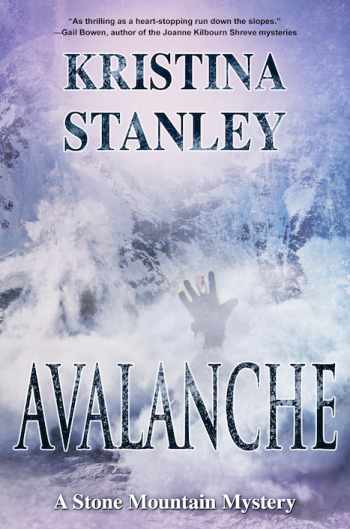
The winter beckons though and I can’t wait for Avalanche, Book 3 of the Stone Mountain Mystery series.