Dragonoak: The Complete History of Kastelir – a review

As my writing begins to touch on diversity and minority rights issues, I knew that I should expand my reading. This novel is my first fantasy that I’ve read that is willing to move beyond the narrow taboos of modern society.
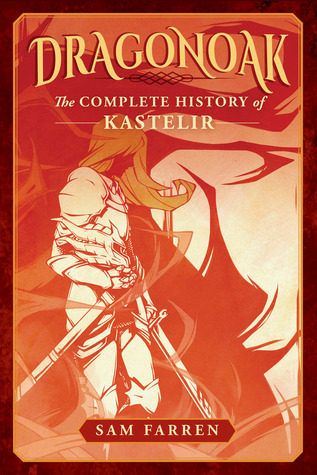
Dragonoak

Dragonoak: The Complete History of Kastelir (Dragonoak #1)

by Sam Farren

After being exiled to the farmland around her village, Rowan Northwood takes the only chance at freedom she might ever get: she runs away with a passing Knight and doesn’t look back. The woman cares nothing for Rowan’s company, but nor does she seem perturbed by the powers that burn within her.
Rowan soon learns that the scope of their journey is more than a desperate grasp at adventure. She breaks away from the weighty judgement of her village, but has no choice but to abandon her Kingdom altogether. Sir Ightham’s past leads them through Kastelir, a country draped in the shadow of its long-dead Queen—a woman who was all tusks and claws and great, spiralling horns.
Hiding her necromancy is no longer Rowan’s greatest challenge, and what leads them across Kingdoms and through mountains is a heavier burden than she ever could’ve imagined.


Review 3.5 stars

I was drawn to read this book as the blurb, and the reviews promised an engrossing fantasy novel where diversity was the norm. I found the opening intriguing with a fascinating backstory trickled out, not dumped on me. Rowan Northwood as a narrator is driven to leave her village by the attitude of the people that saw her as a healer until they discovered her hidden power.

Her journey is one of discovery, about the world that she only knows from her brother Michael’s stories and about other people. However, she is not the protagonist as that is Sir Ightham, a female knight that is well-portrayed as the norm. At first, Rowan is intrigued and inspired by Sir Ightham, but as she discovers more about the knight, a real attraction grows. Personally, I found it difficult to relate to such a distant protagonist, but I kept reading knowing that through Rowan, I should discover more.

Many of the characters are not the fantasy norm exactly. This aspect of the world-building delivered, as did the world beyond Michael’s books, and this element kept me wanting more. The third intriguing character was an asexual called Rán, whose race, the pane, were central to the story – I must avoid spoilers and say little more about that.

When Rán appears, Rowan calls her ‘she’ and for the rest of the book Rán is a ‘she’. But the pane are asexual or transgender, and the pronoun for them individually is ‘they’. However, once I had adapted my mindset to using this gender-neutral pronoun, confusion set in. Why was Rán ‘she’ but other single pane were almost all ‘they’? What about this sentence:

A handful of younger pane crept up on us. Their leader, a girl with the first signs of a right horn showing, inched her way to the steps. I raised a hand to wave and they shrieked, scattering like ants.

I kept reading engrossed in the story – but after researching ‘gender-neutral pronouns’. Other elements threw me, like the treatment of the horses that grated with everything I knew as a retired equestrian journalist.

The jigsaw remained complicated and unclear – well to Rowan as the narrator but not the protagonist – but eventually, after some unnecessary scenes of excessive world-building, the plotlines took shape through new arrivals, encounters and interruptions. The mysterious quest remained unclear.

More began to grate. Some reviews had mentioned there were “a few typos”, but those would have mortified me if my writing had so many. I had to keep re-reading sentences and amending them. Anyway, back to worrying about the horses – but the focus is now on the Queen. A new intrigue so I’m not giving up. I want to reach a satisfactory conclusion.

Rowan is an observant narrator, even if it’s hard being an observer that senses so much. First-person POV is hard, but the reader gets to feel with the main character – although she’s not telepathic. So why the sentences that stray into the omniscient? Confusing and yet avoidable. But enough of that ‘writing style’ nonsense, there’s a mystery to resolve and here comes the next twist.

Finally, in the latter part of the novel, Rowan discovers more and events move faster. I began to find too many loose threads, and it was too late in the story to resolve many of them in time. At least, the central romance reached the next level – but romance is always ongoing.

Much better, according to the author it seems, to add other threads and keep the reader wanting more and let us forgive the cliff-hanger ending – Tolkien did that in Lord of the Rings, so it’s justified. Correction – not in the same way. Reading that trilogy in the 1970s, a glimmer of hope kept me questing, but this time I’m letting Rowan struggle on without me.

Dragonoak would be a good diversity fantasy if not for all the early draft failings like the pacing crisis, first-person omniscient POV, excessive typos and unnecessary scenes. At least, the author can edit the Kindle version one day. For now, I’m off to try a ‘diversity’ SF novel. Perhaps if there is a second edition, then I might join the journey and enjoy some of the inspiring prose.

But not looking at them wasn’t enough to banish them from my mind. Whatever they suffered seeped into the air, following me through busy streets, as though the shadow I’d felt last night had returned to claim me.

Story – four stars

Setting/World-building – five stars

Structure – three stars

Readability – three stars

Editing – three stars

Style – three stars
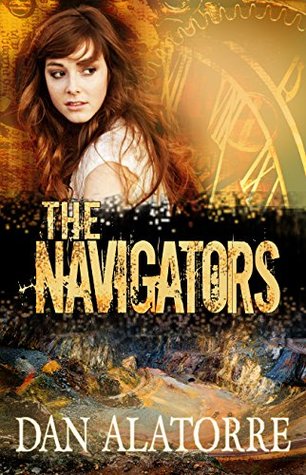
 

The Navigators – a review

Time for another review and this time, a novel about time travel.

Navigators

The Navigators

by Dan Alatorre (Goodreads Author), Allison Maruska (Goodreads Author)(Editor)

A freak landslide at a remote mine site uncovers a strange machine to Barry’s group of palaeontology students. Wary of corrupt school officials, his team takes the machine home to study it in secret, reaching only one realistic – and unbelievable – conclusion: It was designed to bridge the time-space continuum. It’s a time machine.

Testing delivers disastrous results, sending one team member to the hospital and nearly killing another. When word leaks about the discovery, the ultimate power struggle ensues: the university wants it for funding, the power company wants its energy regenerating abilities kept under wraps, and a rival group wants to steal it for themselves. No one cares if Barry’s team comes out alive.

Fleeing for their lives, the students must fight the school, the police, and each other if they want to learn the truth about what they’ve discovered – a truth with more severe consequences than any of them can predict.

Review 5*

An intriguing opening chapter propelled me into the lives of Barry’s group of palaeontology students in Dan Alatorre’s The Navigators. The characterisation built my interest and quickly established the personalities and group conflicts – conflicts that cleverly fed the plot.

These conflicts emerged in such human ways, that I sensed that everyone should watch out – as the blurb implies. Everyone was creating situations that could have those ‘severe consequences’.  As the plotlines unravelled, I was telling the characters to watch out – to no avail. Would I have listened? Not when I was their age.

Their reactions were believable. Plus some good observations on the paradoxes of time and the tough choices it poses. In The Navigators’, time travel tests everyone and loyalties are stretched by the discovery of the machine. I kept asking questions – some of which the friends forgot to ask’

Who do you trust? What are other people’s motivations? What is the way out of this situation?

Maybe not the answers that Dan Alatorre came up with, but they worked and I had to keep reading. I expected some comeuppance but I was ready to be surprised as the intentions came unravelled. That’s life. As with the best books, there were some good morals in the story, such as – lying is never the best answer; shortcuts rarely work (even with a time machine); beauty is more than looks. The latter prompted me to highlight the following dialogue:

“… ‘A beautiful woman’s breasts will eventually sag and her hair will turn gray. What will you be married to then? If you choose wisely, you will be married to a beautiful personality and a curious mind that loves your children and who would do anything for you.’ That is true beauty.”

And where better to put the punchline – at the very end. Now that makes me grin and recommend this novel.

Story – five stars

Setting/World-building – five stars

Structure – five stars

Readability – five stars

Editing – five stars

Style – five stars

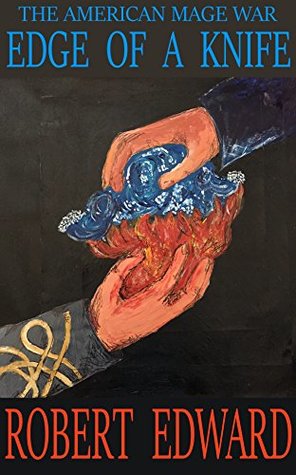
Edge of a Knife – a review


As both a reader and writer, I am fascinated by alternative histories so when Robert Edward mentioned his book on Goodreads, I was game for a read.

EdgeOfAKnife

Edge of a Knife (The American Mage War #1)

by Robert Edward (Goodreads Author)

It has been thirteen years since southern war wizards decisively defeated the Union Army and gained independence for the Confederate States of America. In 1876, the United States is a shattered nation. It stands alone, beset by enemies in a world torn apart by the terrible power of magic. Across the globe, kings and presidents, emperors and generals command sorcerers who harness the four elements of earth, air, water, and fire to wreak havoc on their enemies.
A magical fault line divides North America, where the hydromancers of the United States and pyromancers of the Confederate States maintain an uneasy truce. Both nations race to acquire new and more powerful magic to ensure victory when the next war inevitably comes.
In a Pittsburg tavern, Jared Gilsom, son of a wealthy shipping magnate, smuggler, and part-time thief, meets a strange woman. She has ties to an enigmatic group working both inside and outside the Union government to develop the North’s magical arsenal. A chance battle with southern agents in the city streets draws Jared into their mission. After retrieving a vital treasure from a renegade hydromancer, Jared joins a clandestine raid into the heart of the Confederacy. There, he finds a nation on the brink of its own collapse, where ambitious opportunists wait only for the right moment to seize power.
As Jared and his companions fight their way out of the South, the world continues to spiral into chaos. And magic will either save America or ensure its destruction.

Review 3.8*

My passion for Alternative history began with the American Civil War when I read Ward Moore’s Bring the Jubilee. So, I was drawn to this alternative when again the South was victorious. However, in Robert Edward’s well-crafted world in ‘Edge of a Knife’ magic has somehow emerged although why is a key theme of this novel.

In the opening pages, I was pulled into the story, and this alternative world worked, and the setting of post-alternate American Civil War felt right. At first, the magic was not overt or an all-conquering force. Later in the tale, we discover what has happened to reawaken magic, although Edwards doesn’t reveal all even as the novel concludes. Roll on Book 2 or maybe even in 3.

Anyway, the story was intriguing as it developed, with neat political parallels as well as the central plot. Jared as the main POV character evolved steadily, and a vivid picture emerged, although the others were less vivid – but then we were never inside their heads and nor was Jared. Action in other settings meant that the POV changed, more often to Confederate characters adding another perspective that generated events that crossed with the main character’s quest.

A few scenes from a political perspective felt like exposition, although those scenes added to the world-building and in one case foreshadowed a concluding scene.

At the midpoint, the stakes are raised, and the unexpected twists work. Beyond that key point, there was a sense that the story was building to a climax – a climax that hinted at possible events in Book 2. The events kept racing and twisting as the satisfying ending unfolded. One of the concluding scenes from the perspective of another nation – no spoilers on offer – was unexpected even though subtly foreshadowed. These scenes set up Book 2 and revealed a clever twist that I didn’t see coming.

I recommend the read for those that enjoy alternative history. I can’t say if the American Civil War period is correct, but to me, that felt right. As for stars, I was wavering as I finished the novel between three and four. The inconsistency of some spellings – Pittsburgh with an extra ‘h’ – and some sloppy sentence constructions pointed to a lack of final editing. However, these didn’t ruin the read.

Story – four stars

Setting/World-building – four stars

Structure – four stars

Readability – four stars

Editing – three stars

Fahrenheit 451 – a review

One of the books on my ‘To Review ‘list is one that I read many decades ago, then decided to re-read recently. Most of you may know of ‘Fahrenheit 451’ in some way, but here is the Goodreads blurb as usual.

Fahrenheit451_17880067

Fahrenheit 451

by Ray Bradbury

The terrifyingly prophetic novel of a post-literate future.

Guy Montag is a fireman. His job is to burn books, which are forbidden, being the source of all discord and unhappiness. Even so, Montag is unhappy; there is discord in his marriage. Are books hidden in his house? The Mechanical Hound of the Fire Department, armed with a lethal hypodermic, escorted by helicopters, is ready to track down those dissidents who defy society to preserve and read books.

The classic dystopian novel of a post-literate future, Fahrenheit 451 stands alongside Orwell’s 1984 and Huxley’s Brave New World as a prophetic account of Western civilization’s enslavement by the media, drugs and conformity.

Bradbury’s powerful and poetic prose combines with uncanny insight into the potential of technology to create a novel which, decades on from first publication, still has the power to dazzle and shock.


Review ****

I read this novel many decades ago during my early twenties when I devoured endless sci-fi by all the masters, including Ray Bradbury. Yes, it’s a classic novel but being honest this was never my favourite Bradbury – that would be Something Wicked This Way Comes.

I’ve recently re-read the book and re-discovered its depth and complexity. I was pleased to re-discover elements that I had forgotten, like the Mechanical Hound, probably because it scared me as it did Montag as he fled from it and his old life as a fireman burning books. However, the concept of a world where books were burnt and the media controlled people has become frighteningly true. The concept of people finding a way for books to survive resonated with me, and has drawn me to similar books since. Therefore, I had to relive the horror of a ‘bookless world’ that Ray Bradbury captured in his words. The danger is real and always there; although we have reached the point that the media is controlled as well.

The story never lets up and the writing keeps pace with the nightmare. I felt that there was no hope for the wife he leaves to her drugs, fake friends, and shrinking lives – echoed in so much all around us today. As a reader, I became Montag and desperately prayed for his escape, unable to remember the ending.

It was also good to read some of Bradbury’s background and thoughts on the book in the prefaces, written over the years. He explains how the book was created and that it was written in a very short time at the beginning of his career. So, is four stars me the jaded adult being mean? Not when I would give his later books five. Am I still doing the master a disservice?

Or perhaps I am letting another version of Fahrenheit 451 colour my vision – Francois Truffaut’s 1966 film, which focuses on elements of the book. However, I always feel that in the short time available that a filmmaker cannot capture all the complexity of a novel, so to me Truffaut did an excellent job. The film became a separate creation – a remediation.

Fahrenheit 451, the book will always be where the horror and the warning began. 4.5 stars then.

***

For another excellent blog post on Fahrenheit 451, visit: http://www.lucyvhayauthor.com/book-versus-film-fahrenheit-451-5-ways-the-book-is-better/


Graylin Brown – a review


I’m feeling a bit stressed at the moment, trying to get my debut novel republished, my latest book revised, falling behind in the revision workshop I’m meant to be doing, aware that April is the Blogging from A to Z Challenge, and that I need to announce my A to Z theme in three days.

On top of all that, I realise that there are nine books that I read over the winter but never did proper reviews for; not because I didn’t enjoy them but because I let life get in the way – or should that be declining health and fending off the MonSter. So, that brings me to the stand-out book in the list and the one that meant a great deal.

GraylinBrown33560665

Graylin Brown

by Rodney Saulsberry

If you love the Motown sound you will love, Graylin Brown! The fictional story of a soulful R&B singer, William Bell, who made his way from Detroit to Hollywood with all the joy and pain in between.


Review *****

I must confess that I can’t remember why I picked this book up, but I must admit that I was so grateful from the moment I started reading it. It was probably another review or an Amazon sample but I’m totally glad whatever the reason was. This was a beautiful and emotional read.

From the opening scene, the reader knows that something is wrong with William Bell as he lies in a hospital bed – I had been there and knew. But then the book flashes back to when William was healthy and caught up in the early days of Motown as a talented musician for whom stardom beckoned. Those were wonderful moments and I was swept along, although in the pit of my stomach I knew what was coming. Something strikes him down and the doctors can’t diagnose him – not surprising as this was the 60s and even now this disease is missed or overlooked; and even in 2000, I slipped through the system in a way.

But this is William’s story, not mine. And from here there are a few hinted spoilers, so if you don’t want to know more, stop here and believe me that this book may be shortish but a novel that I recommend.

William recovers, but his recording boss sees him as a liability, waiting for this unknown disease to strike. His career staggers along as his colleagues that he had a hit record with flourish. The cruelty of those judgmental people like his boss is so real and Rodney Saulsberry captures every nuance.

Some years later, William collapses again and from there – well read the book. William’s struggle mimicked mine in many ways, although I have never had a hit record, just struggled with multiple sclerosis. But I understood what he was going through. I asked the author how he had captured the progress so perfectly and he told me that he had family members that had lived with MS.

This is a very realistic depiction of life with multiple sclerosis, with great characters. The feel of the music industry back in the Motown days feels realistic, especially as I have close musician friends though from later decades. I urge you to read this, and I might even be brave enough to do that again. At moments, it had me in tears, not least because the main character’s MS echoed mine, but also because his blood family were there for him at every moment.

The ending is beautiful and so much more. Writing this brings those emotions back. When you finish this moving read, you might understand why.

cdd86cfe83966ea55f47199e5c68402b


1066 Turned Upside Down – a review


As I am now writing an alternative history based on “what if the Vikings had settled permanently In North America”, I delayed reading this superb collection until I’d done more research and written my first draft. I was pleased to see some of my thoughts echoed and to discover how real historical writers craft their tales.

1066_30969349

1066 Turned Upside Down

by Joanna CourtneyHelen HollickAnnie WhiteheadAnna BelfrageAlison MortonCarol McGrathEliza RedgoldG.K. Holloway, Richard Dee

Ever wondered what might have happened if William the Conqueror had been beaten at Hastings? Or if Harald Hardrada had won at Stamford Bridge? Or if Edward the Confessor had died with an heir ready to take his place? Then here is the perfect set of stories for you. ‘1066 Turned Upside Down’ explores a variety of ways in which the momentous year of 1066 could have played out differently.

Written by nine well-known authors to celebrate the 950th anniversary of the Battle of Hastings, the stories will take you on a journey through the wonderful ‘what ifs’ of England’s most famous year in history.


REVIEW *****

As a history addict, I’ve been fascinated by alternative histories for decades so when I saw this collection was being released, I had to read it. However, I delayed delving into this until my own alternative history had evolved. I was not disappointed with any of these tales as they all took different approaches and in their own styles.

In most cases, the characters were based on the historical records, although those sometimes disagree so there was room for subtle variations – as well as believable fictional creations. Sometimes the background characters in the historical panorama have the most interesting tale to tell. As I’m part-British, I kept rooting for Harold and disliked William so cheered when the Normans were thwarted by their enemies.

However, I must admit to having a Viking bias so my favourite tale was Joanna Courtney’s ‘Emperor of the North’ about King Harold Hardrada, closely followed by Anna Belfrage’s ‘The Danish Crutch’ – never discount a ‘cripple’ (or else I’ll run you over with my wheelchair). But there were moments when I laughed as well as cried, and all the stories had me nodding with enjoyment and reading avidly. There is even an amusing and clever science fiction/time travel spin in Richard Dee’s ‘If You Changed One Thing’, and I must mention Alison Morton’s ‘A Roman Intervenes’ when her own alternative Roma Nova world impacts on events.

The collection is assembled in such a way that between the ‘alternatives’ are the related facts as they happened, as far as historians and archaeologists know – which still leaves room for these experienced writers’ imaginations. After each tale, there are interesting points of discussion to make the reader pursue the thoughts raised.

With all these writers’ credits, I now have a list of books to keep me historically entertained for months – if I don’t just keep re-reading this collection of five-star tales.