B is for Bouvines

A2Z-BADGE-100 [2017]

My 2017 theme is “The History of Kanata”, the parallel world that is the setting for “Eagle Passage, and the theme reveal is here. I also wrote about this world in my blog post ‘This could be Kanata.

B

B is for Bouvines: 1214 – A dynasty of Norse-Anglo-Saxons has ruled Albion [Great Britain] for over one hundred and fifty years after some settlers from Kanata ensured the dynasty of Cnut the Great continued. King Arthur II of Albion and his allies in Normandy and Anjou face a claim by Phillipe of France on their French territories. On 27 July 1214, backed by the Holy Roman Emperor, Otto IV. the Albion infantry along with the might of their Mjölnir Militia and the Norman cavalry, prevails at the Battle of Bouvines, leaving the French struggling for allies. Bouvines shifts the balance of power in Europe, but can the nation states avoid war sweeping across the continent or can the extensive Norse trade network from Kanata to Constantinople hold sway?

Mjölnir is the hammer of Thor, worn as an amulet by many Viking warriors, although the bow symbol of the goddess Skaði was favoured by her followers. The Mjölnir Militia arose in Kanata to protect the trading settlements not as Viking marauders. The militia had a strict code of honour and indigenous warriors joined their ranks willingly. A detachment of the Mjölnir Militia was instrumental in ensuring that Cnut the Great’s dynasty continued in 1036, having amalgamated with the legendary Jomsvikings at the request of Magnus I of Norway.


712px-St_Pol

Stained glass inside St. Peter’s church, in Bouvines, Nord. France: Saint-Pol endangers the Flemish army. Photo – Copyright Benjamin Smith / Wikimedia Commons


In our timeline: Wikipedia – The Battle of Bouvines, which took place on 27 July 1214, was a medieval battle which ended the 1202–1214 Anglo-French War. It was fundamental in the early development of France in the Middle Ages by confirming the French crown’s sovereignty over the Angevin lands of Brittany and Normandy.

Philip Augustus of France defeated an army consisting of Imperial German, English and Flemish soldiers, led by Otto IV, Holy Roman Emperor in the north…and King John of England, Otto’s maternal uncle and ally. Allied with Philip was Frederick II Hohenstaufen, who controlled the southern Holy Roman Empire and afterwards deposed Otto.

Philip returned to Paris triumphant, marching his captive prisoners behind him in a long procession, as his grateful subjects came out to greet the victorious king. In the aftermath of the battle, Otto retreated to his castle of Harzburg and was soon overthrown as Holy Roman Emperor by Frederick II, who had already been recognised as emperor in the south a year and a half prior.

King John obtained a five-year truce, on very lenient terms given the circumstances.

Philip’s decisive victory was crucial in ordering politics in both England and France. In the former, so weakened was the defeated King John of England that he soon needed to submit to his barons’ demands and agree to the Magna Carta, limiting the power of the crown and establishing the basis for common law.[19] In the latter, the battle was instrumental in forming the strong central monarchy that would characterize France until the first French Revolution. It was also the first battle in the Middle Ages in which the full value of infantry was realised.

Philip conquered most of Plantagenet’s continental possessions, namely AnjouBrittanyMaineNormandy, and the Touraine, leading to the effective end of the Angevin Empire.


***

Important Links for the A to Z Challenge – please use these links to find other A to Z Bloggers

Website: http://www.a-to-zchallenge.com

Facebook page: https://www.facebook.com/atozchallenge/

Twitter handle: @AprilAtoZ

Twitter hashtag: #atozchallenge

A is for Aquidneck

A2Z-BADGE-100 [2017]

My 2017 theme is “The History of Kanata”, the parallel world that is the setting for “Eagle Passage, and the theme reveal is here. I also wrote about this world in my blog post ‘This could be Kanata’.

A

A is for Aquidneck Island: On 28th September 1638, Samuel Hopkins and his congregation of Separatist settlers are welcomed by the Migisi clan mother, Klasina to discuss their needs, including land requirements. Klasina has called a gathering of local sachems or chief from various indigenous tribes. The Migisi are attempting to stop the spread of firearms. The Vikings, guided by the goddess Skaði, have learnt about the dangers of armed factions from their experiences in Europe, as well as encounters with the Iroquois League and the Council of the Three Fires. The native alliances acted as a nonaggression pact that provided their closely related bands or tribes with peace in their backyards but allowed them to fight outsiders. However, occasional unresolved disputes erupted into wars that the Migisi clan wish to restrict while encouraging the trade in goods that help the tribes thrive.

Samuel and his fellow Congregationalists are offered hospitality and invited to participate in their harvest celebrations. Samuel is stunned to discover that Klasina’s father was a Dutch trader that married her Migisi mother. When his religious morality questions this pagan-Christian alliance, he reminds himself, “If the church-burning Vikings have learnt to live with the natives, even inter-marry, then I must adjust my attitudes.” But will his soul be moved by the clan mother’s daughter, Kateri who wears a pagan bow pendant?  When he discovers that the bow is the symbol of her goddess Skaði that guided the Vikings to settle in Kanata, he is forced to remember that some Christians wear a plain cross around their necks. But that is not the way to show one’s faith.


Miantonomoh_Monument_2

Photo of the Miantonomoh Monument – Karen L. Houle (Wikimedia Commons)


In our timeline: WikipediaEnglish colonists first settled on present-day Aquidneck Island in 1638 in the region called by the natives “Pocasset” (meaning “where the stream widens”)… At one time, Aquidneck Island was controlled by the Wampanoags, whose leader was Sachem Massasoit. Traditionally, Massasoit greeted the Pilgrims at Plymouth, Massachusetts in 1621… A group of European settlers engaged Roger Williams in 1638 to negotiate the terms of their purchase of the island from a sachem named Miantonomi.

Aeon – In early Quebec, Jamestown and Plymouth, colonists held an advantage in firearms only for a handful of years before Native people began building their own arsenals… Except under the rarest circumstances, no one state authority had the ability to choke Indians off from guns, powder and shot… Native tribes competed furiously to control emerging gun markets. They knew that firearms were the new key to military and political dominance, and if they did not seize the opportunity, their enemies would. As a result, indigenous arms races erupted across North America… Indians saw the colonies as potential trade partners, especially for firearms, and new, powerful allies to direct against their Native rivals. https://aeon.co/essays/how-did-the-introduction-of-guns-change-native-america?utm_source=Aeon+Newsletter&utm_campaign=77c10692cb-Daily_Newsletter_13_October_201610_12_2016&utm_medium=email&utm_term=0_411a82e59d-77c10692cb-68908769

In our timeline, the Europeans encouraged the conflicts between the tribes, in certain cases resulting in tribes being decimated and their lands acquired often by Europeans.

Could an early Viking involvement, led by traders, not warriors, have influenced the ways that the indigenous people settled their disputes, especially 500 years before other Europeans arrived?

***

Important Links for the A to Z Challenge – please use these links to find other A to Z Bloggers

Website: http://www.a-to-zchallenge.com

Facebook page: https://www.facebook.com/atozchallenge/

Twitter handle: @AprilAtoZ

Twitter hashtag: #atozchallenge


A to Z Challenge Theme Reveal


 thmrevel

After my complex and demanding theme in 2016, I’m reverting to the approach that I took in 2014 and 2015 – a theme related to a ‘work in progress’.

So, my theme is “The History of Kanata”, the parallel world that is the setting for “Eagle Passage, and if there are more books, “The Manitou Mark” series. I wrote about this world in my blog post ‘This could be Kanata’, and that was a good summary of where the project was mid-December before I did more research.

The main plot of the novel is set in 2020 Kanata – the name originates from a St. Lawrence Iroquoian word, ‘kanata’ meaning village or settlement. This novel is alternative history with a dose of mystery, thriller, and a touch of spirituality. Spirituality as the heroine, Torill Migisi has latent shamanic powers that have been passed on for generations down the matrilineal line that leads her clan.

Torill’s great-grandmother, Chepi, appoints Torill as the next Matriarch to head the Migisi clan and the family’s successful trading corporation, Migisi Rederi, from Stadacona [Quebec City].  However, she puts off her calling, agreeing instead to transport a mysterious cargo for her brother, Andor, by high-tech airship. Airships are the primary means of global travel and planes are less advanced.


Torill discovers that the cargo is a jet plane dredged from Lake Gichigami [Lake Superior], and then someone murders her great-grandmother. Torill and her airship’s crew are forced to escape the authorities who believe she is the killer and is smuggling illegal arms that could trigger a continental war. Why has the plane got the star markings of their neighbour, the Dixie States? This can’t be the plane that Chepi crashed in Gichigami in 1945. What can Torill do if this jet was Chepi’s plane?

The main plot intersperses with stories about the Migisi ancestors involved with the development of the Kanatian world. I will blog each day in April on a key historical event that changed our world into Kanata. For now, I will give you the initial event that set this alternative timeline in motion.


In December 1000 AD, Leif Eriksson is wintering in the settlement called Leifsbúðir on an island he has discovered west of Greenland. A Sámi slave, Arnbjörg notices that Leif’s old foster-father, Tyrkir is missing and searches for him. Fearing that the old retainer is in danger, she alerts Finnr, the bard presumed to be her father, and he tells Leif. Tyrkir is eventually found, drunk from eating the ‘grapes’ he has picked from some vines. Arnbjörg and Tyrkir identify the fruit as a variety of lingonberries. Leif calls the island Vineland, but his most aggressive followers advice fighting the natives and leaving.

However, Arnbjörg has a shamanic vision in which the goddess Skaði shows her what the land could yield if the Vikings stay and co-operate with the indigenous people. Skaði gives Arnbjörg her divine bow, with which she can convince Leif to remain.

A year later, when the settlers are establishing a trading post at Stadacona, Arnbjörg meets and marries a Chippewa native, Misko Etchemin of the Migisi clan. She becomes the spiritual leader of the Migisi clan and a driving force behind their trade ventures. The rest is history – or rather alternative history.

So, please follow my ‘History of Kanata’ next month in the Blogging from A to Z Challenge 2017.

Important Links for the A to Z Challenge – use these to find other A to Z Bloggers


A to Z Reflection

A-to-Z Reflection [2016]


Eleven days after the great event seems a reasonable period of time for honest reflection on the Blogging From A to Z April (2016) Challenge. It’s also a good moment to respond to a friend nominating me for The Liebster Award, as that poses some A to Z and blogging questions. However, that will be tomorrow’s post so stayed tuned to this channel.

So first my thoughts about this year’s April Challenge.

After my first two years, 2014 and 2015, I wanted to do briefer posts that would be quicker to read. As I said in my Blogging from A to Z Challenge Theme Reveal 2016, I wanted something different, tighter and more cryptic. In that I succeeded, but in my desire to produce something ‘challenging’, I chose to write an episodic mystery that created more work. Each episode consisted of one word for each of the letters of the alphabet, commencing with the letter of the day. Of course, I imposed other rules and then as a bonus, had a ‘horse of the day’, and a ‘daily poison’ – again from A to Z.

I did succeed in writing all but a few posts in March, so succeeded in reaching Z and the end of April. However, I struggled to read a lot of other blogs each day – probably about a dozen or so – in addition to the other posts that I follow.

I loved the variety of A to Z blogs out there, and I intend to explore some more in the months ahead. I’m incredibly impressed at the depth of talent in the blogosphere.

My IWSG blog post last Wednesday expressed my concern at making comments, even during quieter periods. So I’m in awe of those that multi-task successfully throughout the Challenge, and don’t believe in clones.

My Liebster comments tomorrow will highlight those bloggers who impressed me, and I admit that I found many individual posts invaluable as well as informative. Maybe I will learn from them in my approach for the 2017 Challenge.

I won’t be giving up blogging quite yet, as doing the A to Z Challenge holds the MaelStrom MonSter at bay by keeping my brain active and distracted.

As for the A to Z Team, they did an excellent job – as always.  So a special thank you to those that worked hard to make it possible, from the co-hosts to their helpers/assistants. Here they all are.

Why comment?

Insecure Writers Support Group Badge

During April I read more blog posts than usual, mainly as part of the Blogging from A to Z Challenge. However, I didn’t comment on as many of them as I should have done, judging by some amazing people like the Ninja Captain. How does he do it?

I know that it is common courtesy to acknowledge the effort someone has made writing a post. So I tried to tweet most of them. But that’s another insecurity: how to thanks all my own re-tweeters like others do.

Anyway back to the comments. I made a few, even trying to stick to the letter of the day – expressing enthusiastic enchantment OR waxing weighty worded warnings.

Quality not quantity?

And when a post already has 96 comments, I hesitate to add another one aping others – unless I have a unique perspective that is worth sharing. But that’s unlikely.

Does my reluctance mean anything? Never that I disliked the post, even when some were long articles although erudite ones.

But I suspect making few comments reduces the traffic to my site. The figures support that fact – 96:3.

What do you think? Or is it a matter of “No Comment”?


NOTE: I won’t comment on any posts for a few days as I’m travelling = a better excuse than the gerbil chewed my thoughts. How about the monster maelstrom sucks?

Maybe sometimes, monster shark munches severely, meaning stressed mind spasms. Maelstrom swamps my serenity.

*

The first Wednesday of every month is officially Insecure Writer’s Support Group day. We post our thoughts on our own blogs. We talk about our doubts and the fears we have conquered. We discuss our struggles and triumphs. We offer a word of encouragement for others who are struggling.

Please visit others in the group and connect with my fellow writers.

Let’s rock the neurotic writing world!

Our Twitter hashtag is #IWSG

And be sure to check out our Facebook group –https://www.facebook.com/groups/IWSG13/

The awesome co-hosts for the May 4 posting of the IWSG are Stephen Tremp, Fundy Blue, MJ Fifield, Loni Townsend, Bish Denham, Susan Gourley, and Stephanie Faris! 

P for… Prep for Doom – a review

P


Prepper  –  NOUN  –  chiefly North American

A person who believes a catastrophic disaster or emergency is likely to occur in the future and makes active preparations for it, typically by stockpiling food, ammunition, and other supplies:there’s no agreement among preppers about what disaster is most imminent whether you’re a doomsday prepper or simply like to be prepared, emergency foods should be kept on hand


Since I’m working on Gossamer Flames, a post-apocalyptic series of interconnected tales, I’m looking for similar fiction to read, not just to see how the best fiction works, but for the details about preppers and how they behave. “Prep for Doom” was therefore a must read. So on to the review.

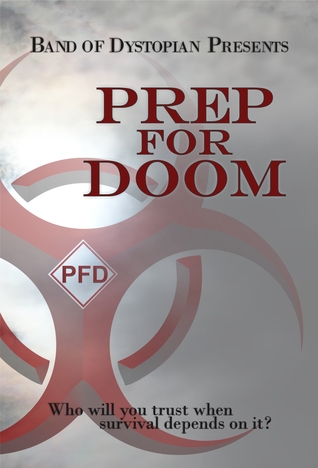
PFD25629151

From the imaginations of twenty authors of dystopian and post-apocalyptic fiction comes PREP FOR DOOM – an integrated collection of short stories that tell the tale of a single catastrophe as experienced by many characters, some of whom will cross paths. What begins with a seemingly innocuous traffic accident soon spirals into a global pandemic. The release of Airborne Viral Hemorrhagic Fever upon New York City’s unsuspecting populace brings bloody suffering within hours, death within a day, and spreads worldwide within a month. An online community called Prep For Doom has risen to the top of a recent doomsday preparation movement. Some have written them off as crazy while others couldn’t be more serious about the safety the preppers could provide in a global disaster. But when AVHF strikes, their preparation may not be enough to save them.


Prep For Doom” is a clever anthology by different authors, each contributing a stand-alone story connected by the pandemic apocalypse, so building into one large story from multiple points of view. The level of collaboration on this project must have been impressive, as is the resulting work.

The characters of each story reflect different reactions to the growing crisis, some more intense and visceral than others. Each protagonist takes the stage in a unique way, and plays out their fate in the disaster – some as victims, some as opportunists, even killers, and some as saviours. Some are committed preppers or have known one for good or bad. But most are ordinary people trying to survive.

Much of the time I was asking how I would react in such a situation. Panic? Help?

Each of the writers tells a facet of the story in their characters’ words. So inevitably, some stories are stronger than others, painting more vivid images. Most wrenched at my emotional responses.

Many characters reappear in other stories, whether in supporting roles or even as people in the ‘crowd’. Some get swept up as casualties, others survive and give hope. Memorably one antagonist is seen in one story from a victim’s viewpoint, yet later another writer vividly shows that antagonist’s desperation and driven fall from survivor to killer.

I wanted to give “Prep for Doom” five stars, but a few things let it down in my opinion.

Setting: although the virus spreads worldwide, we only get to see its impact on US communities, predominantly around the epicentre of New York. The opening chapter is the exception as it’s set somewhere in Africa, but I wanted a few more non-US viewpoints.

Resources: food runs out fast as does water, which makes total sense so some people are surviving on granola bars. The desperate looters feel realistic, but I kept wondering why cell phones worked for so long? Why do some people have the power to keep watching the world die on TV? For a few days perhaps, but this felt longer. Since the hospitals are swamped very quickly, I struggled to believe that some services survived for long. Maybe the emergency facilities are far better than I thought, or Americans are better prepared.

Chronology: inevitably many of the stories start at roughly the same point – the virus release – so the editors will have struggled to place them in order. Unfortunately, at times I was lost and wished there were clearer indicators of time and date in some instances. But most were clear from the words.

Stereotyping: in most cases, the race/sex/religion of the characters didn’t adversely reflect on their actions in an unrealistic way. But one crucial episode grated as the minority concerned gets a trite apology and the story gives them a raw deal. Not wishing to spoil the plot, I will say no more.

Missing elements: there were a few things left unexplained, although maybe there is more to come. For instance, I wanted to know about the initials PFD, which appear throughout and not just for Prep For Doom. Is the link a coincidence, or a reasoned choice?

However, these criticisms are minor and don’t detract from an excellent anthology that I recommend. It has the right blend of realistic actions and reactions, weaving a sense of despair as the reader is carried towards hope.

As to my own post-apocalyptic saga, I feel there are lessons to learn and I will attempt to embrace them.

And for my next read, I am tackling a very different novel in this genre – far bleaker and darker… like grey ash: The Road by Cormac McCarthy.