W is for White House, Washington

W

Throughout the history of the United States, the United Kingdom is the only country to have ever burned the White House or Washington, D.C., and this was the only time since the American Revolutionary War that a foreign power captured and occupied the United States capital.

In the final summer of the War of 1812, the British presence in the Chesapeake region was strengthened by the large numbers of troops arriving after the Napoleonic wars in Europe ended. This diverted the American forces from the frontiers of Upper and Lower Canada, but despite Britain’s strong naval presence in the region, very little was done to protect the small town of Washington. The American secretary of war, John Armstrong, was convinced that Baltimore was the target, and he was half-right as one British attack came there.
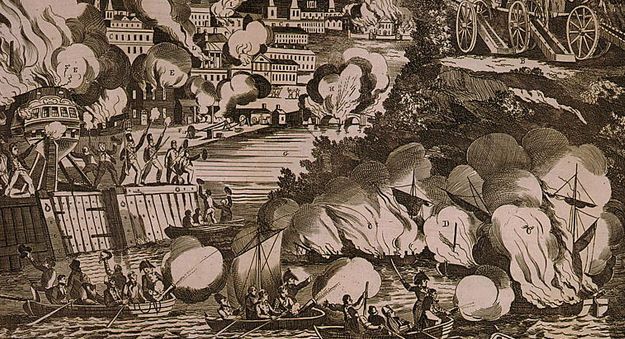
The taking of the city of Washington, wood engraving by G. Thompson, c. 1814 (courtesy Library of Congress/ LC-USZC4-4555)

The taking of the city of Washington, wood engraving by G. Thompson, c. 1814 (courtesy Library of Congress/ LC-USZC4-4555)

However, British forces led by Major General Robert Ross raided the Chesapeake Bay and after defeating the hastily arrayed Americans at the Battle of Bladensburg, the British occupied Washington City on August 24, 1814 and set fire to many public buildings, including the White House (known as the presidential mansion at the time), and the Capitol, as well as other U.S Government facilities including the treasury building, and the navy yard. This action was taken as retaliation against the American destruction of private property in violation of the laws of war, including the Burning of York [present day Toronto] on April 27, 1813, and the Raid on Port Dover.

President James Madison and members of the military and his government fled the city in the wake of the British attack. The Americans’ quick retreat later earned the nickname the “Bladensburg races.”
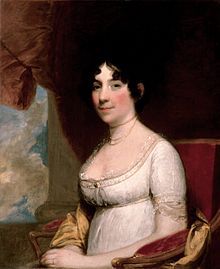
First Lady Dolley Madison

First Lady Dolley Madison

Before leaving, later, the First Lady Dolley Madison and the staff managed to save many of the cabinet records and White House treasures. Nevertheless, the extent of the damages was extreme. James Madison’s personal slave, the fifteen-year-old boy Paul Jennings, was an eyewitness and published his memoir in 1865, considered the first from the White House..

Most contemporary American observers condemned the destruction of the public buildings as needless vandalism. Many of the British public were shocked by the burning of the Capitol and other buildings at Washington; such actions were denounced by most leaders of continental Europe. However, the majority of British opinion believed that the burnings were justified following the damage that United States forces had done with its incursions into Canada.

Further Information:

http://en.wikipedia.org/wiki/Burning_of_Washington

http://www.eighteentwelve.ca/?q=eng/Topic/52

http://en.wikipedia.org/wiki/Dolley_Madison

http://en.wikipedia.org/wiki/Paul_Jennings_(slave)


PREVIOUS A TO Z POSTS

Details on my 2015 A to Z theme and a linked list of posts can be found on my A to Z Challenge page, which also has a linked list of my 2014 posts.

A2Z-BADGE-000 [2015] - Life is Good

The brainchild of Arlee Bird, at Tossing it Out, the A to Z Challenge is posting every day in April except Sundays (we get those off for good behaviour.) And since there are 26 days, that matches the 26 letters of the alphabet. On April 1, we blog about something that begins with the letter “A.” April 2 is “B,” April 3 is “C,” and so on. Please visit other challenge writers.

My theme is ‘The War of 1812’, a military conflict, lasting for two-and-a-half years, fought by the United States of America against the United Kingdom of Great Britain and Ireland, its North American colonies, and its American Indian allies. The Memoirs of a British naval officer from the war is central to my novel “Seeking A Knife” – part of the Snowdon Shadows series.

Further reading on The War of 1812:

http://www.eighteentwelve.ca/?q=eng

http://www.history.com/topics/war-of-1812

http://www.theglobeandmail.com/globe-debate/the-war-of-1812-stupid-but-important/article547554/

http://www.shmoop.com/war-1812/

http://www.pbs.org/wned/war-of-1812/essays/

V is for Voltigeurs

V

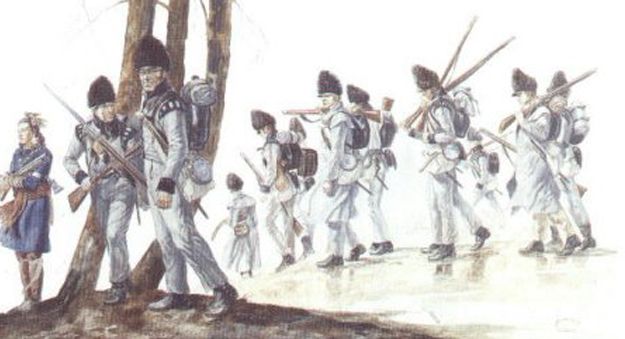
The Canadian Voltigeurs were a light infantry unit, raised in Lower Canada (the present-day Province of Quebec), that fought in the War of 1812. Most colonial forces raised to fight the Americans were English, Irish and Scottish in origin. But French Canada also served, and distinctly.

On 15 April 1812 Sir George Prevost, the Governor General of Canada, authorised the enlistment of a Provincial Corps of Light Infantry under Lieutenant Colonel Charles de Salaberry. The unit, known as the Voltigeurs de Quebec was officially part of the militia, and its enlisted personnel were subject to the Militia laws and ordinances, but for all practical purposes, it was administered on the same basis as the fencible units, also raised in Canada as regular soldiers but liable for service in North America only.

De Salaberry selected members of the leading families of Lower Canada as officers, many related to de Salaberry, though all were treated to his fierce discipline and high standards. Commissions were not confirmed until they had recruited their quota of volunteers. The Voltigeurs were full-time professional soldiers, and had a distinctly “Canadian” pedigree.

Almost all the soldiers and most of the officers were French-speaking, which led to the unit being widely known as the Voltigeurs, a French word meaning “vaulter” or “leaper”, and given to elite light infantry units in the French Army. However, all formal orders on the parade ground or in battle were given in English.

The new unit mustered at Chambly. Quebec. It had eight companies of light infantry, and some Mohawk warriors were attached. Two further companies were recruited from militia of the Eastern Townships of the Montreal district, and officially listed as the ninth and tenth companies, but they formed a separate corps, the Frontier Light Infantry, throughout the war.

Canadian voltigeurs prepare to defend Lacolle Mills during the War of 1812 (painting by G.A. Embleton, courtesy Parks Canada)

Canadian voltigeurs prepare to defend Lacolle Mills during the War of 1812 (painting by G.A. Embleton, courtesy Parks Canada)

Some of the Voltigeurs were in action at the Battle of Lacolle Mills (1812), and early in 1813, three companies were detached under the unit’s second-in-command, Major Frederick Heriot, and moved up the Saint Lawrence River to form part of the garrison of Kingston, the main British base on Lake Ontario. On 29 May, two of these companies took part in the Battle of Sackett’s Harbor. Later in the year, the detachment moved to Fort Wellington at Prescott, and subsequently played an important part in the Battle of Crysler’s Farm.

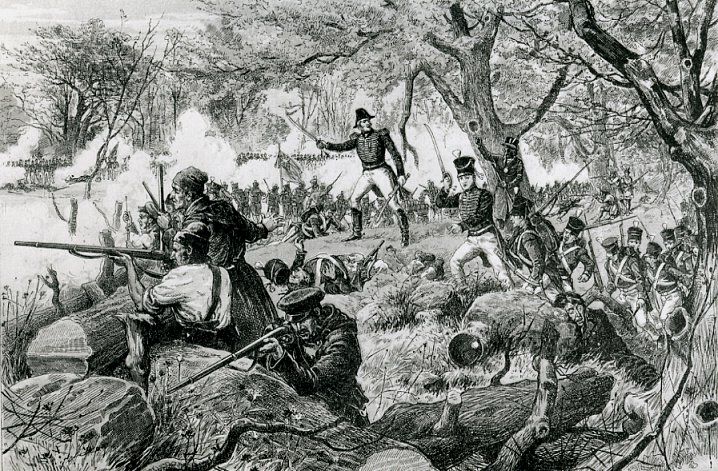
The main body of the unit formed part of a light corps stationed to the south of Montreal, which was commanded by de Salaberry in person. Learning that an American division under Major General Wade Hampton was advancing from New York State, de Salaberry’s force entrenched themselves by the River Chateauguay. On 26 October, Hampton attacked. At the resulting Battle of the Chateauguay, Hampton was repulsed by this all-Canadian force. While primarily a series of skirmishes, the Battle of Chateauguay was a very “Canadian” victory.

Voltigeurs in action at the Battle of the Chateauguay

Voltigeurs in action at the Battle of the Chateauguay

Early in 1814, the entire unit concentrated at Montreal, and was built back up to strength. De Salaberry had been appointed Inspecting Field Officer of Militia, and Major Heriot became the Voltigeurs’ acting Commanding Officer. The Voltigeurs were brigaded with the Frontier Light Infantry, and another militia light infantry unit, the Canadian Chasseurs. The combined light infantry force formed part of a brigade under Major General Thomas Brisbane during the Battle of Plattsburgh, where the British army retreated after its supporting naval squadron was destroyed. On the end of the war, the unit was disbanded, on 24 May, 1815.

The current Les Voltigeurs de Québec today perpetuate the history and traditions of the Canadian Voltigeurs within the Canadian Army.

Further Information:

http://www.eighteentwelve.ca/?q=eng/Topic/17

http://en.wikipedia.org/wiki/Canadian_Voltigeurs

PREVIOUS A TO Z POSTS

Details on my 2015 A to Z theme and a linked list of posts can be found on my A to Z Challenge page, which also has a linked list of my 2014 posts.

 A2Z-BADGE-000 [2015] - Life is Good

The brainchild of Arlee Bird, at Tossing it Out, the A to Z Challenge is posting every day in April except Sundays (we get those off for good behaviour.) And since there are 26 days, that matches the 26 letters of the alphabet. On April 1, we blog about something that begins with the letter “A.” April 2 is “B,” April 3 is “C,” and so on. Please visit other challenge writers.

My theme is ‘The War of 1812’, a military conflict, lasting for two-and-a-half years, fought by the United States of America against the United Kingdom of Great Britain and Ireland, its North American colonies, and its American Indian allies. The Memoirs of a British naval officer from the war is central to my novel “Seeking A Knife” – part of the Snowdon Shadows series.

Further reading on The War of 1812:

http://www.eighteentwelve.ca/?q=eng

http://www.history.com/topics/war-of-1812

http://www.theglobeandmail.com/globe-debate/the-war-of-1812-stupid-but-important/article547554/
http://www.shmoop.com/war-1812/

http://www.pbs.org/wned/war-of-1812/essays/

U is for United States Navy

U

The United States Navy saw substantial action in the War of 1812, where it was victorious in eleven single-ship duels with the Royal Navy. The navy drove all significant British forces off Lake Erie and Lake Champlain and prevented them from becoming British controlled zones of conflict. The result was a major defeat for the British invasion of New York State, and the defeat of the military threat from the Indian allies of the British. Despite this, the U.S. Navy was unable to prevent the British from blockading American ports and landing troops on American soil.

Various U.S. Navy vessels played notable roles in the War, but this focuses on three of them:

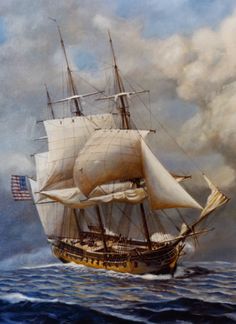
USS Constellation by John W. Schmidt

USS Constellation by John W. Schmidt

USS Constellation was a 38-gun frigate, one of the “Six Original Frigates” authorized for construction by the Naval Act of 1794. She was distinguished as the first U.S. Navy vessel to put to sea and the first U.S. Navy vessel to engage and defeat an enemy vessel. Constructed in 1797, she was decommissioned in 1853. On June 22, 1813, her crew played a crucial role in the Battle of Craney Island. The American victory at Craney Island saved Norfolk and Portsmouth from being captured and pillaged by the enemy.

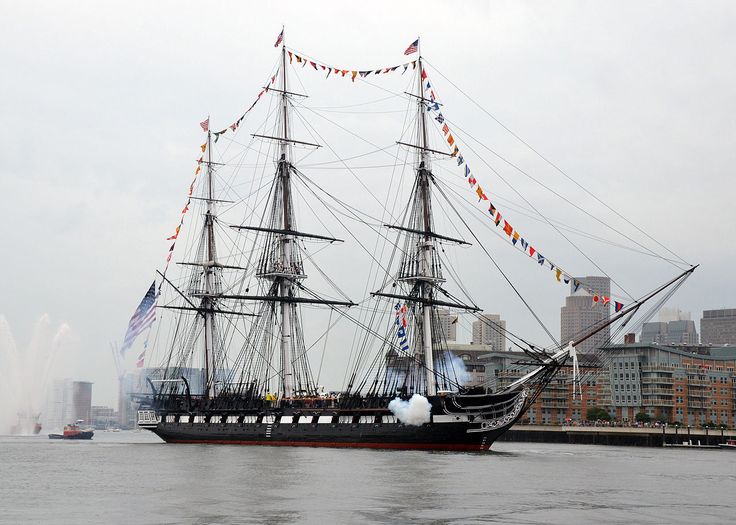
BOSTON (July 4, 2014) USS Constitution fires a 17-gun salute near U.S. Coast Guard Base Boston during the ship's Independence Day underway demonstration in Boston Harbor. Constitution got underway with more than 300 guests to celebrate America's independence. (U.S. Navy photo by Seaman Matthew R. Fairchild/Released) 

BOSTON (July 4, 2014) USS Constitution fires a 17-gun salute near U.S. Coast Guard Base Boston during the ship’s Independence Day underway demonstration in Boston Harbor. Constitution got underway with more than 300 guests to celebrate America’s independence. (U.S. Navy photo by Seaman Matthew R. Fairchild/Released)

USS Constitution is a wooden-hulled, three-masted heavy frigate, named by President George Washington after the Constitution of the United States of America. The boat is the world’s oldest commissioned naval vessel afloat.[Note 1] Launched in 1797, Constitution , like USS Constellation, was one of the “Six Original Frigates”. Joshua Humphreys designed the frigates to be the young Navy’s capital ships, and so Constitution and her sisters were larger and more heavily armed and built than standard frigates of the period. Constitution is most famous for her actions during the War of 1812, when she captured numerous merchant ships and defeated five British warships: HMS GuerriereJavaPictouCyane, and Levant. The battle with Guerriere earned her the nickname of “Old Ironsides” and public adoration that has repeatedly saved her from scrapping.

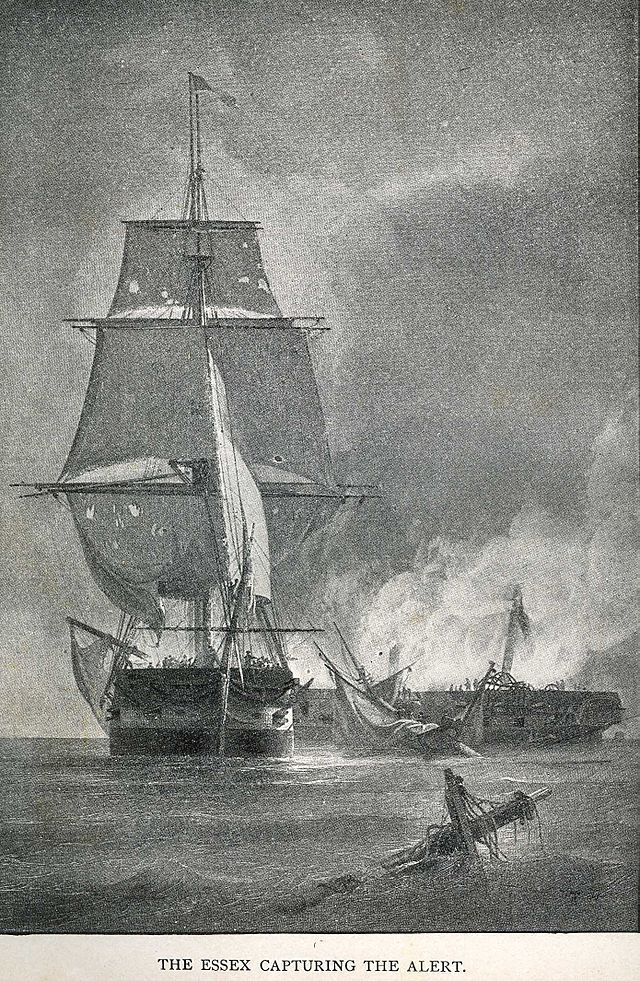
USS Essex capturing Alert. 13 August 1812 - Wikipedia, the free encyclopedia

USS Essex capturing Alert. 13 August 1812 – Wikipedia, the free encyclopedia 

The first USS Essex participated in the Quasi-War with France, the First Barbary War, and in the War of 1812. When war was declared, the 32 gun frigate, commanded by Captain David Porter, made a successful cruise to the southward. By September, when she returned to New York, Essex had taken ten prizes, including the sloop HMS Alert. The youngest member of the Essex crew was 10-year-old midshipman David Glasgow Farragut, who would become the first admiral of the US Navy.

Essex sailed into South Atlantic waters and along the coast of Brazil until January 1813, decimating the British whaling fleet in the Pacific, and capturing thirteen British whalers. In January 1814, Essex sailed into neutral waters at Valparaíso, Chile, only to be trapped there by the British frigate, HMS Phoebe, and the sloop-of-war HMS Cherub. On 28 March 1814, in the Battle of ValparaisoEssex, armed almost entirely with powerful, but short range carronades, resisted the superior British fighting power and longer gun range for over 2 hours. Eventually, the hopeless situation forced Porter to surrender.  The captured frigate then served as HMS Essex until sold at public auction on 6 June 1837.

Patrick O’Brian adapted the story of Essex‍ ’​s attack on British whalers for his novel The Far Side of the World.

Further Information: 

http://en.wikipedia.org/wiki/United_States_Navy

http://en.wikipedia.org/wiki/USS_Constellation_(1797)

http://en.wikipedia.org/wiki/USS_Constitution

http://en.wikipedia.org/wiki/USS_Essex_(1799)

http://www.army.mil/article/98107

PREVIOUS A TO Z POSTS

Details on my 2015 A to Z theme and a linked list of posts can be found on my A to Z Challenge page, which also has a linked list of my 2014 posts.

A2Z-BADGE-000 [2015] - Life is Good

The brainchild of Arlee Bird, at Tossing it Out, the A to Z Challenge is posting every day in April except Sundays (we get those off for good behaviour.) And since there are 26 days, that matches the 26 letters of the alphabet. On April 1, we blog about something that begins with the letter “A.” April 2 is “B,” April 3 is “C,” and so on. Please visit other challenge writers.

My theme is ‘The War of 1812’, a military conflict, lasting for two-and-a-half years, fought by the United States of America against the United Kingdom of Great Britain and Ireland, its North American colonies, and its American Indian allies. The Memoirs of a British naval officer from the war is central to my novel “Seeking A Knife” – part of the Snowdon Shadows series.

Further reading on The War of 1812:

http://www.eighteentwelve.ca/?q=eng

http://www.history.com/topics/war-of-1812

http://www.theglobeandmail.com/globe-debate/the-war-of-1812-stupid-but-important/article547554/
http://www.shmoop.com/war-1812/

http://www.pbs.org/wned/war-of-1812/essays/

S is for Secord

S

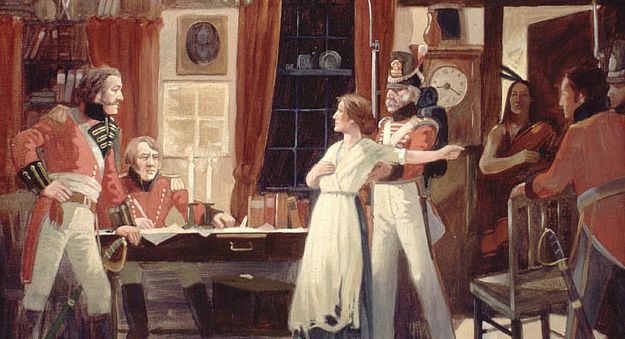
Laura Secord (née Ingersoll; 13 September 1775 – 17 October 1868) was a Canadian heroine of the War of 1812.  Born in Massachusetts and the daughter of a Revolutionary War patriot, Laura Secord might be an unlikely Canadian icon. But on the evening of June 21, 1813, the 37-year-old wife of a Canadian Loyalist soldier and mother of five learned of secret American plans to ambush a nearby British outpost. But her husband James Secord was bedridden after being seriously wounded at the Battle of Queenston Heights. However, Laura hiked across 20 miles (32 km) out of American-occupied territory, through swamps and forests to warn the British, being helped by a group of First Nations men she encountered along the way. She reached Lieutenant James FitzGibbon in the territory that the British still controlled. The information helped the British and their Mohawk warrior allies repel the invading Americans at the Battle of Beaver Dams.

Meeting between Laura Secord and Lieutenant FitzGibbon, June 1813 (painting by Lorne Kidd Smith, courtesy Library and Archives Canada/C-011053)

Meeting between Laura Secord and Lieutenant FitzGibbon, June 1813 (painting by Lorne Kidd Smith, courtesy Library and Archives Canada/C-011053)

The official reports of the victory made no mention of Laura Secord. Laura never revealed how she came to know of the American plan, and while she did take a message to FitzGibbon, it is uncertain if she arrived ahead of Aboriginal scouts who also brought the news. FitzGibbon’s report on the battle noted: “At [John] De Cou’s this morning, about seven o’clock, I received information that . . . the Enemy . . . was advancing towards me . . . .” However, FitzGibbon did provide written testimony in support of the Secords’ later petition to the government for a pension, in 1820 and 1827.

Her action was forgotten until 1860, when the future king Edward VII awarded the impoverished widow £100 for her service. Since her death she has been frequently honoured in Canada, taking on mythological overtones. Her tale has been the subject of books, plays, and poetry, often with many embellishments. Since her death, Canada has bestowed honours on her, including schools named after her, monuments, commemorative chocolates, a museum, a memorial stamp and coin, and a statue at the Valiants Memorial in Ottawa.

Further Information:

http://www.eighteentwelve.ca/?q=eng/Topic/43

http://en.wikipedia.org/wiki/Laura_Secord


PREVIOUS A TO Z POSTS

Details on my 2015 A to Z theme and a linked list of posts can be found on my A to Z Challenge page, which also has a linked list of my 2014 posts.

A2Z-BADGE-000 [2015] - Life is Good

The brainchild of Arlee Bird, at Tossing it Out, the A to Z Challenge is posting every day in April except Sundays (we get those off for good behaviour.) And since there are 26 days, that matches the 26 letters of the alphabet. On April 1, we blog about something that begins with the letter “A.” April 2 is “B,” April 3 is “C,” and so on. Please visit other challenge writers.

My theme is ‘The War of 1812’, a military conflict, lasting for two-and-a-half years, fought by the United States of America against the United Kingdom of Great Britain and Ireland, its North American colonies, and its American Indian allies. The Memoirs of a British naval officer from the war is central to my novel “Seeking A Knife” – part of the Snowdon Shadows series.

Further reading on The War of 1812:

http://www.eighteentwelve.ca/?q=eng

http://www.history.com/topics/war-of-1812

 http://www.theglobeandmail.com/globe-debate/the-war-of-1812-stupid-but-important/article547554/

http://www.shmoop.com/war-1812/

http://www.pbs.org/wned/war-of-1812/essays/

R is for Rottenburg

R

Baron Francis de Rottenburg (1757–1832) was a Swiss-born officer and colonial administrator who served in the French army 1782-1791, and then joined the British army in 1795. He was promoted to Major General and assumed command of the Montreal district when the War of 1812 broke out. This was an important post because of its location on the St Lawrence River and its close proximity to the American border.

In June 1813, he succeeded Major General Sir Roger Hale Sheaffe as military and civil commander in Upper Canada. He was accused of neglecting civil duties and of being unduly cautious in his military decisions. Rottenburg’s main concern was to preserve the army, and he was prepared to withdraw his forces to Kingston, a potential target for an American attack, if Sir James Yeo lost naval control of Lake Ontario. Nevertheless, Rottenburg ordered probing attacks against the American occupiers of Fort George and the town of Niagara as well as raids across the Niagara River. However, his refusal to send reinforcements to Major General Henry Procter, commanding on the Detroit frontier, contributed to the British defeats at the Battle of Lake Erie and the Battle of Moraviantown.

Colonel Francis de Rottenburgs 1799 work Regulations for the Exercise of Riflemen and Light Infantry, and Instructions for their Conduct in the Field was widely consulted by officers during the War of 1812.

Colonel Francis de Rottenburg’s 1799 work “Regulations for the Exercise of Riflemen and Light Infantry, and Instructions for their Conduct in the Field” was widely consulted by officers during the War of 1812.

By early November he knew an American army was proceeding down the St Lawrence River against Montréal and he ordered Lieutenant Colonel Joseph Morrison to pursue the invaders. Morrison defeated part of the army at Crysler’s Farm on 11 November 1813.

The partial martial law that Rottenburg imposed in the Eastern and Johnstown districts, to force farmers to sell food and forage to the army, was an unpopular move which his successor repealed but was nevertheless forced to re-impose upon all of Upper Canada.

In December 1813, Rottenburg was succeeded by Lieutenant General Sir Gordon Drummond, and returned to his previous posts in Lower Canada. Later in 1814, when substantial British reinforcements arrived in Canada. Sir George Prevost prepared to invade the United States by way of Lake Champlain. He placed Rottenburg in command of a division of three brigades. However, Prevost personally led the campaign, which was defeated at the Battle of Plattsburgh. However, Rottenburg played no conspicuous part in the battle, with the result that he was not touched by the chorus of criticism that descended on Prevost, in part from the three brigade commanders, all of whom had seen action in the Peninsular War. In fact, Rottenburg served as president of Procter’s court martial.

Rottenburg remained in Lower Canada until July 1815 when he returned to England, where he died in 1832.

Baron Francis de Rottenburg

Baron Francis de Rottenburg

Further Information:

http://www.biographi.ca/en/bio.php?BioId=37228

http://www.eighteentwelve.ca/?q=eng/Topic/93

http://en.wikipedia.org/wiki/Francis_de_Rottenburg

http://en.wikipedia.org/wiki/Battle_of_Plattsburgh#Land_battle

PREVIOUS A TO Z POSTS

Details on my 2015 A to Z theme and a linked list of posts can be found on my A to Z Challenge page, which also has a linked list of my 2014 posts.

A2Z-BADGE-000 [2015] - Life is Good

The brainchild of Arlee Bird, at Tossing it Out, the A to Z Challenge is posting every day in April except Sundays (we get those off for good behaviour.) And since there are 26 days, that matches the 26 letters of the alphabet. On April 1, we blog about something that begins with the letter “A.” April 2 is “B,” April 3 is “C,” and so on. Please visit other challenge writers.

My theme is ‘The War of 1812’, a military conflict, lasting for two-and-a-half years, fought by the United States of America against the United Kingdom of Great Britain and Ireland, its North American colonies, and its American Indian allies. The Memoirs of a British naval officer from the war is central to my novel “Seeking A Knife” – part of the Snowdon Shadows series.

Further reading on The War of 1812:

http://www.eighteentwelve.ca/?q=eng

http://www.history.com/topics/war-of-1812

 http://www.theglobeandmail.com/globe-debate/the-war-of-1812-stupid-but-important/article547554/
http://www.shmoop.com/war-1812/

http://www.pbs.org/wned/war-of-1812/essays/

B is for Brock

B

Major-General Sir Isaac Brock KB (6 October 1769 – 13 October 1812) was a British Army officer and administrator, who was assigned to Lower Canada in 1802. Despite facing desertions and near-mutinies, he commanded his regiment in Upper Canada (present-day Ontario) successfully for many years. He was promoted to major general, and became responsible for defending Upper Canada against the United States. While many in Canada and Britain believed war could be averted, Brock began to ready the army and militia for what was to come. To this end he oversaw improvements to the fortifications at Quebec and improved the Provincial Marine which was responsible for transporting troops and supplies on the Great Lakes. Though appointed brigadier general in 1807 by Governor General Sir James Henry Craig, Brock was frustrated by a lack of supplies and support.

However, he worked to alter the militia act to expand his forces and began building relationships with Native American leaders such as the Shawnee chief Tecumseh, and nations such as the Anishinaabe. Brock felt that British military fortunes were bleak. In Upper Canada, he possessed only 1,200 regulars which were supported by around 11,000 militia. As he doubted the loyalty of many Canadians, he believed only around 4,000 of the latter group would be willing to fight. Despite this outlook, when the War broke out, the populace was prepared, and quick victories at Fort Michilimackinac and Detroit defeated American invasion efforts.

Brock’s actions, particularly his success at Detroit, earned him a knighthood, membership in the Order of the Bath, accolades and the sobriquet “The Hero of Upper Canada”.

Brock died at the Battle of Queenston Heights. Leading two companies of the 49th Regiment and two companies of York militia, he charged up the heights assisted by aide-de-camp Lieutenant Colonel John Macdonell. In the attack, Brock was struck in the chest and killed, as was his aide who died in a second charge. However the battle was eventually a British victory. [Q will be for Queenston]

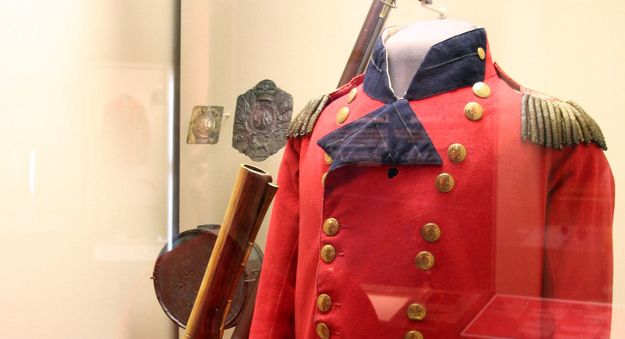
Twelve years after Brock’s death, a 130 foot stone monument was erected in his honour on the heights near the spot where he was killed. His remains, as well as those of Macdonell, were reburied beneath the monument in an elaborate ceremony attended by many of his contemporaries. In 1840, the monument was destroyed by a massive blast of gunpowder, ignited by an American sympathizer. The monument was subsequently rebuilt in 1856, 52 feet taller than before. Today, the monument, which now straddles the longest undefended border in the world, remains one of the most imposing historical landmarks in Canada. Relics of Brock’s career can be seen at the Canadian War Museum in Ottawa, where his bullet-pierced tunic is prominently on display.

ff494dbde08a47201535fa8f3fca5945

The coat worn by Major General Sir Isaac Brock at the time of his death at Queenston Heights on 13 October 1812. On display at the Canadian War Museum, the bullet hole is evident under the lapel (courtesy Archives of Ontario/S1427)

http://www.eighteentwelve.ca/?q=eng/Topic/16

http://en.wikipedia.org/wiki/Isaac_Brock

http://militaryhistory.about.com/od/1800sarmybiographies/p/War-Of-1812-Major-General-Sir-Isaac-Brock.htm

http://www.warof1812.ca/brock.htm

A2Z-BADGE-000 [2015] - Life is Good

The brainchild of Arlee Bird, at Tossing it Out, the A to Z Challenge is posting every day in April except Sundays (we get those off for good behaviour.) And since there are 26 days, that matches the 26 letters of the alphabet. On April 1, we blog about something that begins with the letter “A.” April 2 is “B,” April 3 is “C,” and so on. Please visit other challenge writers.

My theme is ‘The War of 1812’, a military conflict, lasting for two-and-a-half years, fought by the United States of America against the United Kingdom of Great Britain and Ireland, its North American colonies, and its American Indian allies. The Memoirs of a British naval officer from the war is central to my novel “Seeking A Knife” – part of the Snowdon Shadows series.

Further reading on The War of 1812:

http://www.eighteentwelve.ca/?q=eng

http://www.theglobeandmail.com/globe-debate/the-war-of-1812-stupid-but-important/article547554/