E is for Embabeh

A2Z-BADGE-100 [2017]

My 2017 theme is “The History of Kanata”, the parallel world that is the setting for “Eagle Passage, and the theme reveal is here. I also wrote about this world in my blog post ‘This could be Kanata.

E (1)

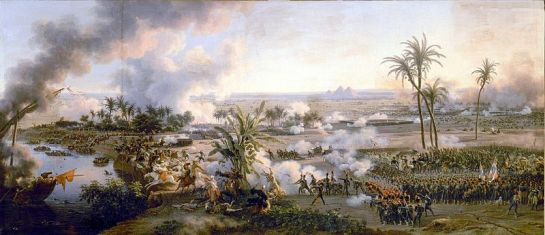
E is for Embabeh: In 1798, the French Republic sought to capture Egypt as the first stage to threaten Albion-Norse trade in the East, and thus force them to make peace. Napoleon Bonaparte’s first target was the island of Malta, which was under the government of the Knights of St. John and granted its owner control of the Central Mediterranean. As a major location on the trading routes, the harbour of Valletta was a key location. Bonaparte’s forces landed on the island but were repelled by the Knights and a garrison of Mjölnir militia defending Anglo-Norse interests.

Napoleon sailed and landed at Alexandria, meeting the forces of the two local Mamluk rulers at the Battle of Embabeh, on July 21st. He planned to keep the two Georgian Mamluk armies divided by fighting on one bank of the Nile, but Mjölnir militia transported the second stranded army across and helped rout the French. Meanwhile, the Albion navy under Rear-Admiral Sir Horatio Nelson defeated the French navy at Aboukir Bay and the Battle of the Nile.

Although Napoleon fled to France, he engineered a coup in November 1799 and became First Consul of the Republic. His ambition inspired him to go further, and in 1804 he became the first Emperor of the French. However, Albion led a successful coalition to restrict his attempted invasions out of France.

Louis-François_Baron_Lejeune_001

Bataille des Pyramides (1808) – Louis-Francois, Baron Lejeune (1775-1848)

In our timeline: Wikipedia – The Mediterranean campaign of 1798 was a series of major naval operations surrounding a French expeditionary force sent to Egypt under Napoleon Bonaparte during the French Revolutionary Wars. The French Republic sought to capture Egypt as the first stage in an effort to threaten British India, and thus force Great Britain to make peace. Departing Toulon in May 1798 with over 40,000 troops and hundreds of ships, Bonaparte’s fleet sailed southeastwards across the Mediterranean Sea. They were followed by a small British squadron under Rear-Admiral Sir Horatio Nelson, later reinforced to 13 ships of the line… Bonaparte’s first target was the island of Malta, which was under the government of the Knights of St. John and theoretically granted its owner control of the Central Mediterranean. Bonaparte’s forces landed on the island and rapidly overwhelmed the defenders, securing the port city of Valletta before continuing to Egypt.

[After landing in Egypt and fighting a minor skirmish, Napoleon advanced on Alexandria.] On 2 Thermidor (20 July), the French army arrived half a mile from the village of Embabé. The heat was unbearable and the army was exhausted and needed a rest, but there was not enough time and so Bonaparte drew up his 25,000 troops for battle approximately nine miles (15 km) from the Pyramids of Giza… This was the start of the so-called Battle of the Pyramids, [also known as the Battle of Embabeh], a French victory over an enemy force of about 21,000 Mamluks. (Around 40,000 Mamluk soldiers stayed away from the battle.) The French defeated the Mamluk cavalry with a giant infantry square, with cannons and supplies safely on the inside. In all 300 French and approximately 6,000 Egyptians were killed. The battle gave rise to dozens of stories and drawings.

On the scientific front, the expedition led to the discovery of the Rosetta Stone, creating the field of Egyptology. Despite many decisive victories and an initially successful expedition into Syria, Napoleon and his Armée d’Orient were eventually forced to withdraw, after sowing political disharmony in France, experiencing conflict in Europe, and suffering the defeat [by Horatio Nelson] of the supporting French fleet at the Battle of the Nile.

However, could events have taken a different course? Napoleon did engineer the coup and later became the Emperor of the French and then invaded successive countries. But who could have stopped him before the retreat from Moscow, or later before Waterloo?

***

Important Links for the A to Z Challenge – please use these links to find other A to Z Bloggers

Website: http://www.a-to-zchallenge.com

Facebook page: https://www.facebook.com/atozchallenge/

Twitter handle: @AprilAtoZ

Twitter hashtag: #atozchallenge

B is for Bouvines

A2Z-BADGE-100 [2017]

My 2017 theme is “The History of Kanata”, the parallel world that is the setting for “Eagle Passage, and the theme reveal is here. I also wrote about this world in my blog post ‘This could be Kanata.

B

B is for Bouvines: 1214 – A dynasty of Norse-Anglo-Saxons has ruled Albion [Great Britain] for over one hundred and fifty years after some settlers from Kanata ensured the dynasty of Cnut the Great continued. King Arthur II of Albion and his allies in Normandy and Anjou face a claim by Phillipe of France on their French territories. On 27 July 1214, backed by the Holy Roman Emperor, Otto IV. the Albion infantry along with the might of their Mjölnir Militia and the Norman cavalry, prevails at the Battle of Bouvines, leaving the French struggling for allies. Bouvines shifts the balance of power in Europe, but can the nation states avoid war sweeping across the continent or can the extensive Norse trade network from Kanata to Constantinople hold sway?

Mjölnir is the hammer of Thor, worn as an amulet by many Viking warriors, although the bow symbol of the goddess Skaði was favoured by her followers. The Mjölnir Militia arose in Kanata to protect the trading settlements not as Viking marauders. The militia had a strict code of honour and indigenous warriors joined their ranks willingly. A detachment of the Mjölnir Militia was instrumental in ensuring that Cnut the Great’s dynasty continued in 1036, having amalgamated with the legendary Jomsvikings at the request of Magnus I of Norway.


712px-St_Pol

Stained glass inside St. Peter’s church, in Bouvines, Nord. France: Saint-Pol endangers the Flemish army. Photo – Copyright Benjamin Smith / Wikimedia Commons


In our timeline: Wikipedia – The Battle of Bouvines, which took place on 27 July 1214, was a medieval battle which ended the 1202–1214 Anglo-French War. It was fundamental in the early development of France in the Middle Ages by confirming the French crown’s sovereignty over the Angevin lands of Brittany and Normandy.

Philip Augustus of France defeated an army consisting of Imperial German, English and Flemish soldiers, led by Otto IV, Holy Roman Emperor in the north…and King John of England, Otto’s maternal uncle and ally. Allied with Philip was Frederick II Hohenstaufen, who controlled the southern Holy Roman Empire and afterwards deposed Otto.

Philip returned to Paris triumphant, marching his captive prisoners behind him in a long procession, as his grateful subjects came out to greet the victorious king. In the aftermath of the battle, Otto retreated to his castle of Harzburg and was soon overthrown as Holy Roman Emperor by Frederick II, who had already been recognised as emperor in the south a year and a half prior.

King John obtained a five-year truce, on very lenient terms given the circumstances.

Philip’s decisive victory was crucial in ordering politics in both England and France. In the former, so weakened was the defeated King John of England that he soon needed to submit to his barons’ demands and agree to the Magna Carta, limiting the power of the crown and establishing the basis for common law.[19] In the latter, the battle was instrumental in forming the strong central monarchy that would characterize France until the first French Revolution. It was also the first battle in the Middle Ages in which the full value of infantry was realised.

Philip conquered most of Plantagenet’s continental possessions, namely AnjouBrittanyMaineNormandy, and the Touraine, leading to the effective end of the Angevin Empire.


***

Important Links for the A to Z Challenge – please use these links to find other A to Z Bloggers

Website: http://www.a-to-zchallenge.com

Facebook page: https://www.facebook.com/atozchallenge/

Twitter handle: @AprilAtoZ

Twitter hashtag: #atozchallenge

A is for Aquidneck

A2Z-BADGE-100 [2017]

My 2017 theme is “The History of Kanata”, the parallel world that is the setting for “Eagle Passage, and the theme reveal is here. I also wrote about this world in my blog post ‘This could be Kanata’.

A

A is for Aquidneck Island: On 28th September 1638, Samuel Hopkins and his congregation of Separatist settlers are welcomed by the Migisi clan mother, Klasina to discuss their needs, including land requirements. Klasina has called a gathering of local sachems or chief from various indigenous tribes. The Migisi are attempting to stop the spread of firearms. The Vikings, guided by the goddess Skaði, have learnt about the dangers of armed factions from their experiences in Europe, as well as encounters with the Iroquois League and the Council of the Three Fires. The native alliances acted as a nonaggression pact that provided their closely related bands or tribes with peace in their backyards but allowed them to fight outsiders. However, occasional unresolved disputes erupted into wars that the Migisi clan wish to restrict while encouraging the trade in goods that help the tribes thrive.

Samuel and his fellow Congregationalists are offered hospitality and invited to participate in their harvest celebrations. Samuel is stunned to discover that Klasina’s father was a Dutch trader that married her Migisi mother. When his religious morality questions this pagan-Christian alliance, he reminds himself, “If the church-burning Vikings have learnt to live with the natives, even inter-marry, then I must adjust my attitudes.” But will his soul be moved by the clan mother’s daughter, Kateri who wears a pagan bow pendant?  When he discovers that the bow is the symbol of her goddess Skaði that guided the Vikings to settle in Kanata, he is forced to remember that some Christians wear a plain cross around their necks. But that is not the way to show one’s faith.


Miantonomoh_Monument_2

Photo of the Miantonomoh Monument – Karen L. Houle (Wikimedia Commons)


In our timeline: WikipediaEnglish colonists first settled on present-day Aquidneck Island in 1638 in the region called by the natives “Pocasset” (meaning “where the stream widens”)… At one time, Aquidneck Island was controlled by the Wampanoags, whose leader was Sachem Massasoit. Traditionally, Massasoit greeted the Pilgrims at Plymouth, Massachusetts in 1621… A group of European settlers engaged Roger Williams in 1638 to negotiate the terms of their purchase of the island from a sachem named Miantonomi.

Aeon – In early Quebec, Jamestown and Plymouth, colonists held an advantage in firearms only for a handful of years before Native people began building their own arsenals… Except under the rarest circumstances, no one state authority had the ability to choke Indians off from guns, powder and shot… Native tribes competed furiously to control emerging gun markets. They knew that firearms were the new key to military and political dominance, and if they did not seize the opportunity, their enemies would. As a result, indigenous arms races erupted across North America… Indians saw the colonies as potential trade partners, especially for firearms, and new, powerful allies to direct against their Native rivals. https://aeon.co/essays/how-did-the-introduction-of-guns-change-native-america?utm_source=Aeon+Newsletter&utm_campaign=77c10692cb-Daily_Newsletter_13_October_201610_12_2016&utm_medium=email&utm_term=0_411a82e59d-77c10692cb-68908769

In our timeline, the Europeans encouraged the conflicts between the tribes, in certain cases resulting in tribes being decimated and their lands acquired often by Europeans.

Could an early Viking involvement, led by traders, not warriors, have influenced the ways that the indigenous people settled their disputes, especially 500 years before other Europeans arrived?

***

Important Links for the A to Z Challenge – please use these links to find other A to Z Bloggers

Website: http://www.a-to-zchallenge.com

Facebook page: https://www.facebook.com/atozchallenge/

Twitter handle: @AprilAtoZ

Twitter hashtag: #atozchallenge


A to Z Challenge Theme Reveal


 thmrevel

After my complex and demanding theme in 2016, I’m reverting to the approach that I took in 2014 and 2015 – a theme related to a ‘work in progress’.

So, my theme is “The History of Kanata”, the parallel world that is the setting for “Eagle Passage, and if there are more books, “The Manitou Mark” series. I wrote about this world in my blog post ‘This could be Kanata’, and that was a good summary of where the project was mid-December before I did more research.

The main plot of the novel is set in 2020 Kanata – the name originates from a St. Lawrence Iroquoian word, ‘kanata’ meaning village or settlement. This novel is alternative history with a dose of mystery, thriller, and a touch of spirituality. Spirituality as the heroine, Torill Migisi has latent shamanic powers that have been passed on for generations down the matrilineal line that leads her clan.

Torill’s great-grandmother, Chepi, appoints Torill as the next Matriarch to head the Migisi clan and the family’s successful trading corporation, Migisi Rederi, from Stadacona [Quebec City].  However, she puts off her calling, agreeing instead to transport a mysterious cargo for her brother, Andor, by high-tech airship. Airships are the primary means of global travel and planes are less advanced.


Torill discovers that the cargo is a jet plane dredged from Lake Gichigami [Lake Superior], and then someone murders her great-grandmother. Torill and her airship’s crew are forced to escape the authorities who believe she is the killer and is smuggling illegal arms that could trigger a continental war. Why has the plane got the star markings of their neighbour, the Dixie States? This can’t be the plane that Chepi crashed in Gichigami in 1945. What can Torill do if this jet was Chepi’s plane?

The main plot intersperses with stories about the Migisi ancestors involved with the development of the Kanatian world. I will blog each day in April on a key historical event that changed our world into Kanata. For now, I will give you the initial event that set this alternative timeline in motion.


In December 1000 AD, Leif Eriksson is wintering in the settlement called Leifsbúðir on an island he has discovered west of Greenland. A Sámi slave, Arnbjörg notices that Leif’s old foster-father, Tyrkir is missing and searches for him. Fearing that the old retainer is in danger, she alerts Finnr, the bard presumed to be her father, and he tells Leif. Tyrkir is eventually found, drunk from eating the ‘grapes’ he has picked from some vines. Arnbjörg and Tyrkir identify the fruit as a variety of lingonberries. Leif calls the island Vineland, but his most aggressive followers advice fighting the natives and leaving.

However, Arnbjörg has a shamanic vision in which the goddess Skaði shows her what the land could yield if the Vikings stay and co-operate with the indigenous people. Skaði gives Arnbjörg her divine bow, with which she can convince Leif to remain.

A year later, when the settlers are establishing a trading post at Stadacona, Arnbjörg meets and marries a Chippewa native, Misko Etchemin of the Migisi clan. She becomes the spiritual leader of the Migisi clan and a driving force behind their trade ventures. The rest is history – or rather alternative history.

So, please follow my ‘History of Kanata’ next month in the Blogging from A to Z Challenge 2017.

Important Links for the A to Z Challenge – use these to find other A to Z Bloggers


The Liebster Award

liebster-award-main

I hinted yesterday that today’s post would be a response to some good news. Sarah Zama from The Old Shelter nominated me for the Liebster Award. Her A to Z blog on the Jazz Age Jazz was entertaining and informative. And her Reflections post is a must-read for the advice on preparing for A to Z – there’s a lot there that I’ll be attempting to take on-board

I always get both nervous and excited when I’m nominated for such an award, especially from a blogger that I respect. Excited about the recognition – nervous as I need to deal with some crucial questions.

This is actually the second time that I have been nominated for the Liebster – first was way back in October 23, 2013, so my answers may have changed since then.

Rules of the Liebster Award

If you have been nominated for The Liebster Award and you chose to accept it, write a blog post about the Liebster Award in which you:

  • Thank the person who nominated you, and post a link to their blog in your post.
  • Display the award on your blog — by including it in your post and/or displaying it using a “widget” or a “gadget”.
  • Answer 11 questions about yourself, which will be provided to you by the person who nominated you.
  • Provide 11 random facts about yourself.
  • Nominate 5 – 11 blogs that you feel deserve the award, who have a less than 1000 followers. [Some claim that this is a flexible rule, so I’m ignoring it. In fact, I don’t qualify. 😉 ]
  • Create a new list of questions for the nominees to answer
  • List these rules in your post (copy and paste from here). Once you have written and published it, you then have to:
  • Inform the people/blogs that you nominated that they have been nominated for the Liebster Award and provide a link for them to your post so that they can learn about it (they might not have ever heard of it!)

bakingbabybrownliebster

11 questions Sarah asked me

  1. When your started your blog, did you know what you were doing?

It was trial and error, but it always will be as the learning process never stops – no exceptions. I started when I began following blog-maestro Robert Lee Brewer  and his introduction to creating a Writer’s Platform. His ‘challenge’ took me through the early stages of blogging and social media.

  1. Many writers I know tell me they don’t blog because they prefer to write their own stories. Why do you?

Blogging for me is not the same as creating my fictional stories. The posts are a chance to address other issues from writing quandaries to health issues. However, a few posts do stray into fictional areas, such as my interviews with characters in my novels, and this year’s A to Z mystery.

  1. Do you plan your posts?

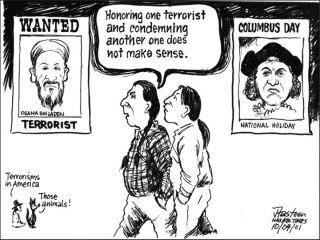
I start scribbling ideas for posts days ahead of when I want to schedule them. I have a black notebook with sketched out ideas, some of which have yet to be developed – like “The First Terrorists”. As the scheduled day approaches, I select the most appropriate idea. Right now I have a review of “The Road” imminent.

  1. Do you stick to a posting schedule?

I have a flexible posting schedule of a weekly post on Tuesday or Wednesday. There’s no particular theme as my readers went for Pick N’Mix. At the moment, that’s enough of a commitment. Looking way ahead, I might have to schedule “The First Terrorists” for October 10th (Columbus Day), especially as this desktop will be in transit to the USA. That will mean some clever scheduling for almost two months.
honoring-terrorists


  1. When you signed up for the A to Z Challenge the first time, did you know what you were doing?

I’d seen a few posts in 2013 so had a rough idea what I was getting into when I did the Challenge in 2014. I chose posts themed around what I was researching for a WIP, but admit that it was a learning process. However, I wrote some posts in advance so wasn’t a complete wreck by the end of April 2014.

  1. What were you thinking when you signed up the second time?

That I needed to write more posts in advance to give myself time to visit others. However, I stuck to a theme related to research for a WIP, although that book is now on a back-burner. This year I resisted the temptation to go with a research theme, as I said in my Reflection above. On further reflection, my research approach might be okay for 2017. Counterfactual history or maybe Snowdon Snippets.

  1. I can hardly resist a blogging challenge. Do you participate in many?

I resist the temptation to do more than A to Z, especially if they are over many days. I have done a few one-off challenges, like posting specific sentences from a manuscript, or details on my current main character.

  1. What is the blogging challenge which was the most fun for you?

In general, trying to select a weekly post that will be of interest to my readers and followers is a challenge. I’m still working on that one, hoping that I will suss what sparks their attention. And what dictates that? The number of comments? Likes? Visits? Probably, the overall reaction. Being ignored is the pits though. In terms of particular posts and fun, I would say that writing the mystery part of “A Brilliant Conspiracy” my A to Z Challenge this year. Challenging because of my rules, but fun as those same rules played a part in the plot and the climax. But I keep worrying that it was too obscure. Was it?

  1. Did you ever produce a vlog? If not, would you consider doing it?

Never have, and won’t consider doing it as I stammer and swallow words because of my disability. That’s also the reason why my days of public speaking ended last century and I won’t do any readings.

  1. Have you ever read articles about marketing to learn promoting your blog?

Read a few but tend to feel that most suggest things that I’m unlikely to do. Perhaps tweaks. Most of the great strides were in the early years. Is that where my blog fails?

  1. Do you think writing a blog is the same as writing a book?

Very different from writing fiction, as different products. However, not in terms of commitment. Both require persistence and perseverance. I find them complimentary – like wine and cheese.


11 random things about myself

  1. Although I’m British, in terms of my maroon passport, I’m actually part Chilean. My maternal grandmother was from Chile and met my grandfather when he was working for a nitrate mining company out there. My mother was born in Santiago.
  2. My office has a view towards Snowdon, which I will miss when we move to the US. However, Idaho has plenty of spectacular mountains and wild scenery.
  3. I went to school in Canada, for a few terms, so got a taste for the outdoor lifestyle over there – especially the skiing. I even went white-water rafting.
  4. My first time on a ski slope I was ready to chuck it all in. I was scared of the nursery slopes. My instructor sent me up the next level run, telling me to try that one. I struggled down, but never looked back. Taking slopes head-on became a regular thrill. I even raced a bit…but not down the nursery slope.
  5. My first success in writing was winning three days with the Royal Navy, when aged about ten I wrote an essay on A Day In The Life of a Helicopter Pilot.
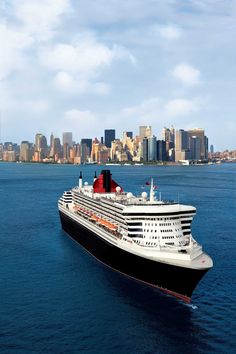
  6. That RN adventure was the last time that I sailed around the Isle of Wight in a large ship – the guided missile destroyer HMS Devonshire – Displacement 5,440 tonnes (6,850 tonnes full load). On September 20th I will sail around the Isle of Wight again but on RMS Queen Mary 2, bound for New York – Displacement 75,000 tonnes.
    862aa8c7d3a3a172a1b352d9bc0d0e1c

    Queen Mary 2 in New York Harbor

  7. I still have one of the books that I read and adored as a child, George Brooksbank’s “Old Mr Fox”. With a cover by celebrated artist Archibald Thorburn, this was my father’s copy, which he was given in 1932 for Christmas, the same year the book was published.
  8. My favourite author is J.R.R Tolkien, but I first discovered him when I read the essay based on his lecture “Beowulf: The Monsters and the Critics“. Reading “The Hobbit” and “Lord of the Rings” came a few months later.
  9. I read the whole of “Lord of the Rings” over one very long weekend when I was at Eton College in 1969. I still have the three hardback copies with their wonderful fold-out maps.
  10. History has always fascinated me, so it was one of my specialist subjects at school and at college. I even enjoy Virtual or Alternative Histories, so one day I might work out how the Vikings colonised Kanata.
  11. I’ve had Multiple Sclerosis since 2000 but writing keeps my brain on track, although it can be exhausting. And I now call it the MaelStrom MonSter.


With the A to Z Challenge in mind, I’d first like to nominate a few fellow A to Z-ers for this award.

Tasha @ Tasha’s Thinkings Wrote 2.5 blogs during A to Z, including her entertaining spooky one on Fictional Phantoms.

Miriam @ An’ de walls came tumblin’ down  Her A to Z was clever stories in which each sentence began with the chosen letter of the day.

Jen @ Lexical Creations This children’s writer tackled a double theme for A to Z. Each post featured an Alphabet book and an instalment of her own fun alphabetical story with letters as characters.

Cheryl @ Plucking Of My Heartstrings Her 2016 theme was non-profit organizations that deserve support, so please visit as many as you can.

Maryann @ if i only had a time machine Her informative and detailed A to Z posts were A 1970s Time Capsule from A to Z. Facts and video clips galore.

Archie @ Travel With Archie – and finally a great travelogue with A to Z posts on US cities. Wonderfully informative and great photos.

Finally, I’m choosing two other bloggers that are deserving of the Liebster Award.

Chrys @ Write with Fey Catching sparks for stories and passing on torches of inspiration.

Mark @ Time Present and Time Past        Author/Lecturer who knows how to tell his facts in an informative and engrossing way.

quill

And these are the questions for them, and of course most are about blogging:

  • Do you have goals for your blog? What are they?
  • Do you have a blogging schedule?
  • I can hardly resist a blogging challenge. Do you participate in many?
  • What is your favourite way to interact with other bloggers?
  • What is your own personal favourite of your own blog posts, and why?
  • What kind of blogs do you like to read the most?
  • Where would you most like to visit?
  • If you could have any kind of pet, what would it be?
  • If you could choose to live in another time, when would you choose?
  • Would you change your chosen career path?
  • Do you have a favourite book that you re-read?


Again, thanks so much to Sarah for giving me the possibility to share the love. And thanks to all those that have inspired me to nominate them.

A to Z Reflection

A-to-Z Reflection [2016]


Eleven days after the great event seems a reasonable period of time for honest reflection on the Blogging From A to Z April (2016) Challenge. It’s also a good moment to respond to a friend nominating me for The Liebster Award, as that poses some A to Z and blogging questions. However, that will be tomorrow’s post so stayed tuned to this channel.

So first my thoughts about this year’s April Challenge.

After my first two years, 2014 and 2015, I wanted to do briefer posts that would be quicker to read. As I said in my Blogging from A to Z Challenge Theme Reveal 2016, I wanted something different, tighter and more cryptic. In that I succeeded, but in my desire to produce something ‘challenging’, I chose to write an episodic mystery that created more work. Each episode consisted of one word for each of the letters of the alphabet, commencing with the letter of the day. Of course, I imposed other rules and then as a bonus, had a ‘horse of the day’, and a ‘daily poison’ – again from A to Z.

I did succeed in writing all but a few posts in March, so succeeded in reaching Z and the end of April. However, I struggled to read a lot of other blogs each day – probably about a dozen or so – in addition to the other posts that I follow.

I loved the variety of A to Z blogs out there, and I intend to explore some more in the months ahead. I’m incredibly impressed at the depth of talent in the blogosphere.

My IWSG blog post last Wednesday expressed my concern at making comments, even during quieter periods. So I’m in awe of those that multi-task successfully throughout the Challenge, and don’t believe in clones.

My Liebster comments tomorrow will highlight those bloggers who impressed me, and I admit that I found many individual posts invaluable as well as informative. Maybe I will learn from them in my approach for the 2017 Challenge.

I won’t be giving up blogging quite yet, as doing the A to Z Challenge holds the MaelStrom MonSter at bay by keeping my brain active and distracted.

As for the A to Z Team, they did an excellent job – as always.  So a special thank you to those that worked hard to make it possible, from the co-hosts to their helpers/assistants. Here they all are.