I is for Impressment

I

Impressment, or removing seamen from U.S. merchant vessels and forcing them to serve on behalf of the British, was one of the main causes of the War of 1812, according to most sources. During the Napoleonic Wars (1803-15), the Royal Navy expanded to 175 ships of the line and 600 ships overall, requiring 140,000 sailors to man. While the Royal Navy could man its ships with volunteers in peacetime, it competed in wartime with merchant shipping and privateers for a small pool of experienced sailors and turned to impressment when it could not operate ships with volunteers alone. Britain did not recognize the right of a British subject to relinquish his status as a British subject, emigrate and transfer his national allegiance as a naturalized citizen to any other country. Thus while the United States recognized British-born sailors on American ships as Americans, Britain did not.

The United States believed that British deserters had a right to become United States citizens. Britain did not recognize naturalized United States citizenship, so in addition to recovering deserters, it considered United States citizens born British liable for impressment. Aggravating the situation was the widespread use of forged identity or protection papers by sailors. This made it difficult for the Royal Navy to distinguish Americans from non-Americans and led it to impress some Americans who had never been British. (Some gained freedom on appeal.)] American anger at impressment grew when British frigates were stationed just outside U.S. harbours in view of U.S. shores and searched ships for contraband and impressed men while in U.S. territorial waters. “Free trade and sailors’ rights” was a rallying cry for the United States throughout the conflict.

We Owe Allegiance to No Crown, by John Archibald Woodside. c. 1814. Photograph copyright Nicholas S. West. Photography by Erik Arnesen.

We Owe Allegiance to No Crown, by John Archibald Woodside. c. 1814. Photograph copyright Nicholas S. West. Photography by Erik Arnesen.

Between 1803 and 1812, approximately 5,000-9,000 American sailors were forced into the Royal Navy with as many as three-quarters being legitimate American citizens. Though the American government repeatedly protested the practice, British Foreign Secretary Lord Harrowby contemptuously wrote in 1804, “The pretention advanced by Mr. [Secretary of State James] Madison that the American flag should protect every individual on board of a merchant ship is too extravagant to require any serious refutation.”

The Royal Navy also used impressment extensively in British North America from 1775 to 1815. Its press gangs sparked resistance, riots, and political turmoil in seaports such as Halifax, St John’s, and Quebec City. In 1805 this led to a prohibition on impressment on shore for much of the Napoleonic Wars. The protest came from a wide swath of the urban community, including elites, rather than just the vulnerable sailors, and had a lasting negative impact on civil–naval relations in what became Canada. The local communities did not encourage their young men to volunteer for the Royal Navy.

http://en.wikipedia.org/wiki/Impressment

http://www.marinersmuseum.org/sites/micro/usnavy/08/08a.htm

http://www.smithsonianmag.com/smithsonian-institution/1812-a-nation-emerges-opens-at-the-national-portrait-gallery-122555161/?no-ist

PREVIOUS A TO Z POSTS:

A is for Anishinaabe ~ B is for Brock ~ C is for Coloured Corps ~ D is for Detroit ~ E is for Erie ~ F is for First Nations ~ G is for Ghent ~ H is for Harrison

A2Z-BADGE-000 [2015] - Life is Good

The brainchild of Arlee Bird, at Tossing it Out, the A to Z Challenge is posting every day in April except Sundays (we get those off for good behaviour.) And since there are 26 days, that matches the 26 letters of the alphabet. On April 1, we blog about something that begins with the letter “A.” April 2 is “B,” April 3 is “C,” and so on. Please visit other challenge writers.

My theme is ‘The War of 1812’, a military conflict, lasting for two-and-a-half years, fought by the United States of America against the United Kingdom of Great Britain and Ireland, its North American colonies, and its American Indian allies. The Memoirs of a British naval officer from the war is central to my novel “Seeking A Knife” – part of the Snowdon Shadows series.

Further reading on The War of 1812:

http://www.history.com/topics/war-of-1812

http://www.eighteentwelve.ca/?q=eng

http://www.theglobeandmail.com/globe-debate/the-war-of-1812-stupid-but-important/article547554/

http://www.shmoop.com/war-1812/

http://www.pbs.org/wned/war-of-1812/essays/

H is for Harrison

H

William Henry Harrison (February 9, 1773 – April 4, 1841) originally gained national fame for leading U.S. forces against American Indians at the Battle of Tippecanoe in 1811, where Harrison’s forces fought off followers of the powerful Shawnee leader Tecumseh (1768-1813). Although the U.S. suffered significant troop losses and the battle’s outcome was inconclusive and did not end Indian resistance, Harrison ultimately emerged with his reputation as an Indian fighter intact, and earned the nickname “Tippecanoe” (or “Old Tippecanoe”). He capitalized on this image during his 1840 presidential campaign, using the slogan “Tippecanoe and Tyler too,”

After a dozen years as governor of the Indiana Territory, Harrison rejoined the Army when the War of 1812 began. He was made a brigadier general and placed in charge of the Army of the Northwest, on September 17, 1812. Promoted to major general, Harrison worked diligently to transform his army from an untrained mob into a disciplined fighting force. Unable to go on the offensive while British ships controlled Lake Erie, Harrison worked to defend American settlements.

In late September 1813, after the American victory at the Battle of Lake Erie, Harrison moved to the attack. Ferried to Detroit by Master Commandant Oliver H. Perry’s victorious squadron, Harrison set off in pursuit British and Native American forces under Major General Henry Proctor and Tecumseh. Catching them on October 5, Harrison won a key victory at the Battle of the Thames which saw Tecumseh killed, the war on the Lake Erie front effectively ended, and the dissolution of the Indian coalition.

William Henry Harrison ~ National Portrait Gallery, Washington DC. ~ Photograph Source: Public Domain

William Henry Harrison ~ National Portrait Gallery, Washington DC. ~ Photograph Source: Public Domain

Harrison told US Secretary of War John Armstrong, Jr. that all his casualties were a result of the native warriors, not the British regulars. Unable to sustain or build on his victory, Harrison and his men headed for Detroit, the Americans now in firm control of the North West frontier. Procter would continue to command those who had fought with him, but his poor handling of the retreat and battle would be his undoing. Though a skilled and popular commander, Harrison resigned the following summer after disagreements with Secretary of War John Armstrong.

After the war, Harrison moved to Ohio, where he was elected to the United States House of Representatives. In 1824 the state legislature elected him to the U.S. Senate. He served a truncated term after being appointed as Minister Plenipotentiary to Colombia in May 1828. In Colombia, he spoke with Simón Bolívar urging his nation to adopt American-style democracy.

Harrison was elected as the ninth President of the United States in 1840, and died on his 32nd day in office of pneumonia in April 1841- the first president to die in office and serving the shortest tenure in United States presidential history. He was the last President born as a British subject. His death sparked a brief constitutional crisis, but its resolution settled many questions about presidential succession left unanswered by the Constitution until the passage of the 25th Amendment in 1967. He was the grandfather of Benjamin Harrison, who was the 23rd President from 1889 to 1893.

http://en.wikipedia.org/wiki/William_Henry_Harrison

http://www.eighteentwelve.ca/?q=eng/Topic/29

http://www.history.com/topics/us-presidents/william-henry-harrison

http://militaryhistory.about.com/od/1800sarmybiographies/p/whharrison.htm

PREVIOUS A TO Z POSTS:

A is for Anishinaabe ~ B is for Brock ~ C is for Coloured Corps ~ D is for Detroit ~ E is for Erie ~ F is for First Nations ~ G is for Ghent

A2Z-BADGE-000 [2015] - Life is Good

The brainchild of Arlee Bird, at Tossing it Out, the A to Z Challenge is posting every day in April except Sundays (we get those off for good behaviour.) And since there are 26 days, that matches the 26 letters of the alphabet. On April 1, we blog about something that begins with the letter “A.” April 2 is “B,” April 3 is “C,” and so on. Please visit other challenge writers.

My theme is ‘The War of 1812’, a military conflict, lasting for two-and-a-half years, fought by the United States of America against the United Kingdom of Great Britain and Ireland, its North American colonies, and its American Indian allies. The Memoirs of a British naval officer from the war is central to my novel “Seeking A Knife” – part of the Snowdon Shadows series.

Further reading on The War of 1812:

http://www.eighteentwelve.ca/?q=eng

http://www.theglobeandmail.com/globe-debate/the-war-of-1812-stupid-but-important/article547554/

http://www.shmoop.com/war-1812/

G is for Ghent

G

The Treaty of Ghent), signed on December 24, 1814, was the peace treaty that ended the War of 1812 between the United States and Great Britain. The treaty restored relations between the two nations to status quo before the war — that is, it restored the borders of the two countries to the line before the war started in June 1812. The Treaty was approved by the Prince Regent (the future King George IV). It took a month for news of the peace treaty to reach the United States. American forces under Andrew Jackson won the Battle of New Orleans on January 8, 1815. The Treaty of Ghent was not in effect until it was ratified by the U.S. Senate unanimously on February 18, 1815.

The peace discussions began in the neutral city of Ghent in August 1814. As the peace talks opened American diplomats decided not to present President Madison’s demands for the end of impressment and suggestion that Britain turn Canada over to the U.S. They let the British open with their demands, chief of which was the creation of an Indian barrier state in the American Northwest Territory (the area from Ohio to Wisconsin). It was understood the British would sponsor this Indian state. The British strategy for decades had been to create a buffer state to block American expansion. The Americans refused to consider a buffer state and the proposal was dropped. Article IX of the treaty included provisions to restore to Natives “all possessions, rights and privileges which they may have enjoyed, or been entitled to in 1811”, but the provisions were unenforceable and in any case Britain ended its practice of supporting or encouraging tribes living in American territory.

In his 1914 painting A Hundred Years Peace, artist Amedee Forestier illustrates the signing of the Treaty of Ghent between Great Britain and the US, 24 December 1814 (courtesy Library and Archives Canada/C-115678).

In his 1914 painting A Hundred Years Peace, artist Amedee Forestier illustrates the signing of the Treaty of Ghent between Great Britain and the US, 24 December 1814 (courtesy Library and Archives Canada/C-115678).

After months of negotiations, against the background of changing military victories, defeats and losses, the parties finally realized that their nations wanted peace and there was no real reason to continue the war. Now each side was tired of the war. Export trade was all but paralyzed and after Napoleon fell in 1814 France was no longer an enemy of Britain, so the Royal Navy no longer needed to stop American shipments to France, and it no longer needed more seamen so impressment was not an issue.

Consequently, none of the issues that had caused the war or that had become critical to the conflict were included in the treaty.

The treaty thus made no significant changes to the pre-war boundaries, although the U.S. did gain territory from Spain. Britain promised to return the freed black slaves that they had taken. In actuality, a few years later Britain instead paid the United States $1,204,960 for them. Both nations also promised to work towards an ending of the international slave trade.

Canadian author, Pierre Berton wrote of the treaty, “It was as if no war had been fought, or to put it more bluntly, as if the war that was fought was fought for no good reason. For nothing has changed; everything is as it was in the beginning save for the graves of those who, it now appears, have fought for a trifle:…Lake Erie and Fort McHenry will go into the American history books, Queenston Heights and Crysler’s Farm into the Canadian, but without the gore, the stench, the disease, the terror, the conniving, and the imbecilities that march with every army.”

The Peace Bridge between Buffalo, New York, and Fort Erie, Ontario, opened in 1927 to commemorate more than a century of peace between the United States and Canada.

http://en.wikipedia.org/wiki/Treaty_of_Ghent

http://www.history.com/topics/treaty-of-ghent

http://www.eighteentwelve.ca/?q=eng/Topic/55

PREVIOUS A TO Z POSTS:

A is for Anishinaabe ~ B is for Brock ~ C is for Coloured Corps ~ D is for Detroit

E is for Erie  ~  F is for First Nations

A2Z-BADGE-000 [2015] - Life is Good

The brainchild of Arlee Bird, at Tossing it Out, the A to Z Challenge is posting every day in April except Sundays (we get those off for good behaviour.) And since there are 26 days, that matches the 26 letters of the alphabet. On April 1, we blog about something that begins with the letter “A.” April 2 is “B,” April 3 is “C,” and so on. Please visit other challenge writers.

My theme is ‘The War of 1812’, a military conflict, lasting for two-and-a-half years, fought by the United States of America against the United Kingdom of Great Britain and Ireland, its North American colonies, and its American Indian allies. The Memoirs of a British naval officer from the war is central to my novel “Seeking A Knife” – part of the Snowdon Shadows series.

Further reading on The War of 1812:

http://www.eighteentwelve.ca/?q=eng

http://www.theglobeandmail.com/globe-debate/the-war-of-1812-stupid-but-important/article547554/

http://www.shmoop.com/war-1812/

F is for First Nations

F

The War of 1812 was a turning point for the First Nations, being the last conflict in north-eastern North America in which their participation was important, if not critical.

The peace treaty of 1783, which concluded the American Revolution, saw the ceding of all lands west of the Ohio River to the United States. However, the British still saw the Indian nations as valuable allies and a buffer to its Canadian colonies and they provided them with arms. Attacks on American settlers in the Northwest further aggravated tensions between Britain and the United States, and was one of the causes of the War of 1812.

In 1812 the Shawnee chief Tecumseh gathered 10,000 warriors, hoping to unify First Nations peoples into a confederacy with their own land and government. Tecumseh sided with the British not because he trusted them, but because he saw them as the lesser of two evils.

With the British fighting Napoleon Bonaparte in Europe, their troops in North America were stretched and the participation of native warriors was key to their campaign. However, First Nations warriors preferred to rely on stealth and spontaneous attack. They were puzzled and sometimes appalled by European tactics and by the extreme casualties the Europeans seemed to countenance. And the advocates of European tactics were unable to understand First Nation tactics, although they often turned the tide of battles.

Just prior to the British capture of Fort Detroit, communications across the Detroit River were all-important. Fast canoes manned by loyal First Nations warriors performed this task (Downriver Despatches by Peter Rindlisbacher).

Just prior to the British capture of Fort Detroit, communications across the Detroit River were all-important. Fast canoes manned by loyal First Nations warriors performed this task (Downriver Despatches by Peter Rindlisbacher).

The First Nations were largely responsible for the fall of Michilimackinac on 17 July 1812, and subsequent victories. However, due to the inefficiency of the British commander at Moraviantown, the brunt of the fighting fell to the First Nations and they were routed and Tecumseh was killed. His loss is hard to overestimate and with him went the remains of the nativist movement. Nevertheless, First Nations warriors continued to fight until the end of the war.

During negotiations for the Treaty of Ghent, the British did try to bargain for the establishment of an Indian Territory but the Americans resolutely refused to agree. The most that they would accept was the status quo before the war. But despite all their efforts, the First Nations were unable to recover their lost territory.

Three years after the death of Tecumseh, Indiana became a state and began to remove all First Nations from their traditional lands, a mass eviction that was repeated in state after state. In the South East, the Creek War came to an end,  and about half of the Creek territory was ceded to the United States, with no payment made to the Creeks. This was, in theory, invalidated by Article 9 of the Treaty of Ghent, thereby restoring to the Indians “all the possessions, rights and privileges which they may have enjoyed or been entitled to in 1811.” The British failed to uphold this, and did not take up the First Nations cause as an infringement of an international treaty. Without this support, the Indians’ lack of power was apparent and the stage was set for further incursions of territory by the United States in subsequent decades, such as the forced removal of the Choctaw and Cherokee under the Indian Removal Act of 1830.

Indian Removal Act 1830. A tragic time in American history that led to the long forced relocation of Indigenous Americans on what is appropriately called the "Trail of Tears".

Indian Removal Act 1830. A tragic time in American history that led to the long forced relocation of Indigenous Americans on what is appropriately called the “Trail of Tears”.

In Canada, the War of 1812 was the end of an era in which the First Nations had been able to keep their positions in return for service in war. Soon, with the growth of Upper Canada, the First Nations were outnumbered in their own lands. It was almost forgotten that if not for their support Upper Canada might very well have fallen into American hands.

In 1992, Georges Erasmus, Chief of the Assembly of First Nations, said, “You have a phrase called “Golden Age.” We do not want to be depicted the way we were, when we were first discovered in our homeland in North America. We do not want museums to continue to present us as something from the past. We believe we are very, very much here now, and we are going to be very important in the future.”
http://www.thecanadianencyclopedia.ca/en/article/first-nations-in-the-war-of-1812/

http://www.eighteentwelve.ca/?q=eng/Topic/9

PREVIOUS A TO Z POSTS:


A is for Anishinaabe ~ B is for Brock ~ C is for Coloured Corps ~ D is for Detroit ~ E is for Erie

A2Z-BADGE-000 [2015] - Life is Good

The brainchild of Arlee Bird, at Tossing it Out, the A to Z Challenge is posting every day in April except Sundays (we get those off for good behaviour.) And since there are 26 days, that matches the 26 letters of the alphabet. On April 1, we blog about something that begins with the letter “A.” April 2 is “B,” April 3 is “C,” and so on. Please visit other challenge writers.

My theme is ‘The War of 1812’, a military conflict, lasting for two-and-a-half years, fought by the United States of America against the United Kingdom of Great Britain and Ireland, its North American colonies, and its American Indian allies. The Memoirs of a British naval officer from the war is central to my novel “Seeking A Knife” – part of the Snowdon Shadows series.

Further reading on The War of 1812:

http://www.eighteentwelve.ca/?q=eng

http://www.theglobeandmail.com/globe-debate/the-war-of-1812-stupid-but-important/article547554/

C is for Coloured Corps

C

Shortly after the Americans declared war on the British in June 1812, a 68 year old West African named Richard Pierpoint proposed the formation of a Black fighting unit, a “Corps of men of Colour.” A small militia unit was formed and became known as the Coloured Corps. Pierpoint, who had fought for the British in the American Revolutionary War, was one of over 50 who served in that unit throughout the war. While the commanding officers were white, six of the enlisted Black men served as sergeants or corporals and the rest served as privates. The number strength of the unit varied throughout the war due to fatalities, illness, desertions and the occasional addition of Black soldiers from other militias. There were usually between 25-30 men. The Coloured Corps saw action in some of best-known battles of the War of 1812. At the Battle of Queenston Heights, they participated in the recapture of the Redan Battery after the death of Major General Brock.

Coloured Corps Painting “Runchey’s Coloured Corps” by Cameron Porteous. Image courtesy of canadianartcards.com. 1812 1 20N.

Coloured Corps Painting
“Runchey’s Coloured Corps” by Cameron Porteous.
Image courtesy of canadianartcards.com. 1812 1 20N.

The Black population throughout British North America had much to fear, should the Americans win the war: those who were free men might find themselves sold into slavery. Those who were enslaved might have hoped that their service to the King as soldiers would win them their freedom.

There were both free and enslaved men in the Coloured Corps’ ranks. While Pierpoint gained his freedom for his service in a British provincial regiment, Butler’s Rangers, he was one of many who were free men when the Corps was founded. Robert Scott, a free man and farmer living in the town of York, joined up. George Martin, another Coloured Corps enlistee, had been a slave as a child, until his freedom was purchased by his own father who, like Pierpoint, had served in Butler’s Rangers.

However, others were not so lucky. “Jack” was a slave who had enlisted in the Coloured Corps, perhaps believing that by doing so he might gain his freedom. He was owned by a white slaveholder, W. A. Nelles, who requested that the military return “Jack” to him in March 1814. Prince Henry was the legal property of William Jarvis, the Provincial Secretary of Upper Canada. He appears on the muster roll in 1813. Was he signed up by Jarvis, or was he a ‘run-away,’ hoping his military service would gain him his freedom?

The Coloured Corps was a unique fighting unit within the British military, consisting of men who valued freedom and who were willing to fight to ensure freedom for themselves, their families and their country.

In 1813, the company was transformed into a unit of the Provincial Corps of Artificers and attached to the Royal Sappers and Miners. It served on the Niagara front during the war, and was disbanded a few months after the war ended.

5b2fc081af57b463cfdb9eb29cd481b6

1814 Corps of Artificiers. Image courtesy of Parks Canada.

The Coloured Corps was dismissed in March of 1815, a few months after the signing of the Treaty of Ghent. In the years following the war, Coloured Corps veterans worked hard at getting back pay and their pensions. The records indicate that these claims were still being settled well into the 1820s and early 1830s. In fact, getting what was owed was often left to their widows and children, as many Coloured Corps veterans died before receiving what was due to them.

The unit’s history and heritage is perpetuated in the modern Canadian Army by the Lincoln and Welland Regiment.

Further Information:

http://tubman.info.yorku.ca/educational-resources/war-of-1812/richard-pierpoint/coloured-corps/

http://www.thecanadianencyclopedia.ca/en/article/the-coloured-corps-african-canadians-and-the-war-of-1812/

http://en.wikipedia.org/wiki/Captain_Runchey%27s_Company_of_Coloured_Men

http://www.eighteentwelve.ca/?q=eng/Topic/25

http://www.pbs.org/wned/war-of-1812/essays/black-soldier-and-sailors-war/

A2Z-BADGE-000 [2015] - Life is Good

The brainchild of Arlee Bird, at Tossing it Out, the A to Z Challenge is posting every day in April except Sundays (we get those off for good behaviour.) And since there are 26 days, that matches the 26 letters of the alphabet. On April 1, we blog about something that begins with the letter “A.” April 2 is “B,” April 3 is “C,” and so on. Please visit other challenge writers.

My theme is ‘The War of 1812’, a military conflict, lasting for two-and-a-half years, fought by the United States of America against the United Kingdom of Great Britain and Ireland, its North American colonies, and its American Indian allies. The Memoirs of a British naval officer from the war is central to my novel “Seeking A Knife” – part of the Snowdon Shadows series.

Further reading on The War of 1812:

http://www.eighteentwelve.ca/?q=eng

http://www.theglobeandmail.com/globe-debate/the-war-of-1812-stupid-but-important/article547554/

B is for Brock

B

Major-General Sir Isaac Brock KB (6 October 1769 – 13 October 1812) was a British Army officer and administrator, who was assigned to Lower Canada in 1802. Despite facing desertions and near-mutinies, he commanded his regiment in Upper Canada (present-day Ontario) successfully for many years. He was promoted to major general, and became responsible for defending Upper Canada against the United States. While many in Canada and Britain believed war could be averted, Brock began to ready the army and militia for what was to come. To this end he oversaw improvements to the fortifications at Quebec and improved the Provincial Marine which was responsible for transporting troops and supplies on the Great Lakes. Though appointed brigadier general in 1807 by Governor General Sir James Henry Craig, Brock was frustrated by a lack of supplies and support.

However, he worked to alter the militia act to expand his forces and began building relationships with Native American leaders such as the Shawnee chief Tecumseh, and nations such as the Anishinaabe. Brock felt that British military fortunes were bleak. In Upper Canada, he possessed only 1,200 regulars which were supported by around 11,000 militia. As he doubted the loyalty of many Canadians, he believed only around 4,000 of the latter group would be willing to fight. Despite this outlook, when the War broke out, the populace was prepared, and quick victories at Fort Michilimackinac and Detroit defeated American invasion efforts.

Brock’s actions, particularly his success at Detroit, earned him a knighthood, membership in the Order of the Bath, accolades and the sobriquet “The Hero of Upper Canada”.

Brock died at the Battle of Queenston Heights. Leading two companies of the 49th Regiment and two companies of York militia, he charged up the heights assisted by aide-de-camp Lieutenant Colonel John Macdonell. In the attack, Brock was struck in the chest and killed, as was his aide who died in a second charge. However the battle was eventually a British victory. [Q will be for Queenston]

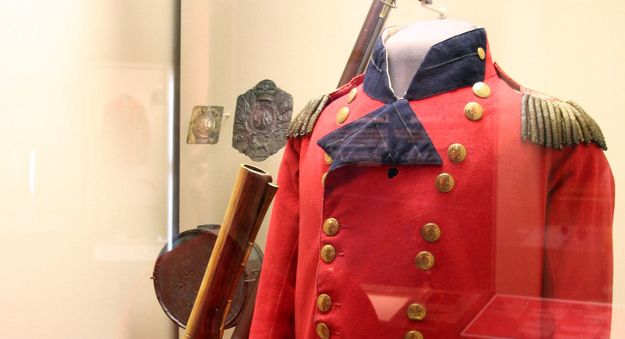
Twelve years after Brock’s death, a 130 foot stone monument was erected in his honour on the heights near the spot where he was killed. His remains, as well as those of Macdonell, were reburied beneath the monument in an elaborate ceremony attended by many of his contemporaries. In 1840, the monument was destroyed by a massive blast of gunpowder, ignited by an American sympathizer. The monument was subsequently rebuilt in 1856, 52 feet taller than before. Today, the monument, which now straddles the longest undefended border in the world, remains one of the most imposing historical landmarks in Canada. Relics of Brock’s career can be seen at the Canadian War Museum in Ottawa, where his bullet-pierced tunic is prominently on display.

ff494dbde08a47201535fa8f3fca5945

The coat worn by Major General Sir Isaac Brock at the time of his death at Queenston Heights on 13 October 1812. On display at the Canadian War Museum, the bullet hole is evident under the lapel (courtesy Archives of Ontario/S1427)

http://www.eighteentwelve.ca/?q=eng/Topic/16

http://en.wikipedia.org/wiki/Isaac_Brock

http://militaryhistory.about.com/od/1800sarmybiographies/p/War-Of-1812-Major-General-Sir-Isaac-Brock.htm

http://www.warof1812.ca/brock.htm

A2Z-BADGE-000 [2015] - Life is Good

The brainchild of Arlee Bird, at Tossing it Out, the A to Z Challenge is posting every day in April except Sundays (we get those off for good behaviour.) And since there are 26 days, that matches the 26 letters of the alphabet. On April 1, we blog about something that begins with the letter “A.” April 2 is “B,” April 3 is “C,” and so on. Please visit other challenge writers.

My theme is ‘The War of 1812’, a military conflict, lasting for two-and-a-half years, fought by the United States of America against the United Kingdom of Great Britain and Ireland, its North American colonies, and its American Indian allies. The Memoirs of a British naval officer from the war is central to my novel “Seeking A Knife” – part of the Snowdon Shadows series.

Further reading on The War of 1812:

http://www.eighteentwelve.ca/?q=eng

http://www.theglobeandmail.com/globe-debate/the-war-of-1812-stupid-but-important/article547554/