Dragonoak: The Complete History of Kastelir – a review

As my writing begins to touch on diversity and minority rights issues, I knew that I should expand my reading. This novel is my first fantasy that I’ve read that is willing to move beyond the narrow taboos of modern society.
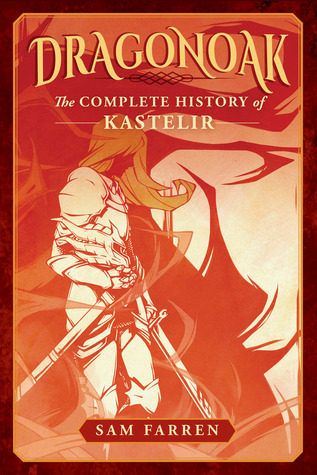
Dragonoak

Dragonoak: The Complete History of Kastelir (Dragonoak #1)

by Sam Farren

After being exiled to the farmland around her village, Rowan Northwood takes the only chance at freedom she might ever get: she runs away with a passing Knight and doesn’t look back. The woman cares nothing for Rowan’s company, but nor does she seem perturbed by the powers that burn within her.
Rowan soon learns that the scope of their journey is more than a desperate grasp at adventure. She breaks away from the weighty judgement of her village, but has no choice but to abandon her Kingdom altogether. Sir Ightham’s past leads them through Kastelir, a country draped in the shadow of its long-dead Queen—a woman who was all tusks and claws and great, spiralling horns.
Hiding her necromancy is no longer Rowan’s greatest challenge, and what leads them across Kingdoms and through mountains is a heavier burden than she ever could’ve imagined.


Review 3.5 stars

I was drawn to read this book as the blurb, and the reviews promised an engrossing fantasy novel where diversity was the norm. I found the opening intriguing with a fascinating backstory trickled out, not dumped on me. Rowan Northwood as a narrator is driven to leave her village by the attitude of the people that saw her as a healer until they discovered her hidden power.

Her journey is one of discovery, about the world that she only knows from her brother Michael’s stories and about other people. However, she is not the protagonist as that is Sir Ightham, a female knight that is well-portrayed as the norm. At first, Rowan is intrigued and inspired by Sir Ightham, but as she discovers more about the knight, a real attraction grows. Personally, I found it difficult to relate to such a distant protagonist, but I kept reading knowing that through Rowan, I should discover more.

Many of the characters are not the fantasy norm exactly. This aspect of the world-building delivered, as did the world beyond Michael’s books, and this element kept me wanting more. The third intriguing character was an asexual called Rán, whose race, the pane, were central to the story – I must avoid spoilers and say little more about that.

When Rán appears, Rowan calls her ‘she’ and for the rest of the book Rán is a ‘she’. But the pane are asexual or transgender, and the pronoun for them individually is ‘they’. However, once I had adapted my mindset to using this gender-neutral pronoun, confusion set in. Why was Rán ‘she’ but other single pane were almost all ‘they’? What about this sentence:

A handful of younger pane crept up on us. Their leader, a girl with the first signs of a right horn showing, inched her way to the steps. I raised a hand to wave and they shrieked, scattering like ants.

I kept reading engrossed in the story – but after researching ‘gender-neutral pronouns’. Other elements threw me, like the treatment of the horses that grated with everything I knew as a retired equestrian journalist.

The jigsaw remained complicated and unclear – well to Rowan as the narrator but not the protagonist – but eventually, after some unnecessary scenes of excessive world-building, the plotlines took shape through new arrivals, encounters and interruptions. The mysterious quest remained unclear.

More began to grate. Some reviews had mentioned there were “a few typos”, but those would have mortified me if my writing had so many. I had to keep re-reading sentences and amending them. Anyway, back to worrying about the horses – but the focus is now on the Queen. A new intrigue so I’m not giving up. I want to reach a satisfactory conclusion.

Rowan is an observant narrator, even if it’s hard being an observer that senses so much. First-person POV is hard, but the reader gets to feel with the main character – although she’s not telepathic. So why the sentences that stray into the omniscient? Confusing and yet avoidable. But enough of that ‘writing style’ nonsense, there’s a mystery to resolve and here comes the next twist.

Finally, in the latter part of the novel, Rowan discovers more and events move faster. I began to find too many loose threads, and it was too late in the story to resolve many of them in time. At least, the central romance reached the next level – but romance is always ongoing.

Much better, according to the author it seems, to add other threads and keep the reader wanting more and let us forgive the cliff-hanger ending – Tolkien did that in Lord of the Rings, so it’s justified. Correction – not in the same way. Reading that trilogy in the 1970s, a glimmer of hope kept me questing, but this time I’m letting Rowan struggle on without me.

Dragonoak would be a good diversity fantasy if not for all the early draft failings like the pacing crisis, first-person omniscient POV, excessive typos and unnecessary scenes. At least, the author can edit the Kindle version one day. For now, I’m off to try a ‘diversity’ SF novel. Perhaps if there is a second edition, then I might join the journey and enjoy some of the inspiring prose.

But not looking at them wasn’t enough to banish them from my mind. Whatever they suffered seeped into the air, following me through busy streets, as though the shadow I’d felt last night had returned to claim me.

Story – four stars

Setting/World-building – five stars

Structure – three stars

Readability – three stars

Editing – three stars

Style – three stars
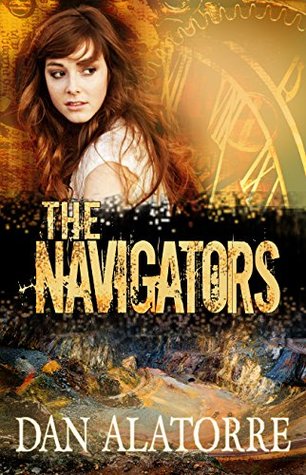
 

The Navigators – a review

Time for another review and this time, a novel about time travel.

Navigators

The Navigators

by Dan Alatorre (Goodreads Author), Allison Maruska (Goodreads Author)(Editor)

A freak landslide at a remote mine site uncovers a strange machine to Barry’s group of palaeontology students. Wary of corrupt school officials, his team takes the machine home to study it in secret, reaching only one realistic – and unbelievable – conclusion: It was designed to bridge the time-space continuum. It’s a time machine.

Testing delivers disastrous results, sending one team member to the hospital and nearly killing another. When word leaks about the discovery, the ultimate power struggle ensues: the university wants it for funding, the power company wants its energy regenerating abilities kept under wraps, and a rival group wants to steal it for themselves. No one cares if Barry’s team comes out alive.

Fleeing for their lives, the students must fight the school, the police, and each other if they want to learn the truth about what they’ve discovered – a truth with more severe consequences than any of them can predict.

Review 5*

An intriguing opening chapter propelled me into the lives of Barry’s group of palaeontology students in Dan Alatorre’s The Navigators. The characterisation built my interest and quickly established the personalities and group conflicts – conflicts that cleverly fed the plot.

These conflicts emerged in such human ways, that I sensed that everyone should watch out – as the blurb implies. Everyone was creating situations that could have those ‘severe consequences’.  As the plotlines unravelled, I was telling the characters to watch out – to no avail. Would I have listened? Not when I was their age.

Their reactions were believable. Plus some good observations on the paradoxes of time and the tough choices it poses. In The Navigators’, time travel tests everyone and loyalties are stretched by the discovery of the machine. I kept asking questions – some of which the friends forgot to ask’

Who do you trust? What are other people’s motivations? What is the way out of this situation?

Maybe not the answers that Dan Alatorre came up with, but they worked and I had to keep reading. I expected some comeuppance but I was ready to be surprised as the intentions came unravelled. That’s life. As with the best books, there were some good morals in the story, such as – lying is never the best answer; shortcuts rarely work (even with a time machine); beauty is more than looks. The latter prompted me to highlight the following dialogue:

“… ‘A beautiful woman’s breasts will eventually sag and her hair will turn gray. What will you be married to then? If you choose wisely, you will be married to a beautiful personality and a curious mind that loves your children and who would do anything for you.’ That is true beauty.”

And where better to put the punchline – at the very end. Now that makes me grin and recommend this novel.

Story – five stars

Setting/World-building – five stars

Structure – five stars

Readability – five stars

Editing – five stars

Style – five stars

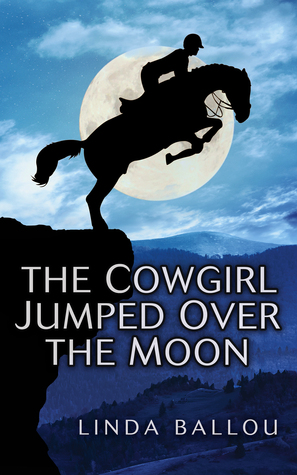
The Cowgirl Jumped Over the Moon – a review

Engrossed in promoting my equestrian thriller, escaping to read about another horse world was strange and yet satisfying. This is my review:

Cowgirl_25613310

The Cowgirl Jumped Over the Moon

by Linda Ballou (Goodreads Author)

Gemcie and her Irish Hunter, Marshal, are about to capture the World Cup when a nasty fall dashes their chances. While she is mending, her arch rival seizes this opportunity to catch a ride on Marshal, and to seduce her young husband. Confused and dazed by her new circumstances, Gemcie heads for the high Sierras hoping the majestic spires that captured the heart of the father she never met will provide the answers she seeks. She finds strength and solace riding solo on the John Muir Trail, but a bear attack ends her time of introspection and places her in the care of a solitary cowboy manning a fire lookout. Brady, who seems to love animals more than people, shows her love and gives her the courage to get back in the saddle. Haunted by images of Marshal being abused by his owners, Gemcie returns to rescue him and fly high with him once more. Ballou’s prose gallops ahead at breakneck speed as she takes you along on this wild ride.

Review 5*

From the opening hook, Linda Ballou’s The Cowgirl Jumped Over the Moon paints a rich picture of not just the show jumping world that Gemcie had earned her place in through hard work and dedication. The accident that dashes the ambitions of Gemcie and her Irish Hunter, Marshal, leads to other events that unravel her life, create new sub plots and take Gemcie into another world dominated by the high Sierras and a different style of riding – western.

The language continues to evoke images and sensations, whether in the actions or the descriptions. We meet new characters, including horses, and, in the mountains, we meet Brady. His portrayal triggers questions for Gemcie and, for this reader, but the challenge is a crucial peak in the novel, handled well. She might baulk at the challenges in the high Sierras, at first, but she is drawn on as the reader is by the plotlines.

However, although I liked how the story unfolded and the descriptive richness, two elements threw me from my ride-read. In Ballou’s defence, these are style issues, I suspect. First, I had problems with the transitions in scenes that changed from one paragraph to another – I am used to a scene break. The other area was Point of View – POVs. At first, I thought the story was head-hopping too much from one character to another then back. But I began to sense that this was ‘limited omniscient POV’ which I am less familiar with, but I accepted it and read on absorbed by the story.

Through the author’s extensive expertise, the novel resonates with accuracy, from descriptions of the wilderness to the various riding elements. Ballou works even vaulting into Gemcie’s recovery, as well as trekking and jumping, and in the ‘author’s note,’ we discover why this feels so right.

Ballou also neatly weaves the various characters and themes into the satisfying ending. Most of the characters feed into the climax as does the power of love and nature. The natural world is described with words that unleash all the senses, and this reader kept nodding at the importance of respecting nature as Brady does – a respect that Gemcie learns, marking her growth.

A satisfying and enjoyable read that I recommend. I await the sequel hinted at in the author’s final comments.

Story – five stars

Setting/World-building – five stars

Structure – five stars

Readability – five stars

Editing – five stars

Style – four ½ stars


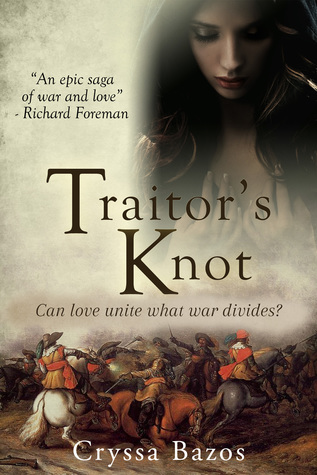
Traitor’s Knot – a review

As anyone knows that has read my guest post ‘From Ostler to Eventer’ on Cryssa Bazos’s website, I found a strong connection to this book through horses. But there was so much more, so, read on for my review.

Traitor's Knot

Traitor’s Knot

by Cryssa Bazos (Goodreads Author)

England 1650: Civil War has given way to an uneasy peace in the year since Parliament executed King Charles I.

Royalist officer James Hart refuses to accept the tyranny of the new government, and to raise funds for the restoration of the king’s son, he takes to the road as a highwayman.

Elizabeth Seton has long been shunned for being a traitor’s daughter. In the midst of the new order, she risks her life by sheltering fugitives from Parliament in a garrison town. But her attempts to rebuild her life are threatened, first by her own sense of injustice, then by falling in love with the dashing Hart.

The lovers’ loyalty is tested through war, defeat and separation. James must fight his way back to the woman he loves, while Elizabeth will do anything to save him, even if it means sacrificing herself.

Review 5*

When I first read the reviews, I added Traitor’s Knot to my Must-Read list. However, I was lucky enough to win a copy in a Giveaway – so many thanks, Cryssa Bazos.

Growing up in England, it was hard not to take sides over the English Civil War so this excellent novel stirred all the right passions and unleashed memories. As a child, I was a Royalist but then switched my loyalties to Parliament as I read more. Then I saw yet another side and wavered again. Therefore, I can feel how many of the characters in Traitor’s Knot struggled with their consciences, although through the author’s words the emotional and physical strife comes vividly alive.

From the first page, I was swept into the past, drawn in by the characters and the action. The setting of the Civil War era felt real and the characters’ behaviour seemed appropriate for the time. I am not a historical expert but nothing jarred and, in fact, there were moments where I nodded my head thinking, ‘That sounds right’. I am convinced that Cryssa Bazos did a great deal of intense research. As a retired equestrian journalist, everything horse-related was accurate and one horse was a character in himself.

The plot was cleverly crafted, with the characters being carefully drawn together as events weaved fate. This was never going to be a smooth ride for James Hart and Elizabeth Seton, and the author made sure of that at every stage. No surprise that I wrote, ‘Beware those Roundheads and their twisted ways’, especially after the opening. One stirred my old animosities and I was ready to make him suffer – that takes great writing.

But knots have ways too. The novel’s title is clever, and knots tie things up in so many ways -I even wanted a ‘knot garden’ and the author delivered. Throughout, there was clever plot development and world building – constructing fiction that felt historical. As a mystery writer, I enjoyed the twists and turns as the plot wove around and away from the obvious. Although I knew my English Civil War, so expected one inevitable outcome – no spoilers, there were unexpected turns of events and I could easily ignore what I knew from school. This was on another more realistic level than dry history text books.

The crafting of the climax was exceptional, building on the strands of the plot, weaving them together in an intricate knot. And the final denouement was so devious and edge of the seat thrilling that I was unable to put the book down even to get some work done.

I look forward to the next novel from Cryssa Bazos.

Story – five stars

Setting/World-building – five stars

Structure – five stars

Readability – five stars

Editing – five stars


Followers of Writing Wings will know that over the last month I have been fortunate to connect with Cryssa Bazos through the English Historical Fiction Authors Blog, and subsequently promoting my novel. Therefore, we have chatted and I may have an idea about what her next novel might be about. But I leave that for her to say.

Cryssa’s website, where there is more about her novel, highwaymen, and the 17th Century, is: https://cryssabazos.com


The Writer’s Cut

Roland_PBookV1

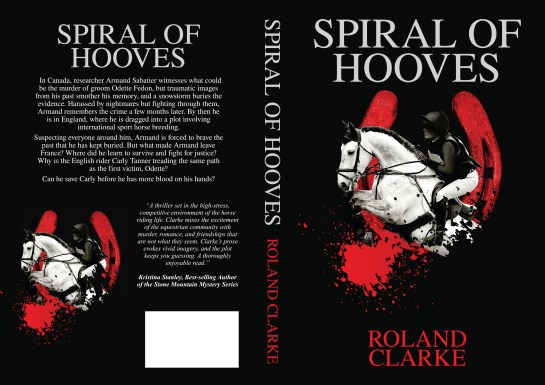
You are invited to the launch of my equestrian mystery Spiral of Hooves: The Writer’s Cut aka The Second Edition on August 7th, 2017, which is incidentally my 64th birthday.

Join me on Facebook or Goodreads as I discuss how the novel came about, my horse world, being an MS warrior, and my future from motorbikes and longboats to spacecraft and airships. I will answer any question posed…within my ability to do so. Of course, there will be prizes from signed copies to other goodies.

The party begins at 9 am. MDT (1600 BST; 1100 EDT; 0800 PST) on Facebook – see HERE for details and invite. (Facebook says in Boise but the party is online so come as you are.) I will also drop in and out of Goodreads to chat and answer questions – HERE – whenever I can slip off Facebook. I am running Giveaways for signed paperback copies of “Spiral of Hooves” – one copy on Facebook, one on Goodreads, and one on each Blog running my ‘interview-promo’ post.

If any authors are willing to join the Facebook party it would let me sit back and chill for an hour – or visit Goodreads – while you entertain the fans and promote yourself. Just ask for a slot and I can add you to the schedule.

ARC copies are still available to read in PDF format, and there is still time to review Spiral of Hooves before the release on August 7th.

I can also supply blog copy to anyone willing to post about the novel and my world. Each blog will be invited to run a Giveaway for a signed paperback copy.

The following links should also direct you to specific Amazon sites:
https://www.createspace.com/3893100
http://www.amazon.com/dp/1548508411
http://www.amazon.ca/dp/1548508411
http://www.amazon.co.uk/dp/1548508411
http://www.amazon.de/dp/1548508411
http://www.amazon.es/dp/1548508411
http://www.amazon.fr/dp/[1548508411
http://www.amazon.it/dp/[1548508411
…………………

  • BLURB: In Canada, researcher Armand Sabatier witnesses what could be the murder of groom Odette Fedon, but traumatic images from his past smother his memory, and a snowstorm buries the evidence. Harassed by nightmares but fighting through them, Armand remembers the crime a few months later. By then he is in England, where he is dragged into a plot involving international sport horse breeding.

Suspecting everyone around him, Armand is forced to brave the past that he has kept buried. But what made Armand leave France? Where did he learn to survive and fight for justice? Why is the English rider Carly Tanner treading the same path as the first victim, Odette?

Can he save Carly before he has more blood on his hands?

  • Genre – Mystery-thriller
  • Tone of the book – serious but not gory
  • Target audience – young adult upwards interested in horses and mysteries

I hope to see you at The Writer’s Cut Party.

//ws-na.amazon-adsystem.com/widgets/q?ServiceVersion=20070822&OneJS=1&Operation=GetAdHtml&MarketPlace=US&source=ac&ref=qf_sp_asin_til&ad_type=product_link&tracking_id=writingwings-20&marketplace=amazon&region=US&placement=B073W3CLDV&asins=B073W3CLDV&linkId=cf6e2a6e43a8dbb58c07611a5c463b6f&show_border=false&link_opens_in_new_window=false&price_color=333333&title_color=0066c0&bg_color=ffffff

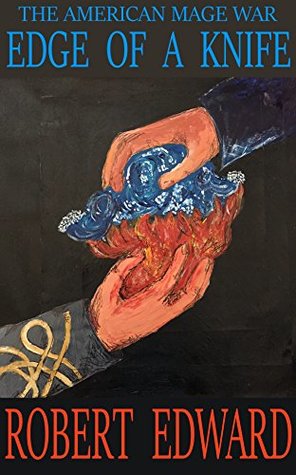
Edge of a Knife – a review


As both a reader and writer, I am fascinated by alternative histories so when Robert Edward mentioned his book on Goodreads, I was game for a read.

EdgeOfAKnife

Edge of a Knife (The American Mage War #1)

by Robert Edward (Goodreads Author)

It has been thirteen years since southern war wizards decisively defeated the Union Army and gained independence for the Confederate States of America. In 1876, the United States is a shattered nation. It stands alone, beset by enemies in a world torn apart by the terrible power of magic. Across the globe, kings and presidents, emperors and generals command sorcerers who harness the four elements of earth, air, water, and fire to wreak havoc on their enemies.
A magical fault line divides North America, where the hydromancers of the United States and pyromancers of the Confederate States maintain an uneasy truce. Both nations race to acquire new and more powerful magic to ensure victory when the next war inevitably comes.
In a Pittsburg tavern, Jared Gilsom, son of a wealthy shipping magnate, smuggler, and part-time thief, meets a strange woman. She has ties to an enigmatic group working both inside and outside the Union government to develop the North’s magical arsenal. A chance battle with southern agents in the city streets draws Jared into their mission. After retrieving a vital treasure from a renegade hydromancer, Jared joins a clandestine raid into the heart of the Confederacy. There, he finds a nation on the brink of its own collapse, where ambitious opportunists wait only for the right moment to seize power.
As Jared and his companions fight their way out of the South, the world continues to spiral into chaos. And magic will either save America or ensure its destruction.

Review 3.8*

My passion for Alternative history began with the American Civil War when I read Ward Moore’s Bring the Jubilee. So, I was drawn to this alternative when again the South was victorious. However, in Robert Edward’s well-crafted world in ‘Edge of a Knife’ magic has somehow emerged although why is a key theme of this novel.

In the opening pages, I was pulled into the story, and this alternative world worked, and the setting of post-alternate American Civil War felt right. At first, the magic was not overt or an all-conquering force. Later in the tale, we discover what has happened to reawaken magic, although Edwards doesn’t reveal all even as the novel concludes. Roll on Book 2 or maybe even in 3.

Anyway, the story was intriguing as it developed, with neat political parallels as well as the central plot. Jared as the main POV character evolved steadily, and a vivid picture emerged, although the others were less vivid – but then we were never inside their heads and nor was Jared. Action in other settings meant that the POV changed, more often to Confederate characters adding another perspective that generated events that crossed with the main character’s quest.

A few scenes from a political perspective felt like exposition, although those scenes added to the world-building and in one case foreshadowed a concluding scene.

At the midpoint, the stakes are raised, and the unexpected twists work. Beyond that key point, there was a sense that the story was building to a climax – a climax that hinted at possible events in Book 2. The events kept racing and twisting as the satisfying ending unfolded. One of the concluding scenes from the perspective of another nation – no spoilers on offer – was unexpected even though subtly foreshadowed. These scenes set up Book 2 and revealed a clever twist that I didn’t see coming.

I recommend the read for those that enjoy alternative history. I can’t say if the American Civil War period is correct, but to me, that felt right. As for stars, I was wavering as I finished the novel between three and four. The inconsistency of some spellings – Pittsburgh with an extra ‘h’ – and some sloppy sentence constructions pointed to a lack of final editing. However, these didn’t ruin the read.

Story – four stars

Setting/World-building – four stars

Structure – four stars

Readability – four stars

Editing – three stars