H is for Honfleur

A2Z-BADGE-100 [2017]

My 2017 A to Z Challenge theme is “The History of Kanata”, the parallel world that is the setting for “Eagle Passage, my alternative history novel that all began when I wondered, “What would have happened if Leif Eriksson had settled Vinland permanently in 1000 AD? For further details and links to my other A to Z posts – and hints at the ones to come visit “Kanata – A to Z Challenge 2017”.

H (1)

H is for Honfleur: 1228 -Wischard Snekker, a shipbuilder, is waterproofing the clinker hull of his latest vessel in the old harbour of Honfleur. A passing stranger remarks in Norman French that it resembles an extended knarr, and he asks what its use will be. When they introduce themselves, they realise their common heritage – as Norwegian Vikings, so speaking in Norwegian, they discuss Wischard’s dream of a ship that can navigate the Great Sea [the Atlantic] with substantial cargo and yet manoeuvre easily and defend itself. The stranger is Keme Migisi, a merchant explorer from distant Kanata, and he shows his new friend sketches of craft that he has observed navigating the Mediterranean and the coastal areas of the Atlantic. He even arrived on a lateen-rigged ship that the Albion fleet obtained in Gascony. Together they design a three-masted ship with the traditional square sail of the Viking ships, plus a foresail and a triangular lateen mizzen, as well as oars for navigating rivers. He will fund the building.

When asked about his Migisi name, Keme admits to family connections that give him access to developments at many European courts which are aiding the Norse connections that are holding Europe together. He values those contacts and they will support their project even though the design must remain a closely guarded secret until they reach Kanata. By spring1229, the Draken Havet Hersker sails laden with a cargo of horses, jewellery, silk, spices, bronze goods, tin ingots, and new settlers willing to brave the crossing and the wilds of Kanata.

Honfleur,_le_vieux_port_(Camille_Corot) (1)

Honfleur, the old port – Jean-Baptiste-Camille Corot  (circa 1824) commons.wikimedia.org

Our timeline: Wikipedia – “Until the 15th century, Europeans were limited to coastal navigation using the barge or the balinger (barinel), ancient cargo vessels of the Mediterranean Sea with a capacity of around 50 to 200 tons. These boats were fragile, with only one mast with a fixed square sail that could not overcome the navigational difficulties of southward oceanic exploration, as the strong windsshoals and strong ocean currents easily overwhelmed their abilities.

The caravel was developed in about 1451, based on existing fishing boats under the sponsorship of Henry the Navigator of Portugal, and soon became the preferred vessel for Portuguese explorers like Diogo CãoBartolomeu Dais or Gaspar and Miguel CorteReal, and by Christopher Columbus. … They were agile and easier to navigate than the barca and barinel, with a tonnage of 50 to 160 tons and 1 to 3 masts, with lateen triangular sails allowing beating.”

However, there was a Portuguese caravel in the English fleet that returned to Gascony in 1226. Yet it was over 200 years before the Age of Discovery began.  When the Ottomans ended the Byzantine Empire with the 1453 conquest of Constantinople by Mehmed the Conqueror, control of the overland trade routes to Cathay and the Far East changed and the Iberians looked to the possibility of finding sea routes east. The Scandinavians had also established trade routes from the Baltic down the river network to Constantinople. But by then, their Greenland colony was struggling and they looked to Europe for their survival.

The shipbuilding technology to cross the Atlantic existed in 1000 AD when Leif Eriksson reached Newfoundland. The additional technology that the Portuguese and Spanish applied 250 years later, existed well before that date. What would be the right motivation for the Scandinavians to apply their extensive shipbuilding skills to build their versions of caravels and explore further afield on the other side of the Atlantic?

***

Important Links for the A to Z Challenge – please use these links to find other A to Z Bloggers

Website: http://www.a-to-zchallenge.com

Facebook page: https://www.facebook.com/atozchallenge/

Twitter handle: @AprilAtoZ

G is for Göta älv

A2Z-BADGE-100 [2017]

My 2017 theme is “The History of Kanata”, the parallel world that is the setting for “Eagle Passage, and the theme reveal is here. I also wrote about this world in my blog post ‘This could be Kanata.

G (1)

G is for Göta älv: In 1036, Harthacnut delays returning from Denmark to England to claim his late father, Cnut the Great’s throne as his rightful heir. Denmark is under threat from Norway, once part of Cnut’s North Sea Empire, comprising Denmark, England, Norway, and parts of Sweden. However, in early 1035 the Danes had been driven out of Norway with Swedish help and Magnus I was crowned King.

An armed delegation of Kanatians, many of Norwegian descent, persuade their Norse brethren to negotiate a treaty at Göta älv in Götland, on the Norwegian-Danish border. Harthacnut and Magnus agree that if either die without an heir, his kingdom would go to the other. The warrior leader of the Kanata delegation, Vefrid Migisi captivates Harthacnut and he proposes to her, asking that her Mjölnir Militia helps him reclaim his English throne. She accepts but Magnus requests that she first persuade the infamous Jomsvikings mercenaries into her army. Two years later, she gives Harthacnut an heir and ensures that a Norse-Anglo-Saxon dynasty will rule Albion.

Magnus_den_godes_saga_-_Magnus_og_Horda-Knut_-_H._Egedius

Imaginative picture of the meeting between Magnus and Harthacnut – (illustration by Halfdan Egedius).

In our timeline: a treaty was agreed at Göta älv in Götland before Harthacnut claimed his English throne. He remained unmarried and had no known children when he died in 1042. His successor was his half-brother Edward the Confessor, which eventually led to various claims to the throne when Edward died – but that is another crucial date in English history, 1066.

Although Magnus I threatened to invade England because of his settlement with Harthacnut. In 1043, Magnus put an end to the Jomsviking threat. He sacked Jomsborg and destroyed the fortress. Magnus was not married but had a daughter out of wedlock, Ragnhild, who married Haakon Ivarsson, a Norwegian nobleman. Her great-grandson would become King Eric III of Denmark.

***

Important Links for the A to Z Challenge – please use these links to find other A to Z Bloggers

Website: http://www.a-to-zchallenge.com

Facebook page: https://www.facebook.com/atozchallenge/

Twitter handle: @AprilAtoZ

Twitter hashtag: #atozchallenge

F is for Franco-Prussian War

A2Z-BADGE-100 [2017]

My 2017 theme is “The History of Kanata”, the parallel world that is the setting for “Eagle Passage, and the theme reveal is here. I also wrote about this world in my blog post ‘This could be Kanata.

F (1)

F is for Franco-Prussian War: (4 August 1870 – 10 May 1871) The conflict was caused by Prussian ambitions to extend German unification and French fears of the shift in the European balance of power that would result if the Prussians succeeded. Prussian ambitions in Europe had become apparent when in 1864 they demanded that Denmark ceded Schleswig-Holstein back to the German people, despite many Danes living in the territory. On 3rd February 1864, a Prussian-Austrian army forced the Danish army to retreat, before promised troops from Sweden-Norway could intervene.

So, when Prussia invaded France across the border near Metz, they were met by a French army bolstered by the elite Mjölnir militia. In three critical defeats of Prussian armies over the next nine months, the cause of German Unification was delayed, although Prussian Chancellor Otto von Bismark, with the intervention of forces of reason on all sides, pursued a path of diplomacy through trade and dynastic marriages emulating the success of the Norse alliances stretching from Kanata to Eastern Rurikid.

French_Cavalry_Officer_Guarding_Captured_Bavarian_Soldiers

A French Cavalry Officer Guarding Captured Bavarian Soldiers, Watercolor with gouache, private collection. (1875). Jean-Baptiste Édouard Detaille (1848–1912)

In our timeline: Denmark did lose Schleswig-Holstein to Prussia, then Prussia continued to unite Germany. France was heavily defeated and lost territory to Germany. As Wikipedia says, “Many historians praise Bismark as a visionary who was instrumental in uniting Germany and, once that had been accomplished, kept the peace in Europe through adroit diplomacy.” When he died a younger Kaiser ruled Germany, one that he clashed with in his final years. “Historians stress that Bismarck’s peace-oriented, ‘saturated continental diplomacy’ was increasingly unpopular because it consciously reined in any expansionist drives. In dramatic contrast stands the ambition of Kaiser Wilhelm II‘s Weltpolitik to secure the Reich’s future through expansion, leading to World War I. Likewise Bismarck’s policy to deny the military a dominant voice in foreign political decision making was overturned by 1914 as Germany became an armed state.”

If German Unification had gone down a different path, would there have been World War I? Would Hitler or Stalin have emerged in a radically reformed Europe with no military superpowers and based on trade?

***

Important Links for the A to Z Challenge – please use these links to find other A to Z Bloggers

Website: http://www.a-to-zchallenge.com

Facebook page: https://www.facebook.com/atozchallenge/

Twitter handle: @AprilAtoZ

Twitter hashtag: #atozchallenge

Insecure and Invalid  

Insecure Writers Support Group Badge


Apologies that I missed my monthly post for Insecure Writer’s Support Group Day, although only by about twenty-four hours. I even have a valid excuse and a doctor’s note – well pages of notes and homework.

Wind back to Monday – basically, I had woken early Monday morning with terrible MS spasms throughout my body. They were so bad that my wife Juanita thought she was losing me, but she helped me through the nightmare. Then throughout the day, there was a growing stream of MS symptoms starting with an inability to type coherently. That was very clear in my final post on Facebook:

“After a terrible night when Juanita Clarke was luckily tere for me, psting is very hard as mystyping everything. So apologies for siaslence.”

From then on, my wife had to keep everyone on Facebook informed of what happened. The shaking became uncontrollable and I slid out of my wheelchair at which point, Juanita rang her granddaughter Jessica, who dashed around to help. Her middle son Jason also arrived. I then vomited up my supper all over the office carpet. Jason phoned 911 and the paramedics arrived in a fire truck and an ambulance.

StLukesbuilding-mer-hospital-lm jpg

I was taken to the ER at St Luke’s Hospital, Meridian where they diagnosed pneumonia which had triggered those MS symptoms. In short, I ended up spending three nights in hospital being pumped with drugs and fluids, sucked of blood, and cared for by a great team at St Luke’s – too many to mention by name but you know who you are, especially if I grilled you about your ancestry or talked incessantly about my writing.

StLukesdsc03910

Throughout this all I missed my wife, Juanita, although she did visit me – at the hospital where she spent two night after her heart attack in late December. Our dogs were always on my thoughts as they couldn’t visit, but I had to confront everything I would lose if I gave up. So now I am back home and posting this explanation for my tardiness and failure to post yesterday.

Yes, I know I posted ‘D is for Donibane’ but some of my A to Z Challenge posts were written and scheduled in advance. However, the last one written and scheduled is ‘I is for Ice’. Hopefully, I can stay ahead, but I won’t be taking Sundays off unless the doctor orders me to rest…. which she has.

10542693_919553014725833_6267297834542028336_o1p1010773-2

E is for Embabeh

A2Z-BADGE-100 [2017]

My 2017 theme is “The History of Kanata”, the parallel world that is the setting for “Eagle Passage, and the theme reveal is here. I also wrote about this world in my blog post ‘This could be Kanata.

E (1)

E is for Embabeh: In 1798, the French Republic sought to capture Egypt as the first stage to threaten Albion-Norse trade in the East, and thus force them to make peace. Napoleon Bonaparte’s first target was the island of Malta, which was under the government of the Knights of St. John and granted its owner control of the Central Mediterranean. As a major location on the trading routes, the harbour of Valletta was a key location. Bonaparte’s forces landed on the island but were repelled by the Knights and a garrison of Mjölnir militia defending Anglo-Norse interests.

Napoleon sailed and landed at Alexandria, meeting the forces of the two local Mamluk rulers at the Battle of Embabeh, on July 21st. He planned to keep the two Georgian Mamluk armies divided by fighting on one bank of the Nile, but Mjölnir militia transported the second stranded army across and helped rout the French. Meanwhile, the Albion navy under Rear-Admiral Sir Horatio Nelson defeated the French navy at Aboukir Bay and the Battle of the Nile.

Although Napoleon fled to France, he engineered a coup in November 1799 and became First Consul of the Republic. His ambition inspired him to go further, and in 1804 he became the first Emperor of the French. However, Albion led a successful coalition to restrict his attempted invasions out of France.

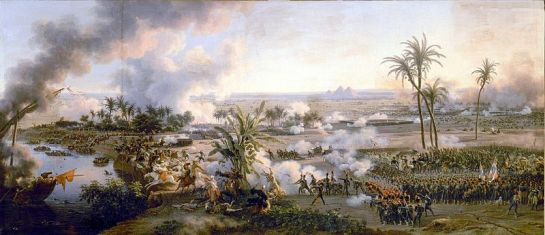
Louis-François_Baron_Lejeune_001

Bataille des Pyramides (1808) – Louis-Francois, Baron Lejeune (1775-1848)

In our timeline: Wikipedia – The Mediterranean campaign of 1798 was a series of major naval operations surrounding a French expeditionary force sent to Egypt under Napoleon Bonaparte during the French Revolutionary Wars. The French Republic sought to capture Egypt as the first stage in an effort to threaten British India, and thus force Great Britain to make peace. Departing Toulon in May 1798 with over 40,000 troops and hundreds of ships, Bonaparte’s fleet sailed southeastwards across the Mediterranean Sea. They were followed by a small British squadron under Rear-Admiral Sir Horatio Nelson, later reinforced to 13 ships of the line… Bonaparte’s first target was the island of Malta, which was under the government of the Knights of St. John and theoretically granted its owner control of the Central Mediterranean. Bonaparte’s forces landed on the island and rapidly overwhelmed the defenders, securing the port city of Valletta before continuing to Egypt.

[After landing in Egypt and fighting a minor skirmish, Napoleon advanced on Alexandria.] On 2 Thermidor (20 July), the French army arrived half a mile from the village of Embabé. The heat was unbearable and the army was exhausted and needed a rest, but there was not enough time and so Bonaparte drew up his 25,000 troops for battle approximately nine miles (15 km) from the Pyramids of Giza… This was the start of the so-called Battle of the Pyramids, [also known as the Battle of Embabeh], a French victory over an enemy force of about 21,000 Mamluks. (Around 40,000 Mamluk soldiers stayed away from the battle.) The French defeated the Mamluk cavalry with a giant infantry square, with cannons and supplies safely on the inside. In all 300 French and approximately 6,000 Egyptians were killed. The battle gave rise to dozens of stories and drawings.

On the scientific front, the expedition led to the discovery of the Rosetta Stone, creating the field of Egyptology. Despite many decisive victories and an initially successful expedition into Syria, Napoleon and his Armée d’Orient were eventually forced to withdraw, after sowing political disharmony in France, experiencing conflict in Europe, and suffering the defeat [by Horatio Nelson] of the supporting French fleet at the Battle of the Nile.

However, could events have taken a different course? Napoleon did engineer the coup and later became the Emperor of the French and then invaded successive countries. But who could have stopped him before the retreat from Moscow, or later before Waterloo?

***

Important Links for the A to Z Challenge – please use these links to find other A to Z Bloggers

Website: http://www.a-to-zchallenge.com

Facebook page: https://www.facebook.com/atozchallenge/

Twitter handle: @AprilAtoZ

Twitter hashtag: #atozchallenge

D is for Donibane

A2Z-BADGE-100 [2017]

My 2017 theme is “The History of Kanata”, the parallel world that is the setting for “Eagle Passage, and the theme reveal is here. I also wrote about this world in my blog post ‘This could be Kanata.

D

D is for Donibane: The firm of Migisi Rederi have decided to attempt winning the Daily Mail £10,000 Flight Across Atlantic prize that is on offer to the first person to make the trans-Atlantic crossing by air in seventy-two hours. This substantial prize is open to pilots of any nationality, and machines of foreign or Albion construction, so the Kanatian freight company builds a hundred and six-meter semi-rigid airship, Dajoji. On 14th June 1914, the airship leaves Donibane, Vineland with its crew of seven including Juhán Allekuk, Arto Brune, and Janna Migisi.

27 hours later, Dajoji reaches Galway, in Ériu [Ireland], ahead of their competitors; although, they have rescued the French aviators from the downed Blériot Aéronautique plane. The Migisi Rederi achievement heralds a new dawn for airships as the principal means of air travel since their fleet of small airships is already carrying goods within Kanata.

The problem of flammable gases like hydrogen had been significantly reduced by the discovery of vast quantities of helium under the central Great Plains area of both Kanata and the Dixie States in 1903, following an oil drilling operation.


R34

Landing of British dirigible R-34 at Mineola, Long Island, N.Y. 1919 – Photo: United States Library of Congress


In our timeline: Wikipedia – In April 1913 the London newspaper The Daily Mail offered a prize of £10,000 (₤887414 in 2015) to

“the aviator who shall first cross the Atlantic in an aeroplane in flight from any point in the United States of America, Canada or Newfoundland and any point in Great Britain or Ireland” in 72 continuous hours”.

The competition was suspended with the outbreak of war in 1914 but reopened after Armistice was declared in 1918. The possibility of transatlantic flight by aircraft emerged after the First World War, which had seen tremendous advances in aerial capabilities.

During 14–15 June 1919, the British aviators Alcock and Brown made the first non-stop transatlantic flight in a Vickers Vimy IV. The Vimy twin-engined bomber was converted for the long flight by replacing its bomb racks with extra petrol tanks.

Pilot John Alcock and navigator Arthur Brown flew the modified Vickers Vimy, powered by two Rolls-Royce Eagle 360 hp engines. It was not an easy flight, with unexpected fog, and a snow storm almost causing the crewmen to crash into the sea. They made landfall in Galway at 8:40 a.m. on 15 June 1919, not far from their intended landing place, after less than sixteen hours of flying.

The Secretary of State for AirWinston Churchill, presented Alcock and Brown with the Daily Mail prize for the first crossing of the Atlantic Ocean in “less than 72 consecutive hours”. There was a small amount of mail carried on the flight making it also the first transatlantic airmail flight.

The first transatlantic flight by rigid airship, and the first return transatlantic flight, was made just a couple of weeks after the flight of Alcock and Brown, on 2 July 1919. Major George Herbert Scott of the Royal Air Force flew the airship R34 with his crew and passengers from RAF East Fortune, Scotland to Mineola, New York (on Long Island), covering a distance of about 3,000 statute miles (4,800 km) in about four and a half days. The flight was intended as a testing ground for post-war commercial services by airship (see Imperial Airship Scheme), and it was the first flight to transport paying passengers. The R34 wasn’t built as a passenger carrier, and extra accommodation was arranged by slinging hammocks in the keel walkway. The return journey to Pulham in Norfolk, England, was from 10 to 13 July and it took 75 hours.

The two primary lifting gases used by airships have been hydrogen and helium.

Hydrogen is the earth’s lightest element, and it can be obtained easily and inexpensively, but its flammability makes it unacceptable for manned airship operations.

In addition to the famous Hindenburg disaster, dozens of hydrogen airships were destroyed by fire, and no American airship has been inflated with hydrogen since the crash of the U.S. Army airship Roma in 1922.  The use of hydrogen as a lifting gas for passenger airships was completely abandoned by the late 1930s.

Helium’s non-flammable nature makes it the only practical lifting gas for manned lighter-than-air flight, but it is scarce and expensive, and the use of helium can reduce a rigid airship’s payload by more than half. The USS Shenandoah ZR-1 made its first flight on September 4, 1923.  It was the first ascent of a helium inflated rigid airship in history.

After an oil drilling operation in 1903 in Dexter, Kansas, helium was found concentrated in large quantities under the American Great Plains, available for extraction as a by-product of natural gas. However, it was not available in any quantity until the 1920s.

Could airships have ever out-performed planes? Was the earlier discovery of helium as a lifting gas the catalyst?


***

Important Links for the A to Z Challenge – please use these links to find other A to Z Bloggers

Website: http://www.a-to-zchallenge.com

Facebook page: https://www.facebook.com/atozchallenge/

Twitter handle: @AprilAtoZ

Twitter hashtag: #atozchallenge