G is for Göta älv

A2Z-BADGE-100 [2017]

My 2017 theme is “The History of Kanata”, the parallel world that is the setting for “Eagle Passage, and the theme reveal is here. I also wrote about this world in my blog post ‘This could be Kanata.

G (1)

G is for Göta älv: In 1036, Harthacnut delays returning from Denmark to England to claim his late father, Cnut the Great’s throne as his rightful heir. Denmark is under threat from Norway, once part of Cnut’s North Sea Empire, comprising Denmark, England, Norway, and parts of Sweden. However, in early 1035 the Danes had been driven out of Norway with Swedish help and Magnus I was crowned King.

An armed delegation of Kanatians, many of Norwegian descent, persuade their Norse brethren to negotiate a treaty at Göta älv in Götland, on the Norwegian-Danish border. Harthacnut and Magnus agree that if either die without an heir, his kingdom would go to the other. The warrior leader of the Kanata delegation, Vefrid Migisi captivates Harthacnut and he proposes to her, asking that her Mjölnir Militia helps him reclaim his English throne. She accepts but Magnus requests that she first persuade the infamous Jomsvikings mercenaries into her army. Two years later, she gives Harthacnut an heir and ensures that a Norse-Anglo-Saxon dynasty will rule Albion.

Magnus_den_godes_saga_-_Magnus_og_Horda-Knut_-_H._Egedius

Imaginative picture of the meeting between Magnus and Harthacnut – (illustration by Halfdan Egedius).

In our timeline: a treaty was agreed at Göta älv in Götland before Harthacnut claimed his English throne. He remained unmarried and had no known children when he died in 1042. His successor was his half-brother Edward the Confessor, which eventually led to various claims to the throne when Edward died – but that is another crucial date in English history, 1066.

Although Magnus I threatened to invade England because of his settlement with Harthacnut. In 1043, Magnus put an end to the Jomsviking threat. He sacked Jomsborg and destroyed the fortress. Magnus was not married but had a daughter out of wedlock, Ragnhild, who married Haakon Ivarsson, a Norwegian nobleman. Her great-grandson would become King Eric III of Denmark.

***

Important Links for the A to Z Challenge – please use these links to find other A to Z Bloggers

Website: http://www.a-to-zchallenge.com

Facebook page: https://www.facebook.com/atozchallenge/

Twitter handle: @AprilAtoZ

Twitter hashtag: #atozchallenge

F is for Franco-Prussian War

A2Z-BADGE-100 [2017]

My 2017 theme is “The History of Kanata”, the parallel world that is the setting for “Eagle Passage, and the theme reveal is here. I also wrote about this world in my blog post ‘This could be Kanata.

F (1)

F is for Franco-Prussian War: (4 August 1870 – 10 May 1871) The conflict was caused by Prussian ambitions to extend German unification and French fears of the shift in the European balance of power that would result if the Prussians succeeded. Prussian ambitions in Europe had become apparent when in 1864 they demanded that Denmark ceded Schleswig-Holstein back to the German people, despite many Danes living in the territory. On 3rd February 1864, a Prussian-Austrian army forced the Danish army to retreat, before promised troops from Sweden-Norway could intervene.

So, when Prussia invaded France across the border near Metz, they were met by a French army bolstered by the elite Mjölnir militia. In three critical defeats of Prussian armies over the next nine months, the cause of German Unification was delayed, although Prussian Chancellor Otto von Bismark, with the intervention of forces of reason on all sides, pursued a path of diplomacy through trade and dynastic marriages emulating the success of the Norse alliances stretching from Kanata to Eastern Rurikid.

French_Cavalry_Officer_Guarding_Captured_Bavarian_Soldiers

A French Cavalry Officer Guarding Captured Bavarian Soldiers, Watercolor with gouache, private collection. (1875). Jean-Baptiste Édouard Detaille (1848–1912)

In our timeline: Denmark did lose Schleswig-Holstein to Prussia, then Prussia continued to unite Germany. France was heavily defeated and lost territory to Germany. As Wikipedia says, “Many historians praise Bismark as a visionary who was instrumental in uniting Germany and, once that had been accomplished, kept the peace in Europe through adroit diplomacy.” When he died a younger Kaiser ruled Germany, one that he clashed with in his final years. “Historians stress that Bismarck’s peace-oriented, ‘saturated continental diplomacy’ was increasingly unpopular because it consciously reined in any expansionist drives. In dramatic contrast stands the ambition of Kaiser Wilhelm II‘s Weltpolitik to secure the Reich’s future through expansion, leading to World War I. Likewise Bismarck’s policy to deny the military a dominant voice in foreign political decision making was overturned by 1914 as Germany became an armed state.”

If German Unification had gone down a different path, would there have been World War I? Would Hitler or Stalin have emerged in a radically reformed Europe with no military superpowers and based on trade?

***

Important Links for the A to Z Challenge – please use these links to find other A to Z Bloggers

Website: http://www.a-to-zchallenge.com

Facebook page: https://www.facebook.com/atozchallenge/

Twitter handle: @AprilAtoZ

Twitter hashtag: #atozchallenge

E is for Embabeh

A2Z-BADGE-100 [2017]

My 2017 theme is “The History of Kanata”, the parallel world that is the setting for “Eagle Passage, and the theme reveal is here. I also wrote about this world in my blog post ‘This could be Kanata.

E (1)

E is for Embabeh: In 1798, the French Republic sought to capture Egypt as the first stage to threaten Albion-Norse trade in the East, and thus force them to make peace. Napoleon Bonaparte’s first target was the island of Malta, which was under the government of the Knights of St. John and granted its owner control of the Central Mediterranean. As a major location on the trading routes, the harbour of Valletta was a key location. Bonaparte’s forces landed on the island but were repelled by the Knights and a garrison of Mjölnir militia defending Anglo-Norse interests.

Napoleon sailed and landed at Alexandria, meeting the forces of the two local Mamluk rulers at the Battle of Embabeh, on July 21st. He planned to keep the two Georgian Mamluk armies divided by fighting on one bank of the Nile, but Mjölnir militia transported the second stranded army across and helped rout the French. Meanwhile, the Albion navy under Rear-Admiral Sir Horatio Nelson defeated the French navy at Aboukir Bay and the Battle of the Nile.

Although Napoleon fled to France, he engineered a coup in November 1799 and became First Consul of the Republic. His ambition inspired him to go further, and in 1804 he became the first Emperor of the French. However, Albion led a successful coalition to restrict his attempted invasions out of France.

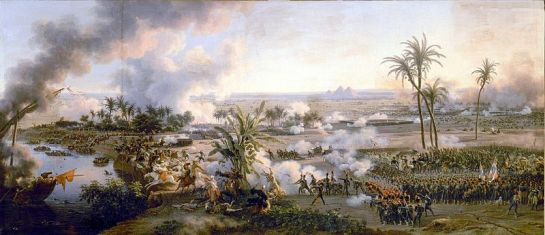
Louis-François_Baron_Lejeune_001

Bataille des Pyramides (1808) – Louis-Francois, Baron Lejeune (1775-1848)

In our timeline: Wikipedia – The Mediterranean campaign of 1798 was a series of major naval operations surrounding a French expeditionary force sent to Egypt under Napoleon Bonaparte during the French Revolutionary Wars. The French Republic sought to capture Egypt as the first stage in an effort to threaten British India, and thus force Great Britain to make peace. Departing Toulon in May 1798 with over 40,000 troops and hundreds of ships, Bonaparte’s fleet sailed southeastwards across the Mediterranean Sea. They were followed by a small British squadron under Rear-Admiral Sir Horatio Nelson, later reinforced to 13 ships of the line… Bonaparte’s first target was the island of Malta, which was under the government of the Knights of St. John and theoretically granted its owner control of the Central Mediterranean. Bonaparte’s forces landed on the island and rapidly overwhelmed the defenders, securing the port city of Valletta before continuing to Egypt.

[After landing in Egypt and fighting a minor skirmish, Napoleon advanced on Alexandria.] On 2 Thermidor (20 July), the French army arrived half a mile from the village of Embabé. The heat was unbearable and the army was exhausted and needed a rest, but there was not enough time and so Bonaparte drew up his 25,000 troops for battle approximately nine miles (15 km) from the Pyramids of Giza… This was the start of the so-called Battle of the Pyramids, [also known as the Battle of Embabeh], a French victory over an enemy force of about 21,000 Mamluks. (Around 40,000 Mamluk soldiers stayed away from the battle.) The French defeated the Mamluk cavalry with a giant infantry square, with cannons and supplies safely on the inside. In all 300 French and approximately 6,000 Egyptians were killed. The battle gave rise to dozens of stories and drawings.

On the scientific front, the expedition led to the discovery of the Rosetta Stone, creating the field of Egyptology. Despite many decisive victories and an initially successful expedition into Syria, Napoleon and his Armée d’Orient were eventually forced to withdraw, after sowing political disharmony in France, experiencing conflict in Europe, and suffering the defeat [by Horatio Nelson] of the supporting French fleet at the Battle of the Nile.

However, could events have taken a different course? Napoleon did engineer the coup and later became the Emperor of the French and then invaded successive countries. But who could have stopped him before the retreat from Moscow, or later before Waterloo?

***

Important Links for the A to Z Challenge – please use these links to find other A to Z Bloggers

Website: http://www.a-to-zchallenge.com

Facebook page: https://www.facebook.com/atozchallenge/

Twitter handle: @AprilAtoZ

Twitter hashtag: #atozchallenge

D is for Donibane

A2Z-BADGE-100 [2017]

My 2017 theme is “The History of Kanata”, the parallel world that is the setting for “Eagle Passage, and the theme reveal is here. I also wrote about this world in my blog post ‘This could be Kanata.

D

D is for Donibane: The firm of Migisi Rederi have decided to attempt winning the Daily Mail £10,000 Flight Across Atlantic prize that is on offer to the first person to make the trans-Atlantic crossing by air in seventy-two hours. This substantial prize is open to pilots of any nationality, and machines of foreign or Albion construction, so the Kanatian freight company builds a hundred and six-meter semi-rigid airship, Dajoji. On 14th June 1914, the airship leaves Donibane, Vineland with its crew of seven including Juhán Allekuk, Arto Brune, and Janna Migisi.

27 hours later, Dajoji reaches Galway, in Ériu [Ireland], ahead of their competitors; although, they have rescued the French aviators from the downed Blériot Aéronautique plane. The Migisi Rederi achievement heralds a new dawn for airships as the principal means of air travel since their fleet of small airships is already carrying goods within Kanata.

The problem of flammable gases like hydrogen had been significantly reduced by the discovery of vast quantities of helium under the central Great Plains area of both Kanata and the Dixie States in 1903, following an oil drilling operation.


R34

Landing of British dirigible R-34 at Mineola, Long Island, N.Y. 1919 – Photo: United States Library of Congress


In our timeline: Wikipedia – In April 1913 the London newspaper The Daily Mail offered a prize of £10,000 (₤887414 in 2015) to

“the aviator who shall first cross the Atlantic in an aeroplane in flight from any point in the United States of America, Canada or Newfoundland and any point in Great Britain or Ireland” in 72 continuous hours”.

The competition was suspended with the outbreak of war in 1914 but reopened after Armistice was declared in 1918. The possibility of transatlantic flight by aircraft emerged after the First World War, which had seen tremendous advances in aerial capabilities.

During 14–15 June 1919, the British aviators Alcock and Brown made the first non-stop transatlantic flight in a Vickers Vimy IV. The Vimy twin-engined bomber was converted for the long flight by replacing its bomb racks with extra petrol tanks.

Pilot John Alcock and navigator Arthur Brown flew the modified Vickers Vimy, powered by two Rolls-Royce Eagle 360 hp engines. It was not an easy flight, with unexpected fog, and a snow storm almost causing the crewmen to crash into the sea. They made landfall in Galway at 8:40 a.m. on 15 June 1919, not far from their intended landing place, after less than sixteen hours of flying.

The Secretary of State for AirWinston Churchill, presented Alcock and Brown with the Daily Mail prize for the first crossing of the Atlantic Ocean in “less than 72 consecutive hours”. There was a small amount of mail carried on the flight making it also the first transatlantic airmail flight.

The first transatlantic flight by rigid airship, and the first return transatlantic flight, was made just a couple of weeks after the flight of Alcock and Brown, on 2 July 1919. Major George Herbert Scott of the Royal Air Force flew the airship R34 with his crew and passengers from RAF East Fortune, Scotland to Mineola, New York (on Long Island), covering a distance of about 3,000 statute miles (4,800 km) in about four and a half days. The flight was intended as a testing ground for post-war commercial services by airship (see Imperial Airship Scheme), and it was the first flight to transport paying passengers. The R34 wasn’t built as a passenger carrier, and extra accommodation was arranged by slinging hammocks in the keel walkway. The return journey to Pulham in Norfolk, England, was from 10 to 13 July and it took 75 hours.

The two primary lifting gases used by airships have been hydrogen and helium.

Hydrogen is the earth’s lightest element, and it can be obtained easily and inexpensively, but its flammability makes it unacceptable for manned airship operations.

In addition to the famous Hindenburg disaster, dozens of hydrogen airships were destroyed by fire, and no American airship has been inflated with hydrogen since the crash of the U.S. Army airship Roma in 1922.  The use of hydrogen as a lifting gas for passenger airships was completely abandoned by the late 1930s.

Helium’s non-flammable nature makes it the only practical lifting gas for manned lighter-than-air flight, but it is scarce and expensive, and the use of helium can reduce a rigid airship’s payload by more than half. The USS Shenandoah ZR-1 made its first flight on September 4, 1923.  It was the first ascent of a helium inflated rigid airship in history.

After an oil drilling operation in 1903 in Dexter, Kansas, helium was found concentrated in large quantities under the American Great Plains, available for extraction as a by-product of natural gas. However, it was not available in any quantity until the 1920s.

Could airships have ever out-performed planes? Was the earlier discovery of helium as a lifting gas the catalyst?


***

Important Links for the A to Z Challenge – please use these links to find other A to Z Bloggers

Website: http://www.a-to-zchallenge.com

Facebook page: https://www.facebook.com/atozchallenge/

Twitter handle: @AprilAtoZ

Twitter hashtag: #atozchallenge

C is for Cristóbal Colón

A2Z-BADGE-100 [2017]

My 2017 theme is “The History of Kanata”, the parallel world that is the setting for “Eagle Passage, and the theme reveal is here. I also wrote about this world in my blog post ‘This could be Kanata.

C

C is for Cristóbal Colón: On 12 October 1492, the three ships of Cristóbal Colón are met off the Bahamas by two well-armed vessels that echo Viking longships with dragon prows, but with caravel features like three masts and lateen sails. Although the Spanish are armed so are the ‘Vikings’, who also have swivel cannons on their ships. The Norse commander says that he is, “Njal Migisi, follower of Thor, here by the blessings of the people of these islands. The Lukku-Cairi are under the protection of the Kanata Konføderasjon.”

Cristóbal Colón orders his men to stand down and the Spaniards are granted anchorage and re-supplied from an established trading port, but then sent away. The Kanatians know that the Spanish will try to settle on the mainland, but will face a Mesoamerican alliance that is prepared for Europeans, their weapons, and diseases.

The Spanish do establish settlements but are forced to co-operate with the Mesoamericans, although with consequences for their neighbours.


Columbus Day 2012 watermark

This is how Courtney imagines things would have happened in 1492 if Simon and River were present. Copyright and more at http://bunnies-and-sunshine.blogspot/2012/happy-columbus-day.html


In our timeline:

“In fourteen hundred ninety-two
Columbus sailed the ocean blue.

He had three ships and left from Spain;
He sailed through sunshine, wind and rain.

He sailed by night; he sailed by day;
He used the stars to find his way.”

Do I need to recite the rest of the poem, or remind people of all the controversy surrounding Columbus’ arrival in the New World and how the continent was settled by Europeans and other nations? History  is a good starting link for the Columbus story, and then there is the view from the other perspective that some might call revisionist. Although, this is a 1992 article, the movement keeps growing, especially on Columbus Day. Personally, as a historian and of Chilean origin, I lean heavily towards the indigenous rights viewpoint, as will become clear as Kanata evolves.

But if Leif Eriksson and the Vikings had stayed in Newfoundland and spread inland, would the First Nations have fared any better, although Eriksson had converted to Christianity? I have chosen a Saami shamaness as my catalyst for change, but what would have been needed to avoid the terrible mistakes made by the later Europeans?


***

Important Links for the A to Z Challenge – please use these links to find other A to Z Bloggers

Website: http://www.a-to-zchallenge.com

Facebook page: https://www.facebook.com/atozchallenge/

Twitter handle: @AprilAtoZ

Twitter hashtag: #atozchallenge

B is for Bouvines

A2Z-BADGE-100 [2017]

My 2017 theme is “The History of Kanata”, the parallel world that is the setting for “Eagle Passage, and the theme reveal is here. I also wrote about this world in my blog post ‘This could be Kanata.

B

B is for Bouvines: 1214 – A dynasty of Norse-Anglo-Saxons has ruled Albion [Great Britain] for over one hundred and fifty years after some settlers from Kanata ensured the dynasty of Cnut the Great continued. King Arthur II of Albion and his allies in Normandy and Anjou face a claim by Phillipe of France on their French territories. On 27 July 1214, backed by the Holy Roman Emperor, Otto IV. the Albion infantry along with the might of their Mjölnir Militia and the Norman cavalry, prevails at the Battle of Bouvines, leaving the French struggling for allies. Bouvines shifts the balance of power in Europe, but can the nation states avoid war sweeping across the continent or can the extensive Norse trade network from Kanata to Constantinople hold sway?

Mjölnir is the hammer of Thor, worn as an amulet by many Viking warriors, although the bow symbol of the goddess Skaði was favoured by her followers. The Mjölnir Militia arose in Kanata to protect the trading settlements not as Viking marauders. The militia had a strict code of honour and indigenous warriors joined their ranks willingly. A detachment of the Mjölnir Militia was instrumental in ensuring that Cnut the Great’s dynasty continued in 1036, having amalgamated with the legendary Jomsvikings at the request of Magnus I of Norway.


712px-St_Pol

Stained glass inside St. Peter’s church, in Bouvines, Nord. France: Saint-Pol endangers the Flemish army. Photo – Copyright Benjamin Smith / Wikimedia Commons


In our timeline: Wikipedia – The Battle of Bouvines, which took place on 27 July 1214, was a medieval battle which ended the 1202–1214 Anglo-French War. It was fundamental in the early development of France in the Middle Ages by confirming the French crown’s sovereignty over the Angevin lands of Brittany and Normandy.

Philip Augustus of France defeated an army consisting of Imperial German, English and Flemish soldiers, led by Otto IV, Holy Roman Emperor in the north…and King John of England, Otto’s maternal uncle and ally. Allied with Philip was Frederick II Hohenstaufen, who controlled the southern Holy Roman Empire and afterwards deposed Otto.

Philip returned to Paris triumphant, marching his captive prisoners behind him in a long procession, as his grateful subjects came out to greet the victorious king. In the aftermath of the battle, Otto retreated to his castle of Harzburg and was soon overthrown as Holy Roman Emperor by Frederick II, who had already been recognised as emperor in the south a year and a half prior.

King John obtained a five-year truce, on very lenient terms given the circumstances.

Philip’s decisive victory was crucial in ordering politics in both England and France. In the former, so weakened was the defeated King John of England that he soon needed to submit to his barons’ demands and agree to the Magna Carta, limiting the power of the crown and establishing the basis for common law.[19] In the latter, the battle was instrumental in forming the strong central monarchy that would characterize France until the first French Revolution. It was also the first battle in the Middle Ages in which the full value of infantry was realised.

Philip conquered most of Plantagenet’s continental possessions, namely AnjouBrittanyMaineNormandy, and the Touraine, leading to the effective end of the Angevin Empire.


***

Important Links for the A to Z Challenge – please use these links to find other A to Z Bloggers

Website: http://www.a-to-zchallenge.com

Facebook page: https://www.facebook.com/atozchallenge/

Twitter handle: @AprilAtoZ

Twitter hashtag: #atozchallenge