The Warrior’s Path – a review

My reading to explore diversity and minority rights issues continues with The Warrior’s Path. This is the first Book in the When Women Were Warriors fantasy trilogy that I became aware of when I first embarked on this quest to move beyond the narrow taboos of modern society. However, this novel was in many ways different from the first read on this journey of enlightenment.

Warrior's Path

The Warrior’s Path (When Women Were Warriors #1)

by Catherine M. Wilson (Goodreads Author)

When she was a child, the author of When Women Were Warriors happily identified with all the male heroes she read about in stories that began, “Once upon a time, a young man went out to seek his fortune.” But she would have been delighted to discover even one story like that with a female protagonist. Since she never did find the story she was looking for all those years ago, she decided to write it.

In Book I of the trilogy, Tamras arrives in Merin’s house to begin her apprenticeship as a warrior, but her small stature causes many, including Tamras herself, to doubt that she will ever become a competent swordswoman. To make matters worse, the Lady Merin assigns her the position of companion, little more than a personal servant, to a woman who came to Merin’s house, seemingly out of nowhere, the previous winter, and this stranger wants nothing to do with Tamras.


Review 5 stars

When Tamras sets out on her journey to become a warrior, the evocative language makes it clear that this is a world of women warriors and her family is part of this tradition. However, the Path is not easy from the moment that Lady Merin assigns her to the position of companion to the introverted stranger, Maara whose past is a mystery.

The writing wove a spell akin to listening to a storyteller. Beautiful poetic phrases kept me reading. The opening flowed and wove me in like one of those fireside tales and held my attention throughout.

The tale is not rushed but Tamras has many things to learn at Lady Merin’s house and throughout there is always the feeling of things to come. We learn with her and yet Tamras already has the seeds of some wisdom in herself, but she must understand through situations and encounters. She grows as she discovers more about herself, about Maara, and about other characters – and they also grow.

This is a beautifully-rendered matriarchal society where the Mother is at the heart of the community. The whole mystical aspect of the Mother is portrayed in believable scenes filled with a deeply spiritual and sensual weaving that evoked in me images of shamanic journeys. The Mother relationship to the Child takes on a more profound meaning towards the closing scenes.

Realistic same-sex relations are the norm and they are the fabric that holds the society together – reminding me of the bonds forged by the male warriors of Sparta. The topic is treated as the norm, alongside the female-male relationships that many aspire to. This aspect was handled subtly as with many aspects of the telling. This is a rich and thriving community that is painted well – elements easing into place as the tale progresses.

The characterisation is rich and worth the steady pace as the seasons change. So many emotions are explored but not rammed at the reader. As winter drifts in then grips the world in its embrace, emotions and relationships are tested. The pace is raised as the tension mounts, but Catherine Wilson is never tempted to let frantic pace outstrip her crafted storytelling.

Words of great wisdom are crafted into the unfolding interactions – like some epic tales. Some characters show great insight, much of it gained with age and experience. Yet, other characters are shown as hasty in their actions and decisions. Spring brings new growth and change in any world so well-painted.

The inevitable conflicts sow seeds for later in the Book and in the trilogy. I was expecting frustrating loose ends, as in some other fantasy trilogies, but the closing scenes were warmly satisfying. The most pressing threads were tied up but more than enough simmered under the surface for Book 2. I came to rest in a comfortable place – one that reminded me of when I had finished The Fellowship of the Ring.

However, as with The Lord of the Rings, I couldn’t wait to buy Book 2 and Journey of the Heart has moved top of my ‘Must Reads’ list.

Story – five stars

Setting/World-building – five stars

Diversity – five stars

Characters – five stars

Structure – five stars

Readability – five stars

Editing – five stars
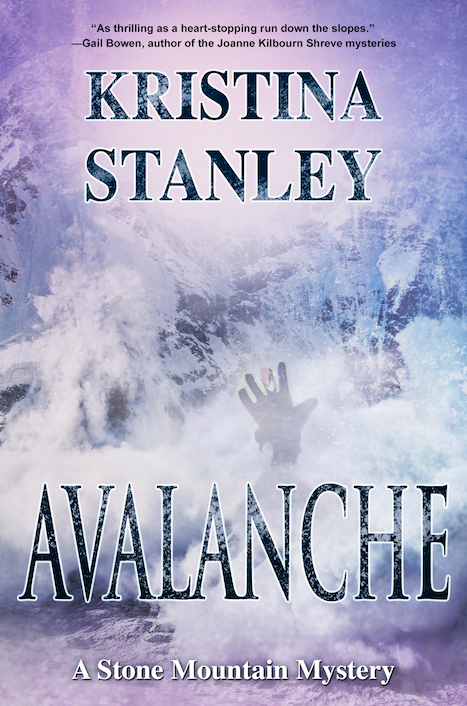
 

Avalanche – a review

Kristina Stanley is one of my writing inspirations through her Stone Mountain mysteries. For the release of Avalanche in 2016, I ran her thoughts on ‘Writing A Series’ which encouraged me in writing my Welsh police procedural. Why I put off reading Avalanche until now is another mystery, especially as I rated the first two books as five stars each.

Anyway, that lapse is now corrected so here’s my review:

Avalanche Cover Final 

Avalanche (A Stone Mountain Mystery #3)

by Kristina Stanley (Goodreads Author)

On a cold winter morning, the safe at Stone Mountain Resort is robbed, and Kalin Thompson’s brother, Roy, suspiciously disappears. As Director of Security, Kalin would normally lead the investigation, but when her brother becomes the prime suspect, she is ordered to stay clear.

The police and the president of the resort turn their sights on Kalin, who risks everything to covertly attempt to clear Roy’s name. As threats against her escalate, she moves closer to uncovering the guilty party. Is Kalin’s faith in her brother justified? Or will the truth destroy her?

Editorial Reviews:

“A mountain as deadly as it is majestic; characters far too familiar with the Seven Deadly Sins and murder—Kristina Stanley’s Avalanche has it all. This fast-paced mystery is as thrilling as a heart-stopping run down the slopes.” —Gail Bowen, author of the Joanne Kilbourn Shreve mysteries

“Layer upon layer, like snow building for an avalanche, Stanley weaves a story that keeps you guessing. You can’t turn the pages fast enough.” —Jeff Buick, author of Bloodline

“Avalanche smashes and uproots relationships in Stone Mountain Resort, leaving devastation in its wake. With as many layers as winter’s snow, this whodunit will keep you turning pages and guessing to the end.” —James M. Jackson, author of the Seamus McCree Series (less)

*

Review – 5 stars

Although Kristina Stanley says at the end of the novel that she wrote Avalanche first, this became the third book in the series. Having read and enjoyed the first two Stone Mountain mysteries, I recommend them all and suggest reading them in order. Once again, Kalin Thompson is the main protagonist, but characters from previous books return and previous incidents are cleverly referred adding to the backstory.

From the fast-moving opening when Kalin’s brother, Roy, suspiciously disappears, the plot twists and turns with enough clues and suspects to keep the reader thinking to the end.

There are multiple suspects when the safe at Stone Mountain Resort is robbed, but with Ray as the prime suspect, Kalin must act covertly to clear his name. How she handles her discoveries and her torn feelings about her brother’s guilt drive the main thread of the novel.

The story is tightly plotted, well-structured and, as I noted down while reading, it’s ‘edge of my snowmobile tense’. There are various suspects when the Royal Canadian Mounted Police begin investigating from Ray to Kalin via other employees at Stone Mountain Resort. I kept wondering, ‘Who will be next?’, ‘Who is guilty of what?’ and ‘Who do you trust?’. Not only Kalin needed to be wary but others caught up in the events as the threat level escalated.

The suspects were gradually narrowed down, although there were enough remaining as the end drew near. Plus, the accusations against Kalin were ongoing, adding to the tension. Twists kept coming, leading to the final confrontation that I only half-guessed in advance. Key elements were cleverly foreshadowed.

The author’s characterisation is excellent in that everyone has something to distinguish them – even the lift-girl from New Zealand. The reader sees the other characters through Kalin’s eyes and through other characters’ viewpoint. The use of various POVs enhances the story and adds to the subplots, diversions and to the red herrings that I always enjoy in a mystery.

The resort offers an evocative setting and Kristina Stanley’s knowledge of that world rings true without creating unnecessary detail. From my time in Canada and my winters skiing on different hills, Stone Mountain Resort and the intrigues came alive for me.

Avalanche was a fast-paced and easy read, and, as I’ve come to expect from Kristina Stanley, and from Imajin Books, it’s well-edited. A definite recommendation if you want a pacey mystery. But read Descent and Blaze first for maximum enjoyment – not vital but best.

Story – five stars

Setting/World-building – five stars

Characters – five stars

Structure – five stars

Readability – five stars

Editing – five stars
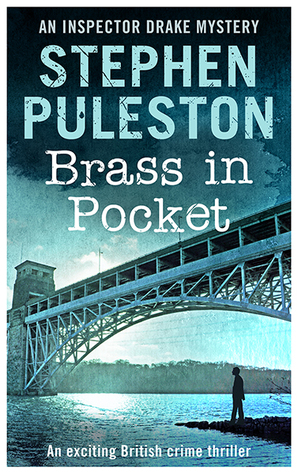
 

Brass in Pocket – a review

Amid my factual research for my North Wales mysteries, I’m trying to read the few Wales-based crime novels that have been written in the last decade. However, the first fictional Welsh policeman that I encountered was Rhys Bowen’s Constable Evan Evans in Evan’s Gate the eighth in her series set in Wales. I need to read the other nine, having found this one on a market stall in Porthmadog, North Wales.

For the less-cosy and the grittier tales, I have turned to Harry Bingham’s Fiona Griffiths series and Stephen Puleston’s Inspector Drake series, the latter set in the familiar location of North Wales. Time to review Book 1 then.

Brass in Pocket (Inspector Drake #1)

by Stephen Puleston (Goodreads Author)

Two traffic officers are killed on an isolated mountain pass in North Wales. Inspector Drake is called to the scene and quickly discovers a message left by the killer – traffic cones in the shape of a No 4.

The killer starts sending the Wales Police Service lyrics from famous rock songs. Are they messages or is there some hidden meaning in them?

Does it all mean more killings are likely? When a politician is killed Drake has his answer. And then the killer sends more song lyrics. Now Drake has to face the possibility of more deaths but with numbers dominating the case Drake has to face his own rituals and obsessions.

Finally when the killer threatens Drake and his family he faces his greatest challenge in finding the killer before he strikes again.

BrassInPocket 

Review 4.3 stars

From the moment that two traffic officers are killed on the Crimea Pass, I felt that I was back in Snowdonia and I was drawn in. The setting of North Wales was always the hook for me and it felt real. Having lived there for a few years, I know some of the places. I could visualise the locations, even when I hadn’t been everywhere mentioned. A seamless blend of the familiar with the unknown. I want to return to Puleston’s world even if I can’t return to Snowdonia.

It was hard to like Inspector Drake with his odd habits, like his obsession with tidiness and routines, but I felt drawn to his determination and his team’s dogged work to decipher the significance of the killer’s clues from numbers to song lyrics.

As the killings continued, I set myself the challenge of discovering the killer ahead of the police team. At one point, I believed that I was almost there, but the plot alluded me. The killer seemed to think the numbers and lyrics meant something – unless he was toying with us. There were moments where I wondered if everything was a red-herring. The press played a key role in that, and as an ex-journalist, I have seen what some of them can do.

I was interested in the ways that the novel’s police operated, knowing that the author was a retired lawyer so knew his facts. The details rang true in the telling. I realise that the UK police underwent changes in 2015 so that means Inspector Drake might be facing some frustrating times in future books.

As the threats got more personal in this first book, the life that Drake had created was thrown into the spotlight, including the fallout from his obsessions that kept distracting him from what was important. The characterisation of Drake felt, at times, repetitive but then that was what he had become. Those habits can grate, but he rang true. I had an OCD neighbour once and Drake fits those patterns.

However, the supporting characters never quite earned so much space. His Detective Sergeant, Caren Waits had some scenes in her POV, but they felt like side-tracks and I never felt that we got to know her enough – except through Drake’s viewpoint. As for the other characters, they all had distinct personalities but there were moments when I felt there were too many cast members – especially with multiple suspects and witnesses. Maybe that’s the problem when searching for a serial killer.

However, having a POV for the killer worked much better than the POV for Caren. Seeing the plot unfold from the mind of the ‘game-master’ worked as he drove the plot more than Drake at times.

This is a recommended read and I will be checking out Book #2.

Story – five stars

Setting/World-building – five stars

Characters – four stars

Structure – four stars

Readability – four stars

Editing – four stars

*


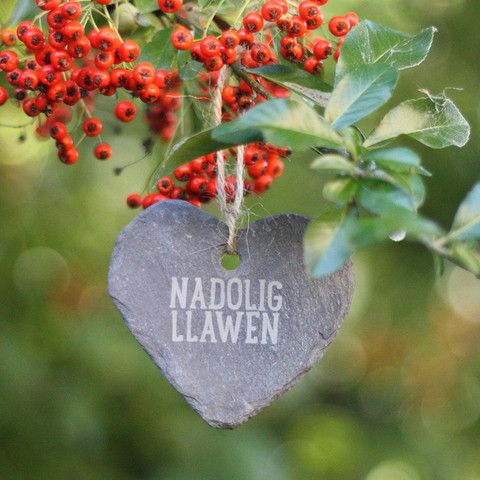
Season’s Greetings to all my followers and visitors – or should I say Nadolig Llawen.

May 2018 bring us all inspiration, great reading, good health, hope and peace.

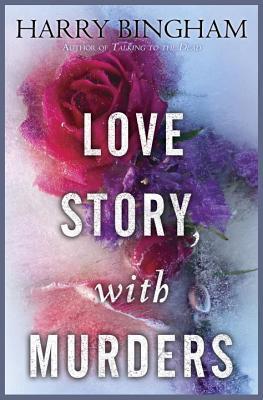
Love Story, with Murders – a review

Having discovered the quirky and dark Welsh detective Fiona Griffiths in Talking to the Dead, I had to read Book 2 in this unique series. I didn’t regret it and Book 3 beckons. [For my review of Book 1 see: https://rolandclarke.com/2016/04/11/talking-to-the-dead-a-review/ ]

Love Story

Love Story, With Murders (Fiona Griffiths #2)

by Harry Bingham (Goodreads Author)

The second novel featuring recovering psychotic DC Fiona Griffiths opens with as intriguing a pair of murders as you could imagine. Firstly, part of a human leg is discovered in a woman’s freezer, bagged up like a joint of pork. Other similarly gruesome discoveries follow throughout a cosy Cardiff suburb, with body parts turning up in kitchens, garages and potting sheds. And while the police are still literally putting the pieces together, concluding that they all belong to a teenage girl killed some ten years earlier, parts of another body suddenly start appearing, but this time discarded carelessly around the countryside clearly very shortly after the victim – a man – was killed.

Mysteries don’t come much more macabre or puzzling than this. Who were the two victims, and what connection could they have shared that would result in this bizarre double-discovery?

But that’s only half the story. The most gruesome moments are much more about Fiona and her curious mental state. There is a complex and very clever double mystery here, and what makes the story unique is the parallel unraveling of Fiona’s own mystery, and it’s her voice, established precisely in the first book but given even freer rein here, that makes it so compelling.

Review 5 stars

In this second novel in an engrossing series, DC Fiona Griffiths is once again challenged to apply her strange talents to solving a case or maybe it’s two cases. This DC is not like others and this is one of the winning formulas that Harry Bingham gives to the character.

With her personality traits being at times psychotic, the first person POV works as we discover more and more about Fiona’s past and about the cases. She has more than murder to handle and she needs to act off-piste to get things done and progress the cases. The violence, in the victim’s remains or the action, is not excessive or overtly gruesome, but some fans of the cosy approach might baulk at it. Fiona doesn’t, of course.

At this stage in her policing career, Fiona still has things to learn, often things she recognises and ignores at her cost – but what better way to keep the plot moving and the reader guessing. Her relationship with her fierce boss, DI Watkins, is unexpected and interesting – the secondary characters are all well portrayed, especially the DI. There are sub-plots surrounding some of them and these all add to the story.

Fiona’s attitudes are unusual but her flippancy and willingness to think her mind are what makes her unique – and believable. I wouldn’t want her to be ‘normal’ and boring – in fact, people aren’t when we get to know them properly as some of the characters prove over time.

The settings from Cardiff to the rural areas of South Wales are all vividly evoked, and through Fiona’s senses, so, we also discover more about her in the words she uses. Having lived in Wales – North Wales – there were descriptions that stirred memories – for instance:

“The valley narrows as it climbs. Pasture and snippets of woodland on the valley floor. Green fields pasted as high up the mountainsides as technology and climate can take them. The flanks of the hillside are grizzled with the rust-brown of bracken, humped with gorse and hawthorn, slashed with the rocky-white of mountain streams.”

Anybody that has negotiated Welsh roads will recognise the ones that Fiona needs to take on her rural investigation. Throughout, the settings felt realistic as did the way that the plot unfolded. Nothing is ever neat in a Fiona Griffiths case – nor in reality.

You never know what Fiona is going to do next, so the reader needs to keep going – and believing in her and the author. Fiona keeps the tension going with her decisions and actions. I was on the edge of my seat as I read, hoping that Fiona would survive – even if I knew there were sequels. That takes good writing to bring about.

I loved the Welsh attitude, even if not all Welsh people are as forthright as Fiona in saying, “Twll dîn pob Sais.” Later in the novel, she repeats this as a thought and translates -” Every Englishman an arsehole”.

After a stimulating ride for my head, I am ready for the next book, having recommended the first two without reservation – well, if you want a cosy mystery series look elsewhere. I want more of Fiona and her different approach to policing, to life – and I want to know what is at the heart of her behaviour, to discover more about her past.

Note that this was released in 2014, so, this comment from Fiona had me wondering if Harry Bingham was going to get tweeted by the US President;

“My newfound clarity allows me to look at the pole-dancing platform too. It’s got all the class of a Las Vegas casino personally styled by Donald Trump”

Story – five stars

Setting/World-building – five stars

Characters – five stars

Structure – five stars

Readability – five stars

Editing – five stars
*

UPDATE: This review had to be edited for Amazon, as it was rejected in this version. I wonder why. Where did I stray from their guidelines? I removed three paragraphs in the hope that might evade the censors – 1. the comment about Englishmen; 2 &3. The paragraphs about Trump. Was it the profanity or the reference to the Twitter Man?


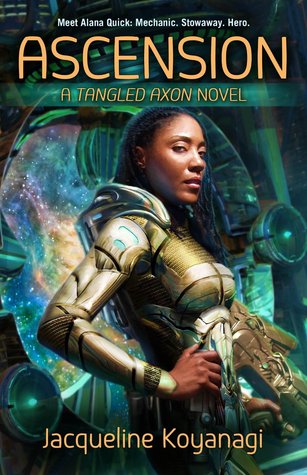
Ascension – a review

As my current WIP explores diversity and minority rights issues, my reading expands to understand the issues better. This novel was an inspiring insight and a great read.

Ascension

Ascension (Tangled Axon #1)

by Jacqueline Koyanagi (Goodreads Author)

Alana Quick is the best damned sky surgeon in Heliodor City, but repairing starship engines barely pays the bills. When the desperate crew of a cargo vessel stops by her shipyard looking for her spiritually advanced sister Nova, Alana stows away. Maybe her boldness will land her a long-term gig on the crew. But the Tangled Axon proves to be more than star-watching and plasma coils. The chief engineer thinks he’s a wolf. The pilot fades in and out of existence. The captain is all blond hair, boots, and ego . . . and Alana can’t keep her eyes off her. But there’s little time for romance: Nova’s in danger and someone will do anything–even destroying planets–to get their hands on her.

Review 5 stars

The blurb for Ascension hooked me as did most of the reviews. As an SF addict, I wasn’t disappointed, and the ‘diversity’ themes worked, although I am, I admit, an outsider in many ways.

Ascension had a great opening with subtle info and backstory from the family finances and the planetary economics – familiar inequalities – through to the disease that afflicts the protagonist. The thoughts, words and actions ensure that I was immediately attracted to Alana Quick as she stowed away on the Tangled Axon and gradually began unravelling things about the strange and diverse crew.

What drives the starship captain Tev? That was a question that kept being answered and yet only layer by layer. She was as intriguing to me as she was for Alana. All the crew were complex with carefully revealed backstories and motivations, and the characterisation was well-crafted.

Just like the jewellery which provided me with one of many puzzles, although I laughed as the reveal was not as I expected. The novel was filled with little details that both added to the world-building and set it apart.

The stakes were raimped-up at a crucial point and I found myself asking ‘Did that really happen?!’ Somebody was motivated to raise the danger-level, but why? Wearing my mystery-reader glasses, I had suspects, but the curveballs kept me guessing – and reading. The threat to the crew, the starship and Alana produced some great writing. The structure and the placement of the key moments felt spot-on.

Alana sensed so much and her words evoked so many feelings. I am a fan of deep POV and Ascension worked for me as it drew me into the protagonist’s mind – a mind torn by events, her attachments, her feelings, her fears and her declining health.

With so much to bear, her senses became even more emotive as the novel developed. I felt the chronic suffering in my own diseased body – yes, I have two chronic diseases – and Jacqueline Koyanagi did an excellent job capturing that. In fact, she caught the disease suffering so well that I was sure that the other ‘sensitivity’ issues were dealt with as carefully.

Alana unravels reality, not always making or taking the right moves, but as all the best protagonists do, by seeing through another’s eyes – except that moment is a revelation like no other. And we all need to learn why love burns, although for Alana it goes so much deeper. But I’m toying with you, avoiding spoilers. Suffice to say, that an unexpected twist leads to the clever climax and the hint that there will be more to enjoy.

A highly recommended read, especially if you want SF with a twist – a diverse breath of plasma.

Story – five stars

Setting/World-building – five stars

Characters – five stars

Structure – five stars

Readability – five stars

Editing – five stars
 

Messandrierre – a review

July 5th saw the launch of Angela Wren’s Merle, the second novel in the Jacques Forêt crime series, about which I will post about next.  So, I knew that I needed to re-visit Messandrierre where I first encountered Angela Wren’s intelligent investigator, Jacques Forêt. This release of Merle is a chance to expand on my initial review of Messandrierre.

Messandrierre

Messandrierre (Jacques Forêt #1)

by Angela Wren (Goodreads Author)

Sacrificing his job in investigation following an incident in Paris, Jacques Forêt has only a matter of weeks to solve a series of mysterious disappearances as a Gendarme in the rural French village of Messandrierre.

But, as the number of missing persons rises, his difficult and hectoring boss puts obstacles in his way. Steely and determined, Jacques won’t give up and, when a new Investigating Magistrate is appointed, he becomes the go-to local policeman for all the work on the case.

Will he find the perpetrators before his lover, Beth, becomes a victim?

Messandrierre – #1 in a new crime series featuring investigator, Jacques Forêt.

Also in the series:
Merle (#2)

Review 5 stars

I enjoyed every page of this mystery, so read the novel twice. The pace suited the setting that felt as real as the memorable characters. Messandrierre may not exist – or maybe it does. The Cevennes is my favourite region in France, and Angela Wren captures the nuances perfectly. The location came alive so much that I was convinced that I had been there.

The people felt real, from the principals of Jacques and Beth to all the secondary characters that made up the vibrant picture of a French community, and the wider area beyond. Each one had their idiosyncrasies, and some had secrets that added clever threads and red herrings to the mystery.

The plot developed steadily with the additional plotlines adding to the investigation. Jacques is not exactly alone in unravelling who is responsible for the disappearances that set the case simmering.

Messandrierre neatly built to a climax, that I guessed but not in the manner it happened. I was tricked into a bit of wrong thinking a few times – on the first reading. On the second, I saw how Wren had created her cunning red herrings – or should I say harengs rouges.

This novel is a mystery that I highly recommend for those that don’t need a fast-roller-coaster ride and want to savour the story. I also recommend Messandrierre for those that like indulging in exploring the France off the beaten track – but don’t expect a tame tourist guide.

Story – five stars

Setting/World-building – five stars

Characters – five stars

Structure – five stars

Readability – five stars

Editing – five stars