X is for Xochimilco

A2Z-BADGE-100 [2017]

My 2017 A to Z Challenge theme is “The History of Kanata”, the parallel world that is the setting for “Eagle Passage”, my alternative history novel that all began when I wondered, “What would have happened if Leif Eriksson had settled Vinland permanently in 1000 AD? For further details and links to my other A to Z posts – and hints at the ones to come visit “Kanata – A to Z Challenge 2017”.

X (1)

X is for Xochimilco: March 26, 1850, Xochimilco – ecological scientists and sanitation innovators, Leena Riika Niellä and her partner Roope Richardson are travelling by steam powered boat and canoes through the extensive lakes and canal system of Xochimilco taking water samples. They are accompanied by a senior minister for the Mēxihcan Board of Health, Citlali Aguado who is concerned about the decline in the nation’s sanitation in the Valley of Mēxihca. He wants the Kanatian experts to advise on the best policies to be introduced, based on their expertise in the field and extensive work in other cities across the continent. Their immediate recommendations include reduced exploitation of the natural water resources, controls on waste discarded from ships, and sewage treatment plants based on the reed bed advancement made in recent years. Industrial waste must not be allowed to contaminate the water, soil, or air, but be re-used.
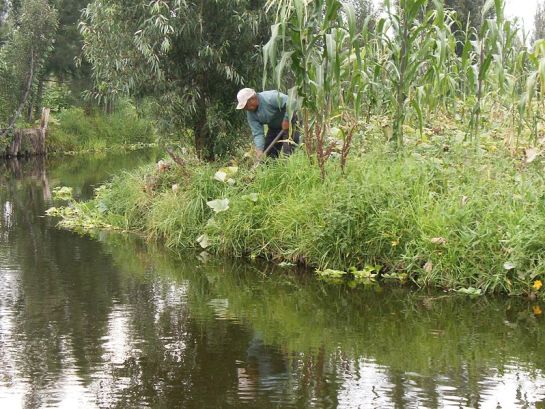
 

Chinampa

A farmer weeding his crops on one of Xochimilco’s remaining chinampas (farm island) – Photographer – Jflo23 – GNU Free Documentation Licence


In our timelineWikipedia – Xochimilco borough is centred on the formerly independent city of Xochimilco, which was established on what was the southern shore of Lake Xochimilco in the pre-Hispanic period. The name “Xochimilco” comes from Nahuatl and means “flower field.” This referred to the many flowers and other crops that were grown here on artificial land called chinampas since the pre-Hispanic period. Xochimilco is best known for its canals, which are left from what was an extensive lake and canal system that connected most of the settlements of the Valley of Mexico….In 1850, the first steam powered boat travelled through here, connecting Mexico City with Chalco. Steam powered ships remained in Xochimilco waters from then until the 1880s, when they faded from use. Before during and after, Xochimilco continued to make more traditional rafts, canoes and trajineras, pushed along the shallow waters by a pole


…Up through the centuries, the valley lakes continued to shrink but there were still canals that linked Xochimilco to the centre of Mexico City. In the late 19th century, Mexico City had outgrown its traditional water supplies and began to take water from the springs and underground aquifers of Xochimilco. Degradation of the lakes was fastest in the early 20th century when projects such as the Canal del Desagüe were built to further drain the valley. This and excessive aquifer pumping lowered water tables and canals near Mexico City centre dried up and cut off an inexpensive way to get goods to market for Xochimilco. This had a major effect on the area’s economy, along with the effects of the loss of fishing for many local communities.

Wikipedia – Ellen Henrietta Swallow Richards (December 3, 1842 – March 30, 1911) was an industrial and environmental chemist in the United States during the 19th century. Her pioneering work in sanitary engineering and experimental research in domestic science laid a foundation for the new science of home economics

…In the 1880s, her interests turned toward issues of sanitation, in particular air and water quality. She performed a series of water tests on 40,000 samples of local waters which served as drinking water for their immediate populations… in the state of Massachusetts. As a result, Massachusetts established the first water-quality standards in America, and the first modern sewage treatment plant was created.

Reed beds are becoming the popular and sustainable choice for wastewater and sludge management. Subsurface Flow Constructed Wetlands is one of the options available in Washington State.

***

Important Links for the A to Z Challenge – please use these links to find other A to Z Bloggers

Website: http://www.a-to-zchallenge.com

Facebook page: https://www.facebook.com/atozchallenge/

Twitter handle: @AprilAtoZ

Twitter hashtag: #atozchallenge
W is for Welsh Indians

A2Z-BADGE-100 [2017]

My 2017 A to Z Challenge theme is “The History of Kanata”, the parallel world that is the setting for “Eagle Passage”, my alternative history novel that all began when I wondered, “What would have happened if Leif Eriksson had settled Vinland permanently in 1000 AD? For further details and links to my other A to Z posts – and hints at the ones to come visit “Kanata – A to Z Challenge 2017”.

W (1)

W is for Welsh Indians:  1 March 1181, Ohiːyo, [Good river in Seneca] – With their Chippewa kindred, Siofra Migisi and her fellow Kanatian traders land at an impressive city of wide streets, distinctive earthwork mounds, with structures including platforms, conical and ridgetop peaks. The clean streets are thronged with other traders bartering goods, and the Chippewa explain that this city is on a vast river network extending to the seas. As they approach the platform mound that houses the central community, Siofra hears a party of fair-skinned natives, much like themselves, speaking a language she recognises as Welsh.

She approaches them, greeting them in their own tongue, explaining that she grew up in Dublin, a Norse trading city that the Welsh frequented. The leader of the strangers greets her back in Norse, then explains that they are followers of Prince Madog ab Owain Gwynedd, and they are seeking fertile land to settle. Like the Vikings they are integrating with the indigenous people, sharing their knowledge. Siofra invites the Welsh Indians to travel with them and explore the riches that seem to abound along the Ohiːyo.


In our timelineWikipedia: “Madoc, also spelled Madogab Owain Gwynedd was, according to folklore, a Welsh prince who sailed to America in 1170, over three hundred years before Christopher Columbuss voyage in 1492.”

Forgotten Dragon: “By all accounts, the young Prince Madoc spent his formative years in the Norse city of Dublin, and likely learned the skills of sailing and shipbuilding from his time there. …Disappointed and disillusioned with the events that followed his father’s passing, Madoc gathered up some followers and in the footsteps of previous intrepid Norse explorers, set out for a new beginning.”


The Filson Historical Society: “…The story goes that the death Madoc’s father, Prince Owen Gwynedd of Wales, triggered internecine strife among his successors. Desiring no part in the conflict, Madoc sailed west across the ocean with a small fleet of ships. Some time later he returned to Wales, telling of an unknown country, pleasant and fertile. Convincing some of his countrymen to accompany him, he set sail again and never returned.”

Fairhope, Alabama: “Some historians maintain that the colonists evolved over the next several hundred years into the Mandan Indian Tribe of Missouri, an atypical tribe of “Indians” who used vestiges of the Welsh language and with some members of the tribe having light skin, red hair and blue eyes. In the tribe’s sacred ceremonies as witnessed by the Indian painter, George Catlin in the early 1800s, the members of the tribe worshipped a god they referred to as “Madoc.”

But this was before the discovery of the Mississippian culture. Angel Mounds State Historic Site is located on the Ohio River in Vanderburgh and Warrick counties in the southwestern corner of the U.S. state of Indiana. It is the site of a town constructed and occupied from 1100 CE to 1450 CE as one of the farthest north-eastern expressions of the Mississippian culture. Its characteristic earthwork mounds, with shapes including platform, conical and ridgetop are found in other locations along the river network.

***

Important Links for the A to Z Challenge – please use these links to find other A to Z Bloggers

Website: http://www.a-to-zchallenge.com

Facebook page: https://www.facebook.com/atozchallenge/

Twitter handle: @AprilAtoZ

Twitter hashtag: #atozchallenge
V is for Vijayanagara Confederation

A2Z-BADGE-100 [2017]

My 2017 A to Z Challenge theme is “The History of Kanata”, the parallel world that is the setting for “Eagle Passage”, my alternative history novel that all began when I wondered, “What would have happened if Leif Eriksson had settled Vinland permanently in 1000 AD? For further details and links to my other A to Z posts – and hints at the ones to come visit “Kanata – A to Z Challenge 2017”.

V (1)

V is for Vijayanagara Confederation: 16 May 1929, Vijayanagara – Chakravarti Rajagopalachari, premier of the Vijayanagara Confederation gathers a conference of representatives from throughout the Indian sub-continent to discuss a union of their nations. With the co-operation of Mohandas Karamchand Gandhi from the Maratha Republic and Muhammad Ali Jinnah of the Khilafat Protectorate, they establish the Bharat Federation, named after the historical name for India, Bharatavarsha.

The constitution of the Federation is built around universal suffrage, and economic policies based on import substitution industrialisation and a mixed economy, where the government-controlled public sector co-existed with the private sector. Efficient administration and vigorous overseas trade in goods that Bharat excelled in producing is encouraged in exchange for goods that the states are not able to be self-reliant in. A formal agreement is made with the Kanata Konføderasjon to develop airship technology. In all states, religious pluralism is to be adhered to as well as an end to purdah, child marriage, untouchability, and the extreme oppression of widows, up to and including sati.

All attempts by outsiders, from the Moghuls, the British, the Portuguese, and the Chinese, to influence the affairs of the sub-continent had been resisted over centuries, and Bharat becomes a founder member of the Union of World Nations in 1930.

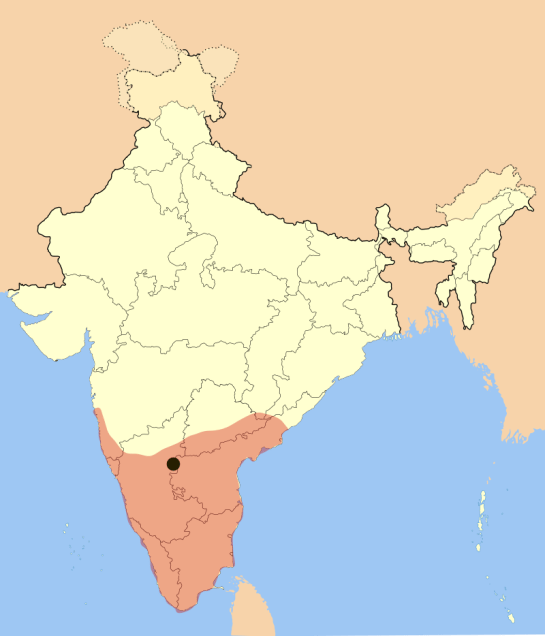
Vijayanagara-empire-map.svg

Location of Vijayanagara Empire – author Mlpkr GNU Free Documentation Licence


In our timeline: The Vijayanagara Empire was established in 1336 by Harihara I and his brother Bukka Raya I of the Sangama Dynasty. The empire rose to prominence as a culmination of attempts by the southern powers to ward off Islamic invasions by the end of the 13th century.

The empire’s legacy includes many monuments spread over South India, the best known of which is the group at Hamp, formerly the capital city of Vijayanagara.  Efficient administration and vigorous overseas trade brought new technologies such as water management systems for irrigation. The empire’s patronage enabled fine arts and literature to reach new heights in KannadaTeluguTamil, and Sanskrit, while Carnatic music evolved into its current form. The Vijayanagara Empire created an epoch in South Indian history that transcended regionalism by promoting Hinduism as a unifying factor.

The largest feudatories of the Vijayanagar empire – the Mysore KingdomKeladi NayakaNayaks of MaduraiNayaks of TanjoreNayakas of Chitradurga and Nayak Kingdom of Gingee – declared independence and went on to have a significant impact on the history of South India in the coming centuries. These kingdoms lasted into the 18th century, while the Mysore Kingdom remained a princely state until Indian Independence in 1947, although they came under the British Raj in 1799 after the death of Tipu Sultan.

Tragically, India and Pakistan’s path to partition was bloody and difficult despite the attempts of the leaders, including Mohandas Karamchand Gandhi, Jawaharlal Nehru – the first Prime Minister of India – and Muhammad Ali Jinnah, founder of Pakistan. The ongoing political tensions between the nations has often been cited as a potential nuclear flashpoint.

Among other prominent activists was  Chakravarti Rajagopalachari (10 December 1878 – 25 December 1972) born in Tamil Nadu. Informally called Rajaji or C.R., he was an Indian politician, independence activist, lawyer, writer and statesman. Rajagopalachari was the last Governor-General of India. He also served as leader of the Indian National CongressPremier of the Madras PresidencyGovernor of West Bengal, Minister for Home Affairs of the Indian Union and Chief Minister of Madras state.

Would the foreign powers have taken over the Indian sub-continent if the states had been united? What could have emerged without the British Raj? What language would have become the dominant language? Could Bharat be a major ally or rival of Kanata?

***

Important Links for the A to Z Challenge – please use these links to find other A to Z Bloggers

Website: http://www.a-to-zchallenge.com

Facebook page: https://www.facebook.com/atozchallenge/

Twitter handle: @AprilAtoZ

Twitter hashtag: #atozchallenge

 

U is for Uppsala

A2Z-BADGE-100 [2017]

My 2017 A to Z Challenge theme is “The History of Kanata”, the parallel world that is the setting for “Eagle Passage”, my alternative history novel that all began when I wondered, “What would have happened if Leif Eriksson had settled Vinland permanently in 1000 AD? For further details and links to my other A to Z posts – and hints at the ones to come visit “Kanata – A to Z Challenge 2017”.

U (1)

U is for Uppsala: 19 March 1756, Uppsala, Sweden –  Renowned Swedish mathematician and scientist, Samuel Klingenstierna, invites German-born engineer and entrepreneur, Carl Wilhelm Siemens, from his adopted home in northern Albion to Uppsala University. His contacts at St Andrews University in Scotland say that Siemens has been experimenting on improving the blister and cast steel production.

Setting up a site on the edge of eastern banks of the River Fyris, with access to Uppsala’s trade centre, Klingenstierna ensures ready access by water to Sweden’s phosphorus-free ore. At the new works, Siemens succeeds in manufacturing quality durable steel efficiently and sustainably using a regenerative furnace, or open hearth process.

Siemens calculates that the furnace recovers enough heat to save 70–80% of the fuel. Applying the knowledge that he gained as a student at St Andrews, where energy and fuel saving was taught as a primary endeavour, he has discarded the older notions of heat as a substance and accepted it as a form of energy. The two scientists combine forces to revolutionise and advance the production of steel and the efficient use of steam engines, essential to Nordic trade and industrialisation

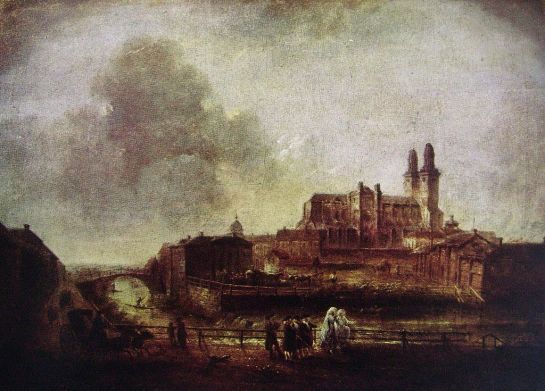
Utsikt_av_Uppsala_med_domkyrka,_Elias_Martin._Malmö_museum

Uppsala in the 18th century – Elias Martin – Malmo museum (Public domain)


In our timeline: One of the earliest forms of steel, blister steel, began production in Germany and England in the 17th century and then improved as cast-steel, but the cost ensured that was only ever used in speciality applications. The first major breakthrough was in 1856 when Henry Bessemer came up with a more effective way to introduce oxygen into molten iron in order to reduce the carbon content – the Bessemer Process. In the 1860s, German engineer Carl Wilhelm Siemens further enhanced steel production through his creation of the regenerative furnace or open-hearth process, which largely replaced the Bessemer Process.

Samuel Klingenstierna was a very renowned Swedish mathematician and scientist, and a professor at Uppsala University from 1728-1752.

***

Important Links for the A to Z Challenge – please use these links to find other A to Z Bloggers

Website: http://www.a-to-zchallenge.com

Facebook page: https://www.facebook.com/atozchallenge/

Twitter handle: @AprilAtoZ

Twitter hashtag: #atozchallenge
T is for Texas

A2Z-BADGE-100 [2017]

My 2017 A to Z Challenge theme is “The History of Kanata”, the parallel world that is the setting for “Eagle Passage”, my alternative history novel that all began when I wondered, “What would have happened if Leif Eriksson had settled Vinland permanently in 1000 AD? For further details and links to my other A to Z posts – and hints at the ones to come visit “Kanata – A to Z Challenge 2017”.

T (1)

T is for Texas: 1836 – Thirty-three years after the Dixie States acquired territory from France by the Louisiana Purchase, the Mēxihcans attempt to claim Texas. The port of New Orleans is no longer in Kanatian hands, as it was the only concession that the Dixies received after invading the Chesapeake Bay area in 1812 and instead lost their capital at Richmond in the peace talks. From their new capital in Memphis, the Dixie States control the Mississippi all the way to the Gulf of Mēxihco, but Kanata still has trading posts all along the coast.

On the 13 February 1836, Antonio Lopez de Santa Anna leads a Mēxihca army of six thousand troops north to wipe out the massively outnumbered Texian army garrisoned at the Alamo Mission in San Antonio de Béxar.  From there, seizing Texas will be straightforward. However, the unusually low temperatures in Texas, including snow, slow his progress and he is unaware that Kimantsi scouts have detected the army as it heads north and alerted the Mjölnir Militia at the trading post on the Nueces estuary. As the senior merchant, Donat Migisi values dealing with the Texians over the Mēxihcans. Kanata is anxious to see the buffer territory in the south of the continent strengthened.

With two hundred Kimantsi and Mjölnir guerrillas divided into two groups, Santa Anna’s army is harassed by a fast-moving enemy. After two weeks of ceaseless assaults, and with his forces disillusioned, Santa Anna reaches the Medina, where a final ambush decimates the invaders and only a thousand remain. The delays allow reinforcements from the other Dixie States to reach the Alamo, along with another fifty Mjölnir Militia led by Donat’s sister, Daina. Traps are set everywhere from covered pits, fire trenches and barricades creating pinch points for sharpshooters. The harassed army is driven forward by relentless marauders, and Santa Anna is forced to sue for peace. “We’ve ensured the Mexicans remember the Alamo, and remember to stay south of the Nueces,” say Colonels Travis and Bowie.


Fall-of-the-alamo-gentilz_1844

The Fall of the Alamo, painted by Theodore Gentilz in 1844, depicting the Alamo complex from the south. The Low Barracks, the chapel. and the wooden palisade connecting them are in the foreground. – Texas State Library – Public Domain.


In our timeline: Richmond, Virginia was the most permanent capital of the Confederacy in the American Civil War. Although 25% of the city’s buildings were destroyed, by departing Confederate troops, the city recovered – as did Washington which the British burnt during the War of 1812, when the US invaded the British provinces of Canada.

Memphis did see some action during the Civil War as a strategic location on transportation routes. Its access by water was key to its initial development, with steamboats plying the Mississippi river. Railroad construction strengthened its connection to other markets to the east and west.

Tragically, “Remember the Alamo” is linked to a heroic but bloody defeat of the brave Texian defenders under Colonels Travis and Bowie. Snow did hamper the Mexican army, and Comanche warriors did harass the advancing troops, many of whom were conscripts, but the reinforcements were delayed and there were Mexican settlers in Texas spreading false information as well as spying for Santa Anna. Texian Army General Sam Houston was only able to exact revenge afterwards, at the Battle of San Jacinto.

Could the combined strategies of the Kimantsi warriors and the Mjölnir Militia with their generations of elite fighting prowess have bought the crucial time for the reinforcements? Was Kanata correct to side with a neighbour that had invaded them twenty-four years earlier?

***

Important Links for the A to Z Challenge – please use these links to find other A to Z Bloggers

Website: http://www.a-to-zchallenge.com

Facebook page: https://www.facebook.com/atozchallenge/

Twitter handle: @AprilAtoZ

Twitter hashtag: #atozchallenge

S is for Stadacona

A2Z-BADGE-100 [2017]

My 2017 A to Z Challenge theme is “The History of Kanata”, the parallel world that is the setting for “Eagle Passage”, my alternative history novel that all began when I wondered, “What would have happened if Leif Eriksson had settled Vinland permanently in 1000 AD? For further details and links to my other A to Z posts – and hints at the ones to come visit “Kanata – A to Z Challenge 2017”.

S (1)

S is for Stadacona: 13 September 1759 – France has been making desperate attempts to expand its territories in North America, but Captain Benning Migisi and his Odawa militia lieutenant, Obwandiyag, watch at night from their ship as French scouts scale the cliff onto the plains beyond Stadacona, capital of Kanata [Quebec City]. Benning, Obwandiyag, and their force of Mjölnir Militia attack the French scouts but encounter other French troops. They evade French patrols to reach their own lines and warn the Kanatian commander, General Jakob Ulve, of the impending French assault.

On the morning of the 13 September, the Kanatian forces, regular and Mjölnir Militia, repel the repeated attacks of the French. However, Benning Migisi dies saving his friend Obwandiyag, and in his dying breath says, “We are one people. We are one within Manitou’s sight.”

This is the last attempt by the French to invade Kanatian soil, although the Dixie States declare war on their northern neighbours forty-three years later.


Benjamin_West_005

Death of General Wolfe (1770) – Artist: Benjamin West (1738-1820) – National Gallery of Canada, Ottawa, Ontario – Public Domain.


In our timeline: On the 13 September 1759, at the Battle of the Plains of Abraham, also known as the Battle of Quebec, British forces led by General James Wolfe successfully resisted the column advance of French troops and Canadien militia under General Louis-Joseph, Marquis de Montcalm. Wolfe received three gunshot wounds that ended his life within minutes of the beginning of the engagement and Montcalm died the next morning after receiving a musket ball wound just below his ribs. In the wake of the battle, the French evacuated the city; their remaining military force in Canada and the rest of North America came under increasing pressure from British forces.

France ceded most of its possessions in eastern North America to Great Britain in the Treaty of Paris. However, from 1763 to 1791, the British retained Quebec as the capital of the Province of Quebec; from 1791 to 1841, it was the capital of Lower Canada; from 1852 to 1856 and from 1859 to 1866, it was capital of the Province of Canada; and since 1867, it has been capital of the Province of Quebec.

As Kanata chose Stadacona (Quebec City) as their capital and major trading port, would there have been other nations that would attack the city? Or would the 1759 victory have been sufficient deterrent, except for the Dixie States?

***

Important Links for the A to Z Challenge – please use these links to find other A to Z Bloggers

Website: http://www.a-to-zchallenge.com

Facebook page: https://www.facebook.com/atozchallenge/

Twitter handle: @AprilAtoZ

Twitter hashtag: #atozchallenge