N is for Nanwalek

A2Z-BADGE-100 [2017]

My 2017 A to Z Challenge theme is “The History of Kanata”, the parallel world that is the setting for “Eagle Passage”, my alternative history novel that all began when I wondered, “What would have happened if Leif Eriksson had settled Vinland permanently in 1000 AD? For further details and links to my other A to Z posts – and hints at the ones to come visit “Kanata – A to Z Challenge 2017”.

N (1)

N is for Nanwalek:  20 August 1415 – A decrease in the summer Arctic ice, and news via the Kalmar Union that Rus traders have opened a north-eastern passage that might connect to Kanata, has encouraged Kanatian explorers to find a north-west passage.

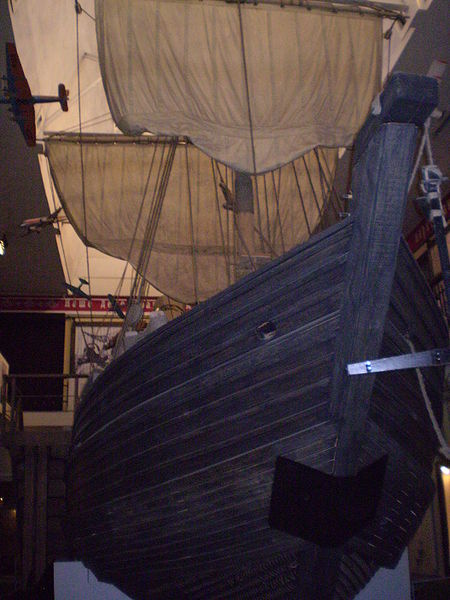
Using ice-breaking ships that combine lateen rigs and the ‘kochi’ technology of the Rus, Danish-Venetian navigator Jannick Chabotto has guided a fleet of five ships with merchant-adventurer Sacagawea Migisi, through to open water. Approaching a strait [Bering Straits] that could lead into the Cathay Ocean, they espy a fleet of four Rus traders flying the flag of the Rurikid Dynasty. They follow them into the port of Nanwalek, where the Rus leader Semyon Dezhnyov is fascinated to meet a mixed blood Mjölnir commander. and a detachment of Mjölnir Militia comprising various nationalities. However, everyone agrees that the trading post of Nanwalek must remain under the control of the indigenous Sugpiat people. But the Kanatians and Rus vow to explore the Cathay Ocean.


JohnCabotPainting

John Cabot in traditional Venetian garb by Giustino Menescardi (1762). A mural painting in the ‘Sala dello Scudo’ in the Palazzo Ducale. (Public domain)

In our timeline: In 1786, Nanwalek, Alaska became a Russian trade post called Point Alexandrovski using the indigenous people to harvest sea-otter furs. On 30 March 1867, Alaska was sold by Russia to the United States. Locals changed the community name to Nanwalek, meaning “place by lagoon,” in the language of the Sugpiat.


Semyon Dezhnyov (c. 1605 – 1673) was a Russian polar explorer and the first Russian to find the Bering Straits. He was also a Pomor, whose people developed the ‘koch’ icebreaking ships.

The Venetian Zuan Chabotto – known in English as John Cabot – was the first recorded European, in 1497, to search for the North-West Passage.  The first crossing solely by ship was the Norwegian explorer Roald Amundsen in 1903–1905. He used a small ship and hugged the coast. In contrast, the Russian-Siberian route involves far fewer islands and narrow straits so it is not surprising that the Russians discovered the Bering Straits first. However, the north-west coast of North America was explored by both the Spaniards and the British in the late 18th century.

If Viking descendants from Russia and Kanata met, would they be amicable merchants or bitter rivals? Would they have a common language after 400 years? Modern Scandinavians are pretty smart about understanding each other given the Old Norse roots of their languages.

***

Important Links for the A to Z Challenge – please use these links to find other A to Z Bloggers

Website: http://www.a-to-zchallenge.com

Facebook page: https://www.facebook.com/atozchallenge/

Twitter handle: @AprilAtoZ

Twitter hashtag: #atozchallenge

M is for Maid of Norway

A2Z-BADGE-100 [2017]

My 2017 A to Z Challenge theme is “The History of Kanata”, the parallel world that is the setting for “Eagle Passage”, my alternative history novel that all began when I wondered, “What would have happened if Leif Eriksson had settled Vinland permanently in 1000 AD? For further details and links to my other A to Z posts – and hints at the ones to come visit “Kanata – A to Z Challenge 2017”.

M (1)

M is for Maid of Norway:  8 July 1317 – Dunfermline Palace, Scotland: Margaret of Scotland, known as The Maid of Norway’ due to her birthplace, and her husband, Edvard II of England have united the lands of Albion with their marriage in 1300 and established diplomatic marriages with influential nobles. Christina, the daughter of their Lord Protector in Scotland, Robert the Bruce, is married to their son Alexander, and the Bruce has invited them back to the royal residence.

They are introduced to the scholar Cináed Giselbert who has travelled extensively from the heartlands of Kanata to the academic centres of the Islamic caliphates. He claims that an integrated, holistic view of science is the way forward. His observations have led to some conclusions that could benefit Albion and its allies. The charcoal and tar industries thrive under the support of enlightened merchants. But he has observed that burning timber, most especially in funeral pyres, wastes gases and vapours that are blown away in the wind. He demonstrates a device based on ancient drawings that can harness these gases and vapours. But he apologises that it is crude and craves support from the monarchs and their supporters, saying that other scholars share his beliefs. Margaret persuades Edvard to found a scholastic guild of higher learning in St Andrews, where Cináed Giselbert can gather other academics, explore devices to enhance society, and pass on their knowledge to students.

Margaret,_Maid_of_Norway
Stained glass window depicting Margaret, Maid of Norway, who was briefly Queen regnant of Scotland.  Creative Commons Attribution – Colin Smith

In our timeline: Undiscovered Scotland – “Margaret, Maid of Norway lived from 9 April 1283 to 26 September 1290 and was Queen of Scotland from 19 March 1286 to 26 September 1290. She was the granddaughter of Alexander III [of Scotland]. …In September 1290, Margaret set sail in a Norwegian ship from Bergen … Storms drove the ship off course to Orkney, and it eventually landed at St Margaret’s Hope, South Ronaldsay. Here Margaret, Maid of Norway, died, apparently from the effects of sea-sickness, still aged only eight. Had her marriage to [the future] Edward {II] gone ahead, the crowns of Scotland and England would have been united some three hundred years earlier than they eventually were, in 1603. And three hundred years of bloody history would probably have been very different.”

St Andrews University was not founded until 1413, after Oxford (1167), Cambridge (1209), and Northampton (1261).

Charcoal production is an ancient method of fuel production from wood that does require careful forest management, and in Britain led to extensive coppicing, as well as deforestation when demand exceeded demand. Similar deforestation occurred in Scandinavia and Finland where charcoal was a by-product of wood tar production. Charcoal is produced most extensively today in Brazil where it is used to transform ore into pig iron, and from there into mass-produced steel.

The first efficient steam engine to be applied industrially was designed by Thomas Savery in 1698. However, there were some ancient designs.

Aeon – In ‘Could we reboot a modern civilization without fossil fuels’, Lewis Dartnell writes, “Another, related option might be wood gasification. The use of wood to provide heat is as old as mankind, and yet simply burning timber only uses about a third of its energy. The rest is lost when gases and vapours released by the burning process blow away in the wind. Under the right conditions, even smoke is combustible. We don’t want to waste it.” Later, he writes, “For a society to stand any chance of industrialising under such conditions, it would have to focus its efforts in certain, very favourable natural environments: not the coal-island of 18th-century Britain, but perhaps areas of Scandinavia or Canada that combine fast-flowing streams for hydroelectric power and large areas of forest that can be harvested sustainably for thermal energy.”

Could Kanata industrialise itself if its inventors, like Cináed Giselbert, take the correct steps along a different energy path, focusing more on renewable wood derived fuel than coal? In my 2020 scenario, solar has become a major source, but how could they get there without ravaging the planet?

***

Important Links for the A to Z Challenge – please use these links to find other A to Z Bloggers

Website: http://www.a-to-zchallenge.com

Facebook page: https://www.facebook.com/atozchallenge/

Twitter handle: @AprilAtoZ

Twitter hashtag: #atozchallenge

L is for Louisiana Purchase

A2Z-BADGE-100 [2017]

My 2017 A to Z Challenge theme is “The History of Kanata”, the parallel world that is the setting for “Eagle Passage”, my alternative history novel that all began when I wondered, “What would have happened if Leif Eriksson had settled Vinland permanently in 1000 AD? For further details and links to my other A to Z posts – and hints at the ones to come visit “Kanata – A to Z Challenge 2017”.

L (1)

L is for Louisiana Purchase: 20 December 1803 – After eleven months of protracted negotiations, Darja Migisi is relieved when the French government formally hand over control of the Île d’Orléans to Kanata, after numerous hostile encounters all around the Louisiana and Atlantic coast ever since Napoleon Bonaparte and Spain have been attempting to disrupt the region. However, Kanata’s southern neighbours, the Dixie States, under their President, Thomas Jefferson, have offered the Napoleonic government money for all the French land settled along the Mississippi river as far as the Kanata border, knowing that the Emperor needs money to finance his European wars. The Mexican government under Governor Cuauhtémoc de Salcedo countered by offering bullion for all the land where they have settlements, although the Dixie States have made significant inroads west, mainly into Texas and Oklahoma. Darja Migisi and the Kanatian delegation are concerned that these complex land issues cannot be settled so easily, especially when almost all the land is still settled by their indigenous brethren. But for now, the greatest concerns are the ambitions of France. However, with the Mesoamerican power blocs co-operating with the Iberian crowns conflict will be hard to avoid. At least, Kanata is granted the right to patrol the Mississippi and control trade through Île d’Orléans, now called New Orleans. Whether the Dixie States will accept their influence might be another point of conflict in later years.

Louisiana_Purchase

The Louisiana Purchase. Projection = USA Contiguous Albers Equal Area Conic (EPSG: 102003) – Sources: Natural Earth and Portland State University. Author – William Morris


In our timeline: The Louisiana Purchase in 1803 was by far the largest territorial gain in U.S. history. Stretching from the Mississippi River to the Rocky Mountains, the purchase doubled the size of the United States. Before 1803, Louisiana had been under Spanish control for forty years. Although Spain aided the rebels in the American Revolutionary War, the Spanish didn’t want the Americans to settle in their territory.

The acquisition of the Louisiana Territory for the bargain price of less than three cents an acre was among Jefferson’s most notable achievements as president. American expansion westward into the new lands began immediately, and in 1804 a territorial government was established. On April 30, 1812, exactly nine years after the Louisiana Purchase agreement was made, the first state to be carved from the territory–Louisiana–was admitted into the Union as the 18th U.S. state.

[Wikipedia and History.com]

Would the Dixie States and the Mesoamerican nations accept Kanata controlling the main port on the Gulf Coast as well as the key inland waterway? Or is war between them inevitable?

***

Important Links for the A to Z Challenge – please use these links to find other A to Z Bloggers

Website: http://www.a-to-zchallenge.com

Facebook page: https://www.facebook.com/atozchallenge/

Twitter handle: @AprilAtoZ

Twitter hashtag: #atozchallenge

K is for Kalmar Union

A2Z-BADGE-100 [2017]

My 2017 A to Z Challenge theme is “The History of Kanata”, the parallel world that is the setting for “Eagle Passage”, my alternative history novel that all began when I wondered, “What would have happened if Leif Eriksson had settled Vinland permanently in 1000 AD? For further details and links to my other A to Z posts – and hints at the ones to come visit “Kanata – A to Z Challenge 2017”.

K (1)

K is for Kalmar Union: 12 June 1397 – Kalmar Castle, Denmark: Outnumbered by superior forces, two rival Hanseatic merchant captains, Palle Fisker and Izaak Rusnak, are escorted to Kalmar Castle by Captain Urika Migisi and her three Kanatian warships. Queen Margaret I of Denmark is hosting a gathering of merchants and nobles from across the Baltic to form a trading alliance across Northern Europe. The delegates agree as long as Kanata sets up a neutral trading post to secure the arrangement, based at Palle’s home port of Visby, on the strategic island of Gotland. Urika wins Palle’s heart, but his rivalry with Izaak spills down the generations – all the way to 2020.


Skibsflaget_fra_Mariakirken_i_Lübeck

A medieval ship flag captured from a Danish ship by forces from Lubeck in 1427 displaying the arms of Denmark, Sweden, Norway and Pomerania – Illustration by Professor Julius Magnus Petersen. (Public Domain)


In our timeline: The Kalmar Union was created and existed from 1397 to 1523, joining under a single monarch the three kingdoms of DenmarkSweden (then including Finland), and Norway, together with Norway’s overseas dependencies (then including IcelandGreenland, the Faroe Islands and the Northern Isles). Queen Margaret of Denmark was the regent at this time and a prime mover. One main impetus for the Union’s formation was to block German expansion northward into the Baltic region. The Hanseatic League were one of the major rivals of the Scandinavians, as were the Victual Brothers, a loosely organised guild of pirate operating at one time from Visby, a former Hanseatic city.

Although the Kalmar Union suffered from all the rivalry around the Baltic, including conflicts between the Scandinavian nations, could a powerful intermediary like Kanata have safeguarded Baltic trade? This might have been feasible, especially as Visby as the main port on the island of Gotland was well-placed to monitor traffic.

***

Important Links for the A to Z Challenge – please use these links to find other A to Z Bloggers

Website: http://www.a-to-zchallenge.com

Facebook page: https://www.facebook.com/atozchallenge/

Twitter handle: @AprilAtoZ

Twitter hashtag: #atozchallenge

J is for Jasper

A2Z-BADGE-100 [2017]

My 2017 A to Z Challenge theme is “The History of Kanata”, the parallel world that is the setting for “Eagle Passage, my alternative history novel that all began when I wondered, “What would have happened if Leif Eriksson had settled Vinland permanently in 1000 AD? For further details and links to my other A to Z posts – and hints at the ones to come visit “Kanata – A to Z Challenge 2017”.

J (1)

J is for Jasper: 1813, Jasper, Kanata: Fur trader Doron Klen is negotiating with postmaster-merchant Jasper Hawes over the value of the goods that he wants to be sent on the next shipment east. Jasper agrees on a fair price given the distance from the post at the gateway to the Assinwati mountains [Rockies] to Lake Gichigami [Superior] and the main trading ports. Another fur trader sneers at Doron, condemning his Jewish ways extorting money out of good Christians like Jasper. However, Jasper reminds the angry fur trader that Kanata welcomes all settlers, especially those fleeing from persecution, and reminds him that his sect was condemned for their beliefs. Yet, the indigenous tribes welcomed them all – in fact, does he condemn them for their beliefs or the Norse founders that follow Skaði or Odin? Maybe he should complain to the Mjölnir militia. The rogue fur trader is forced to accept that Jasper is correct, and he apologises to Doron, who adds that if his Jewish homeland was ever free, many of his people might return there.


Jasper_House_National_Historic_Site_of_Canada_2012-09-23_19-35-58

Jasper House National Historic Site of Canada – Photographer: Themeancanadian


In our timeline: Until the British seized Montreal in 1760, there were no Jewish settlers in Canada, as the French required that everyone was Roman Catholic. There were several Jews in the British regiments, and from then on Jewish settlers were initially merchants and fur traders. Canada was one of the destinations of choice, alongside the United States, following the pogroms in Eastern Europe and Russia.

Jasper is named after a real Jasper Hawes who was the postmaster at the trading post established there in 1814 as part of the network controlled by the Hudson’s Bay Company.

***

Important Links for the A to Z Challenge – please use these links to find other A to Z Bloggers

Website: http://www.a-to-zchallenge.com

Facebook page: https://www.facebook.com/atozchallenge/

Twitter handle: @AprilAtoZ

Twitter hashtag: #atozchallenge

I is for Ice

A2Z-BADGE-100 [2017]

My 2017 A to Z Challenge theme is “The History of Kanata”, the parallel world that is the setting for “Eagle Passage, my alternative history novel that all began when I wondered, “What would have happened if Leif Eriksson had settled Vinland permanently in 1000 AD? For further details and links to my other A to Z posts – and hints at the ones to come visit “Kanata – A to Z Challenge 2017”.

I (1)

I is for Ice: 1264, Eyrar, Iceland:   Fishermen Thorvard Gilsson and Kjartan Jonsson are repairing their nets and discussing their concerns that the increase in drift ice around the northern coast of Iceland is threatening their safety when fishing. The spread of sea ice is also making trade harder, especially with Greenland to the west, but at least the merchants from Kanata continue to support them both, providing much-needed goods, including timber so the settlers don’t need to chop down their few precious trees.

The Kanata merchants must have access to many varieties of trees, says Kjartan, as their shipwrights have crafted some rugged vessels that can navigate great storms and probably the drift ice. The fishermen suspect the vessels are reinforced, particularly around the waterline with double planking to the hull and strengthening cross members inside the ship. If they had enough iron that could be wrapped around the outside. Maybe the Kanatians will teach them the secrets so they can build safer fishing boats.

Thorvard agrees and suggests they make a formal request via the Althing. Both men are glad that the Icelandic chieftains and guild representatives rejected swearing allegiance to the king of Norway, knowing that it was Kanata that protected them and ensured peace in the country.

Krsk_koch

A 17th-century Russian koch in a museum – Public Domain

In our timeline: In 1250 the Atlantic Sea ice began to grow and by 1300 there were signs throughout Europe that the Medieval Warm Period was ending. This new period, although the dating varies, has been called the ‘Little Ice Age’. Sea ice surrounding Iceland in many years extended for miles in every direction, closing harbours to shipping. Greenland was largely cut off by ice from 1410 to the 1720s, although it is unclear if this why the Norse settlements were abandoned. Timber was scarce on both Greenland and Iceland, which was one resource the expeditions to Vinland and Markland were seeking. But these timber expeditions did not continue. Building the first wooden ships that could navigate Arctic waters was achieved in North Russia.

Wikipedia – “In the 11th century, in North-Russia started settling the coasts of the White Sea, named so for being ice-covered for over half of a year. The mixed ethnic group of the Karelians and the Russians in the North-Russia that lived on the shores of the Arctic Ocean became known as Pomors (“seaside settlers”). Gradually they developed a special type of small one- or two-mast wooden sailing ships, used for voyages in the ice conditions of the Arctic seas and later on Siberian rivers. These earliest icebreakers were called kochi. The koch’s hull was protected by a belt of ice-floe resistant flush skin-planking along the variable water-line, and had a false keel for on-ice portage. If a koch became squeezed by the ice-fields, its rounded bodylines below the water-line would allow for the ship to be pushed up out of the water and onto the ice with no damage.”

The skill of the Kanatian shipwrights with access to plenty of timber should have allowed them to build early icebreakers to navigate via Greenland and Iceland to and from Europe. Would they have access to the Pomors and their kochi because of the Eastern trade routes? [Maybe when I get to ‘N’ that might produce an answer.]

***

Important Links for the A to Z Challenge – please use these links to find other A to Z Bloggers

Website: http://www.a-to-zchallenge.com

Facebook page: https://www.facebook.com/atozchallenge/

Twitter handle: @AprilAtoZ

Twitter hashtag: #atozchallenge